


Fitness Flohmarkt · Guide
Setting up a home gym: complete setups for 10, 20, and 40 square meters
It is not the budget that decides first, but the space. These three setups show you what actually fits in what area, with real dimensions instead of estimates.
Plan your room · Equipment and sets · Calculate your budget · View the hybrid setup
In short
Here you plan your room: equipment footprints, movement, ceiling height and layout. The 10, 20 and 40 m² examples help you sketch a plan, but are not universal minimum areas. Check whether each item fits using its dimensions and the complete movement path.
The basic calculation
What is the minimum amount of space needed for a home gym?
Do not just add up equipment footprints. Allow room for exercises, loading, getting on and off, and clear routes to doors and windows. A 220 cm barbell needs extra space at the sides for hands and plates. Check ceiling and head clearance for the specific exercise. A narrow room can work differently from a square room with the same area.
Measure the room first before you order anything, and outline the footprints on the floor with painter's tape. These five minutes will save you from the most common misorder in the home gym sector: a rack that fits, but doesn't leave room for a door to open.
| Device | Base area | Ceiling height | Example room; check individually |
|---|---|---|---|
| Adjustable dumbbell (pair) | 42 × 21 cm is a dumbbell | no specification | from 6 m² |
| Adjustable weight bench | 130 × 75 cm | no specification | from 8 m² |
| Foldable Power Rack | 123 × 70.5 cm, folded depth 9 cm | 237 cm | from 10 m² |
| Half Rack | 120 × 120 cm | 231 cm | from 12 m² |
| Power Rack | 152 × 133 cm | 215 cm | from 14 m² |
| Barbell including loading area | approx. 2.70 × 2 m free | no specification | from 16 m² |
Setup 1
Home Gym in 10 m²: everything that works or disappears
On 10 m², equipment you can put away after training matters. A bench with wheels and adjustable dumbbells store compactly. A folding rack is an option if you need its functions and the wall mounting and movement space are suitable. For barbell training, also draw the bar, loading area and plate storage. Without a barbell, a rack is not an essential first purchase.
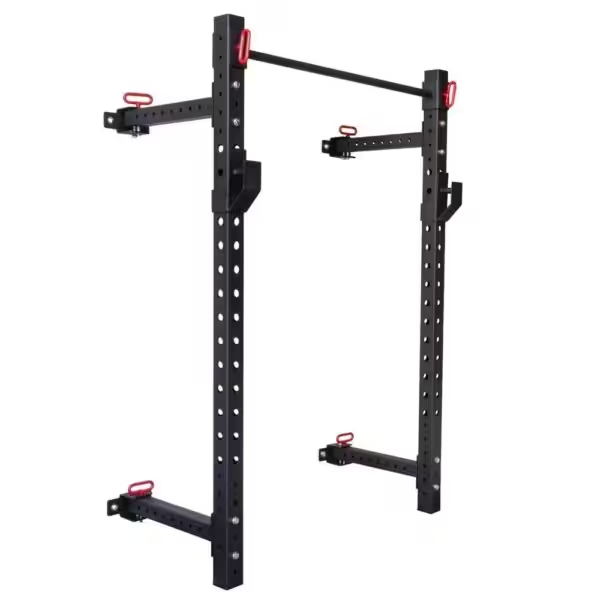
R-SERIES Foldable Power Rack
- Art. F-42718
- 123 × 70.5 × 231 cm
- folded 9 cm deep
- up to 400 kg
- Minimum ceiling height 237 cm
Six safety pins out, rack folded against the wall, room back. Unfolded, the 75 mm uprights support up to 400 kg, J-hooks and pull-up bar are included. Important: Due to its design, the rack is mounted to the wall, so you need a load-bearing wall and a ceiling height of at least 237 cm.
Ideal for: Garage, hobby room or guest room that needs to be something else again after training.
View Foldable Rack
Adjustable Dumbbell 24 kg
- Art. F-21645
- 2.5 to 24 kg in 15 increments
- 42 × 21 × 20.5 cm
- Replaces 15 dumbbells
Change the weight by turning the ends, with settings from 2.5 to 24 kg. You need a pair to use two dumbbells at once. Allow for their cradles or a suitable stand for storage and adjustment.
Ideal for: all those who simply lack the wall space for a dumbbell rack.
View dumbbellwill determine which of the two weight classes suits you and whether one dumbbell is enough or two are needed. Adjustable dumbbell advisor in detail. Other compact solutions for small rooms lie in the Category Dumbbells.
Setup 2
Home gym in 20 m²: the barbell gets a permanent place
On 20 m², a permanent barbell station can make sense. The Power Rack shown measures 152 × 133 × 214 cm. Add space for the bench, loading, plate storage and access. Overhead presses and pull-ups also depend on body height, grip height and ceiling clearance. Check placement, fastening and safety settings according to the instructions. Floor area alone does not confirm safe installation.
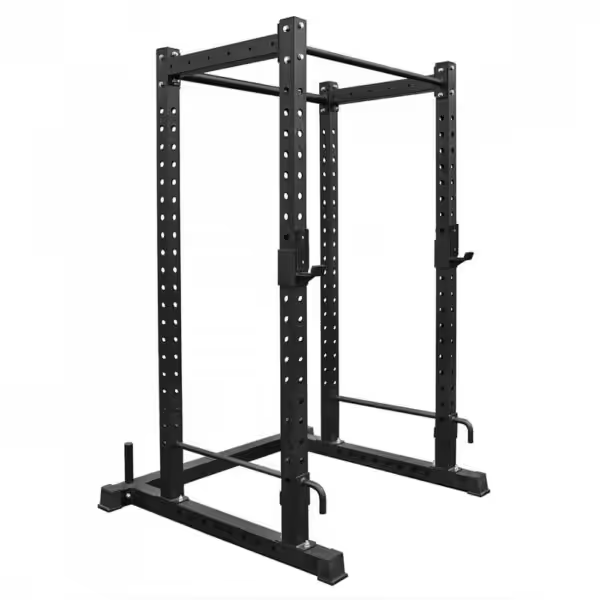
R-SERIES Power Rack
- Art. F-55936
- 152 × 133 × 214 cm
- Minimum ceiling height: 215 cm
- up to 500 kg
- 90 kg net weight
Four posts, adjustable safety bars, J-hooks, and a pull-up bar are included. The safety bars catch the barbell if a repetition fails, which is why this is the only design that allows you to train safely and heavily on your own. Barbell and weights are sold separately.
Ideal for: Basement and garage gyms where heavy barbell training is done consistently.
View power rack
Bumper Plate Set + Olympic Bar 90 kg
- Art. F-57182
- Barbell 20 kg, 220 cm
- 70 kg of weight plates
- Discs 45 cm in diameter
- Lock Jaws included
Bars, plates, and collars in one package: 2× 5 kg, 2× 10 kg, and 2× 20 kg drop-resistant bumper plates plus a 20 kg needle-bearing Olympic bar. The bar holds up to 450 kg, and you can easily expand later with additional 50 mm plates. Keep the 220 cm length in mind when planning your room width.
Ideal for: getting started with barbell training without having to piece everything together individually.
View set
Adjustable Bench
- Art. F-44851
- 130 × 75 × 47 cm
- up to 500 kg
- Backrest 11 positions
- Transport rollers
The bench fits the inside width of the power rack, allowing you to perform bench presses with the safety bars in place. Backrest in eleven positions, seat at three angles, covering flat, incline, and shoulder presses. Thanks to wheels and a handle, you can push it against the wall after your set.
Ideal for: every setup from 8 m², because standing against the wall it takes up hardly any space.
View weight benchSetup 3
40 m² Home Gym: Two Workout Stations, Cardio, and Open Space
From 40 m², plan zones rather than more equipment: a strength area with rack and barbell, a cardio area with rower or ski ergometer, and a free area of at least 3 × 4 m for dumbbells, kettlebells, sled and floor work. For two people or a club, a freestanding two-station rig can replace a second rack. Two squat and pull-up stations on one structure can take less space than two separate racks. Find suitable endurance equipment in the Cardio category.
Underground
Which flooring belongs in the home gym?
Plan flooring for its use, subfloor and expected loads. An equipment mat, continuous rubber flooring and a drop zone serve different purposes. Calculate tiles from the covered area: four per square metre at 500 × 500 mm, one at 1000 × 1000 mm. Protection and noise reduction do not guarantee structural floor capacity or suitability for dropping weights.
What thickness can withstand what load and when a dedicated drop zone is worthwhile is explained in detail in the Flooring buying guide. You can find the selection of panels, rolls, and edge finishes in the Floor protection mats category, the appropriate Connect+ flooring with click system is available from CHF 15 per plate, with a volume discount starting at 40 pieces.
Check room
Ceiling height, wall, and load-bearing capacity: what you need to measure beforehand
Three numbers determine whether your planned setup will work at all. First, ceiling height: the power rack needs 215 cm, the half rack 231 cm, the foldable rack 237 cm. These values apply just for setting it up. For pull-ups, your head needs to go over the bar, so plan for an additional 30 to 40 cm above the pull-up bar depending on your height. Second, the wall: fold-down racks and wall-mounted rigs are bolted down and require load-bearing masonry or concrete; drywall alone is not enough. Third, the ceiling: in older buildings and on wooden beam ceilings, you should clarify the load-bearing capacity before having several hundred kilos of plates concentrated in one spot. Generally, distribute weight across stands rather than in a stack.
The comparison of which design is the better choice for limited height or a narrow floor plan can be found in the Rigs and Racks Buying Guide with all dimensions side by side. All models, including the more affordable home versions, are in the Rack category.
Sequence
What you buy first and what can wait
The sensible order is: floor, bench, weights, rack, cardio. The floor first, because otherwise you'll have to pull it back out later from under all the equipment. Then the bench, because it stays in every expansion stage and allows for a complete upper-body workout with dumbbells alone. The weights before the rack, because a rack without a barbell and plates is useless, while dumbbells work even without a rack. Cardio equipment comes last, because it takes up the most space per training stimulus and is often available for free outdoors. Anyone who follows this order has a functioning gym after every single purchase instead of a construction site. It's better to buy a few good pieces than a cheap complete package that you'll replace in two years.
Classification
What is worth it for whom
Apartment with an adjoining room
Fold-down rack on a load-bearing wall, two adjustable dumbbells, a bench on wheels, and 6 m² of rubber flooring. No dropping weights, no arguments with the neighbors.
Basement or garage with 20 sqm
Freestanding power rack, 90 kg bumper plate set, and an adjustable bench. Measure the ceiling height beforehand; in basements, 215 cm is not a given.
Two people, one room
Instead of two racks, a freestanding rig with two stations. Same footprint, double the capacity, and storage for kettlebells and plates attached directly to it.
Association, company or practice
Starting at 40 m², the floor plan becomes the real challenge. Define zones, keep pathways clear, plan the flooring first. A personal consultation is well worth it for this.
Frequently Asked Questions
Setting up a home gym: the most important answers
What is the minimum amount of space needed for a home gym?
One fixed minimum area does not suit every workout. Draw equipment, complete movements, loading space and clear access on your floor plan. The examples on this page are starting points, not approval for every room shape.
What ceiling height do I need for a rack in my home gym?
The Power Rack requires a minimum ceiling height of 215 cm, the Half Rack 231 cm, and the folding rack 237 cm. For pull-ups, depending on your height, add another 30 to 40 cm above the pull-up bar because your head needs to go over it. Measure precisely beforehand in basement rooms.
Which flooring belongs in the home gym?
For free weight areas, 20 mm solid rubber, installed as a click system. It absorbs impacts, protects the subfloor, and reduces noise. Under cardio equipment, thinner 6 mm mats are sufficient. Only the training zone is laid out, not the entire room.
How many floor panels do I need for my area?
Multiply length by width in meters. In the 500 × 500 mm format, you need four panels per square meter; in the 1000 × 1000 mm format, you need one. For 3 × 2 m, that is 24 small or 6 large panels. Starting from 40 small panels, the unit price drops automatically.
Does a squat rack fit in a home gym with little space?
Yes. When unfolded, the folding rack measures 123 × 70.5 cm and folds down to a wall depth of 9 cm. Measuring 120 × 120 cm, the half rack also requires significantly less space than a power rack. Both support enough weight for heavy barbell training.
What weights do I need for a home gym?
For starters, two adjustable dumbbells ranging from 2.5 to 24 kg are enough. Anyone training with a barbell will get by for a long time with a set consisting of a 20 kg bar and 70 kg of plates. Expansion can be done later with individual plates in the 50 mm standard.
What should I buy first for my home gym?
Floor, bench, weights, rack, cardio, in that order. The floor first, because otherwise it would have to be pulled out from under all the equipment later. Cardio machines last, because they take up the most space per training stimulus.
Measure your room, then you choose the rack
Length, width, ceiling height: With these three numbers, you can find the right design in just a few minutes.
View all Rigs & Racks