


Fitness Flohmarkt · Guide
Kettlebell weight: 8, 12, 16 or 24 kg? How to find your level
Material and design · Choose your weight · Build a set · Competition and dimensions
The question of weight determines your training success more than the shape of the bell. This guide names concrete levels for beginners, development, and sports, and shows what weights are in the Kettlebell selection at all, and tells you how you can tell you've made a mistake.
In short
Choose kettlebell weight by exercise, experience and controlled execution. A bell suitable for swings may not suit a one-arm press. 8, 12, 16 and 24 kg are weight increments, not fixed rules by sex. If buying just one bell, test it for your main exercise. Handle diameter and bell size also matter.
Weight by exercise · Compare size and handle
The initial question
Which kettlebell weight fits your level?
Start with the movement you plan to use. Check that you can pick up, move and set down the weight under control. A one-arm press may suit a different increment from a two-handed swing or goblet squat. Barbell experience does not yet establish safe kettlebell technique. Test possible weights under the same conditions; sex and body weight alone are not enough to decide.
The following criteria help with comparison but do not replace trying the weights. Materials and designs are explained in the Kettlebell Buying Guide. If buying several weights, see the kettlebell set guide. Weight selection remains the focus here.
Weight your movement
Choose kettlebell weight by exercise
There is no fixed eight-kilogram gap between swing and press. Movement, technique, repetition count and experience determine the load you control. A heavier bell does not correct poor execution. Check each exercise separately before choosing a second weight.
| Movement | Weight selection | Control check |
|---|---|---|
| two-handed swing | Test for hip movement and planned repetitions | Acceleration and deceleration remain controlled |
| Goblet squat | Test for holding position and movement depth | The bell stays stable in front of the torso |
| Clean and Press | Check the clean and one-arm press separately | No uncontrolled impact or compensation |
| Turkish Get-up | Establish the sequence first, then the load | Each position remains controllable |
A second weight fills a specific exercise or load gap. There is no fixed gap between swing and press loads. Choose quantity and increments by your tested working weights; set selection belongs on the Set page.
What actually exists
What weight classes are there anyway?
The ranges checked here list weights from 2 to 48 kg overall. Soft runs from 2 to 12 kg; rubber-coated and Competition bells also offer 2 kg steps up to 20 kg. Therefore, 6 kg is not exclusive to Soft Kettlebells. Cast Iron lists 4 to 48 kg, and the checked Urethane selection lists 4 to 24 kg. Check price and availability after selecting the variant on the product page.
| Row | Span | Listed increments | step size |
|---|---|---|---|
| Soft Kettlebell | 2 to 12 kg | 2, 4, 6, 8, 10, 12 kg | 2 kg |
| Vinyl-coated kettlebell | 4 to 40 kg | 4, 6, 8, 10, 12, 14, 16, 18, 20, 24, 28, 32, 36, 40 kg | 2 kg to 20 kg, then 4 kg |
| Kettlebell Cast Iron | 4 to 48 kg | 4, 8, 12, 16, 20, 24, 28, 32, 36, 40, 44, 48 kg | 4 kg |
| Urethane Kettlebell | 4 to 24 kg | 4, 8, 12, 16, 20, 24 kg | 4 kg |
| Competition Kettlebell | 4 to 32 kg | 4, 6, 8, 10, 12, 14, 16, 18, 20, 24, 28, 32 kg | 2 kg to 20 kg, then 4 kg |
The increments show whether your desired intermediate step exists. Moving from 12 to 14 kg may make more sense than automatically jumping to 16 kg if it suits the exercise and your control. The current price appears after selecting the variant on the product page.

Kettlebell | with rubber shell
- 4 to 40 kg
- 14 steps
- Cast iron with rubber
- Handle 27 to 40 mm
- from CHF 10.-
The only series that covers every other kilogram increment from 4 to 20 kg and still goes up to 40 kg. This allows you to hit your weight even when 12 kg is too light and 16 kg is too heavy. The rubber coating cushions setting it down, while the handle remains bare cast iron. With this entry-level model, minor casting blemishes may occur on the handle due to the manufacturing process.
Ideal for: all those who want to progress in small steps and work out at home or in the basement.
Select weight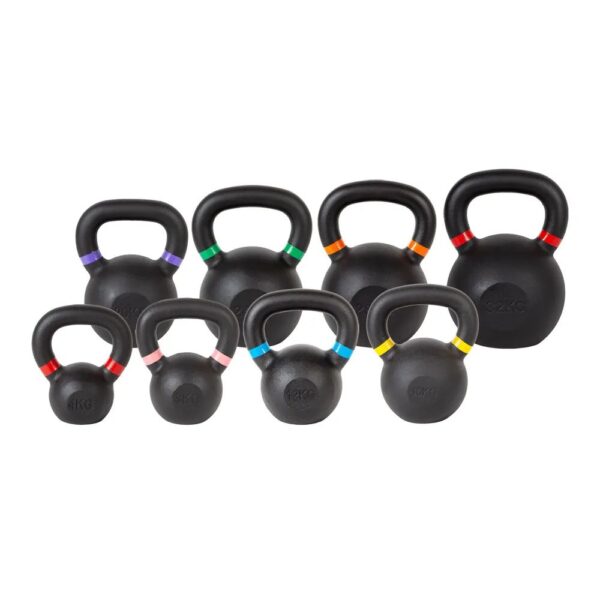
Kettlebell | Cast Iron
- 4 to 48 kg
- 12 steps
- cast in one piece
- Handle 29 to 39 mm
- from CHF 16.-
The Cast Iron range runs from 4 to 48 kg in 4 kg steps. Check the percentage jump for your exercise. A wide range establishes neither the right starting weight nor that three bells cover all your training.
Ideal for: Home gyms and studios that eventually want to go from 16 kg to 32 kg or more.
Select weight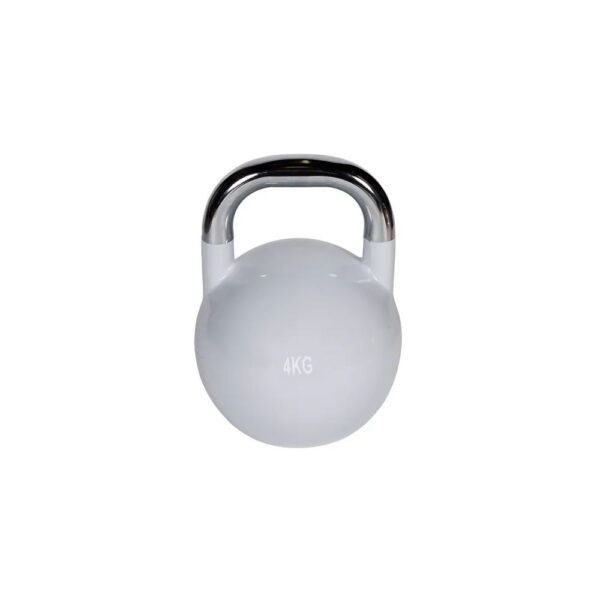
Competition Kettlebell | for competitions
- 4 to 32 kg
- 12 steps
- Height always 28 cm
- Handle spacing 33 mm
- from CHF 40.-
This Competition range keeps external dimensions constant. A heavier load still changes the demands. Check each setting with controlled technique; design and rules belong on the Competition page.
Ideal for: technical training, high repetition counts, and all with competitive ambitions.
Select weightWhat changes as well
How much bigger does the sphere get with each weight?
With cast iron, the kettlebell grows with the weight, and noticeably so: the 8 kg ball is 19.5 cm high, the 24 kg ball 27 cm. That is 7.5 cm more ball that has to pass between your legs during the swing, and the reason why a jump from 8 to 24 kg feels not only heavier, but also clunkier. At the same time, the handle grows from 33 to 37 mm, which is the actual stumbling block for small hands and high repetition numbers. None of this happens with the competition kettlebell: at any weight, it measures 28 cm in height, 21 cm in diameter, and has a 33 mm handle. Its 33 mm handle corresponds exactly to that of the 8 kg cast iron ball, meaning the handle of a beginner weight, even though it can contain up to 32 kg. Anyone who does a lot of single-arm and high-repetition work gains more from this than the price difference might suggest at first glance.
| Cast Iron Weight | Height | Ball diameter | Handle diameter |
|---|---|---|---|
| 4 kg | 16.5 cm | 9 cm | 29 mm |
| 8 kg | 19.5 cm | 12 cm | 33 mm |
| 12 kg | 22 cm | 14 cm | 34 mm |
| 16 kg | 24.5 cm | 16 cm | 35 mm |
| 20 kg | 25 cm | 17 cm | 36 mm |
| 24 kg | 27 cm | 18 cm | 37 mm |
| 32 kg and more | 28.5 cm | 20 cm | 39 mm |
For the choice of weight, this means two things. First: If you are unsure whether 16 or 20 kg, it is often not your strength that decides, but your hand. Second: Anyone stacking multiple bells in a corner should allow for about 20 cm of width per heavy bell. The exact dimensions of each tier are listed on the product page of the Cast iron kettlebell in the Variant Information tab.
The Honesty Check
How you know your weight is wrong
Assess weight against the planned movement and workload. Lack of soreness proves neither that the weight is too light nor that training is ineffective. If you cannot accelerate, catch or set the bell down under control, reduce the load and check technique. A failed clean can also be a technique issue. Progress when the intended repetitions and positions are reliable, not by the calendar.
For rehabilitation or physiotherapy, load follows the individual treatment plan. A soft body is not permission to drop the bell and does not replace suitable flooring. The Soft Kettlebell lists weights from 2 to 12 kg; suitability depends on exercise, grip and intended use.
The order
If you buy only one kettlebell: which weight?
If starting with one bell, choose it for your main exercise. A 16 kg bell suitable for swings may not suit your press; 8 or 12 kg do not guarantee every exercise either. Test the intended movement and repetitions. A second weight later fills a specific gap rather than automatically becoming necessary after two or three months.
For intervals and circuits, choose weight, repetitions and rest together. A lighter bell for more repetitions is not inherently more effective than a heavy one. Your goal and controlled execution remain decisive.
Four typical cases
What is worth it for whom
Beginner with no strength training background
Choose the first weight for your main exercise. Smaller increments are available in the rubber-coated range; check the specific variant.
Beginner with some strength training experience
Check kettlebell technique first. For later heavier weights, the Cast Iron range up to 48 kgis an option; this does not establish a suitable starting weight.
Light weights, group class
Soft Kettlebells are listed in 2 kg steps from 2 to 12 kg. View the Soft range. Weight and use are chosen for the specific exercise or individual plan.
Hybrid and competitive sports
For consistent dimensions when changing weights, the Competition Kettlebell is an option. Competition weights follow the discipline and current division, not a universal 24 kg standard.
If you're still undecided about the design, the Overview of all buying guides Go on. And if you just don't want to commit to the weight, a look into the Kettlebell category the fastest way to see all available levels side by side.
Frequently Asked Questions
Kettlebell weight: the short answers
What kettlebell weight for beginners?
Suitable weight depends on exercise, experience and controlled execution. Test possible increments for your main exercise instead of choosing by sex alone. A one-arm press may suit less weight than swings.
What kettlebell weight for women?
No single increment suits all women. 8, 12 or 16 kg may suit different exercises and experience levels. What matters is controlling the pickup, movement and set-down. If buying one bell, prioritise your main exercise.
Is 8 kg enough to start?
8 kg may suit technique practice or certain exercises. Check the specific movement to judge whether it is challenging enough for the planned repetitions. Sex alone does not decide this.
Is 16 kg too heavy for beginners?
16 kg may suit one movement and be too heavy for another. Check swing and press separately, for example. If control is lacking, reduce the load and clarify technique; a blanket rule to switch to exactly 12 kg would be too crude.
What weight for the kettlebell swing?
Choose a load you can accelerate and catch with controlled hip movement. A heavier weight does not replace learning technique. The gap from your press weight is individual, not automatically eight kilograms.
Are there 10 kg kettlebells?
Yes, but not in every series. 10 kg, 14 kg, and 18 kg are available in the rubber-coated series, the competition kettlebell, and, up to 12 kg, the soft kettlebell. The cast iron and urethane series go in 4 kg increments and therefore skip straight from 8 to 12 kg.
When should I increase to the next weight?
Progress when the intended range and planned repetitions are reliably controlled. Test the next increment on one exercise first. Lack of soreness is not a progression criterion; weight jumps and timing are individual.
Is your level set?
The ranges list weights from 2 to 48 kg. Check price and stock for your chosen variant before ordering.
Buy kettlebells