



Fitness Flohmarkt · Guide
Kettlebell weight: 8, 12, 16 or 24 kg? How to find your level
The question of weight determines your training success more than the shape of the bell. This guide names concrete levels for beginners, development, and sports, and shows what weights are in the Kettlebell selection at all, and tells you how you can tell you've made a mistake.
In short
For beginners, 8 kg is suitable for women and 12 to 16 kg for men. This applies to the swing and squat; for overhead exercises, go one step lighter. Those who already do strength training start with 12 to 16 kg or 20 kg, respectively. If you are buying only a single kettlebell, 8 kg and 16 kg are the tried-and-tested sizes.
The initial question
Which kettlebell weight fits your level?
For swings and squats, women start with 8 kg and men with 12 to 16 kg. Those who already do regular strength training go up one level, to 12 to 16 kg or 20 kg, respectively. For anything pressed overhead or controlled with one arm, you go down one level. The reason for these ranges is simple: during a swing, the entire hip works against the kettlebell, whereas during a press, only one shoulder does. Anyone who does both with the same weight will have too little for one movement and too much for the other. The following table gives you the specific level for each profile, including the answer to the most frequent question in the store: which weight, if it is to be only one. The deciding factor here is not your body weight, but how much strength training you have done so far and how confident you are in hip hinging and squatting.
| Who you are | Swing & Squat | overhead press | Turkish Get-up | If it has to be only one |
|---|---|---|---|---|
| Woman, no strength training so far | 8 kg | 6 to 8 kg | 6 to 8 kg | 8 kg |
| Man, no strength training yet | 12 to 16 kg | 12 kg | 8 to 12 kg | 16 kg |
| Woman with workout experience | 12 to 16 kg | 8 to 12 kg | 8 to 12 kg | 12 kg |
| Man with training experience | 20 to 24 kg | 16 to 20 kg | 16 kg | 20 kg |
| Hybrid and competitive sports | 24 kg and more | 20 to 24 kg | 24 kg | 24 kg |
These values are starting points, not test scores. Which design fits, whether cast iron, rubber-coated, urethane, soft, or competition ball, is determined by the Kettlebell Buying Guide in detail. This is only about the number on the ball.
Weight your movement
Why you need more weight for swings than for pressing
The difference is around two increments, which means 8 kg given the usual 4-kg progression. During the swing, the entire posterior chain accelerates the kettlebell, and a kettlebell that is too light tempts you to jerk it up with your arms instead of throwing it with your hips. When pressing overhead, everything depends on a single shoulder, and a weight that is too heavy causes you to arch your lower back. Between these two poles lie all other exercises: squats are closer to the swing because the legs assist, while single-arm movements and the Turkish get-up are closer to the press because stability rather than strength is the limiting factor. Rows and deadlifts can handle more weight again because the back distributes the load across many joints. Therefore, anyone who uses a single kettlebell for everything will inevitably train one half of their program in the wrong range—usually the swing, because the kettlebell needs to feel reasonable for the press.
| Movement | Typical level women | Typical male behavior | What was the weight limit |
|---|---|---|---|
| two-handed swing | 8 to 16 kg | 16 to 24 kg | Hip strength |
| Goblet squat | 8 to 16 kg | 16 to 24 kg | Leg strength and core |
| Rowing and deadlifting | 12 to 20 kg | 20 to 32 kg | Grip strength |
| Clean and Press | 6 to 12 kg | 12 to 20 kg | Shoulder strength |
| Turkish Get-up | 6 to 12 kg | 8 to 16 kg | Stability |
Practically speaking, this means: Two weights cover almost the entire repertoire. A lighter ball for everything overhead, a significantly heavier one for swings and squats. Anyone who wants both in one design and needs the fine gradation will find what they are looking for at Vinyl-coated kettlebell best suited because it goes up to 20 kg in 2 kg increments.
What actually exists
What weight classes are there anyway?
In the Fitness-Flohmarkt product range, kettlebells range from 2 to 48 kg, but not every series includes every increment. Cast iron and urethane come in 4 kg steps, meaning 4, 8, 12, 16, 20, 24 kg, and so on. Anyone looking for a 10 kg, 14 kg, or 18 kg kettlebell will only find them in the rubber-coated series and the competition kettlebell, because these two are graded in 2 kg steps up to 20 kg. At the very bottom, at 2 kg and 6 kg, the soft series is the only option. This is the real reason why the design matters at all when it comes to weight: it determines whether the increment you need actually exists. Above 40 kg, choices become limited, leaving only cast iron, and below 4 kg, the soft series is exclusively available. The table shows both at a glance.
| Row | Span | Available levels | step size | Starting at | Price per kilo |
|---|---|---|---|---|---|
| Soft Kettlebell | 2 to 12 kg | 2, 4, 6, 8, 10, 12 kg | 2 kg | CHF 12.00 | drops with the weight |
| Vinyl-coated kettlebell | 4 to 40 kg | 4, 6, 8, 10, 12, 14, 16, 18, 20, 24, 28, 32, 36, 40 kg | 2 kg to 20 kg, then 4 kg | CHF 10.00 | CHF 2.50 |
| Kettlebell Cast Iron | 4 to 48 kg | 4, 8, 12, 16, 20, 24, 28, 32, 36, 40, 44, 48 kg | 4 kg | CHF 16.00 | CHF 4.- |
| Urethane Kettlebell | 4 to 24 kg | 4, 8, 12, 16, 20, 24 kg | 4 kg | CHF 20.00 | CHF 5.00 |
| Competition Kettlebell | 4 to 32 kg | 4, 6, 8, 10, 12, 14, 16, 18, 20, 24, 28, 32 kg | 2 kg to 20 kg, then 4 kg | CHF 40.- | drops with the weight |
The column Price per kilo is not an estimate, but a division. With the rubber-coated model, the 4 kg kettlebell costs CHF 10 and the 40 kg kettlebell CHF 100, which results in exactly CHF 2.50 per kilo at both ends of the range. For Cast Iron, it is CHF 16 for 4 kg and CHF 192 for 48 kg, which means a constant CHF 4 per kilo. This does not apply to the competition kettlebell: there, the kilo costs CHF 10 at the 4 kg tier and still CHF 4 at the 32 kg tier, because a light kettlebell with full competition size is more complex to manufacture than a heavy one. Anyone who starts light and buys expensive is therefore paying the highest price per kilo of their life.

Kettlebell | with rubber shell
- 4 to 40 kg
- 14 steps
- Cast iron with rubber
- Handle 27 to 40 mm
- from CHF 10.-
The only series that covers every other kilogram increment from 4 to 20 kg and still goes up to 40 kg. This allows you to hit your weight even when 12 kg is too light and 16 kg is too heavy. The rubber coating cushions setting it down, while the handle remains bare cast iron. With this entry-level model, minor casting blemishes may occur on the handle due to the manufacturing process.
Ideal for: all those who want to progress in small steps and work out at home or in the basement.
Select weight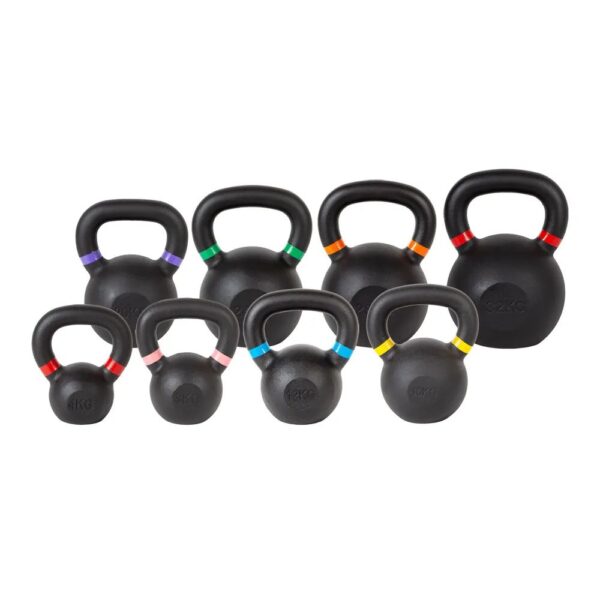
Kettlebell | Cast Iron
- 4 to 48 kg
- 12 steps
- cast in one piece
- Handle 29 to 39 mm
- from CHF 16.-
If you want to progress over years, this is the series with the most room for growth: it goes 8 kg further than any other. The 4 kg steps are small enough that every jump is noticeable, and large enough that three balls cover almost your entire workout.
Ideal for: Home gyms and studios that eventually want to go from 16 kg to 32 kg or more.
Select weight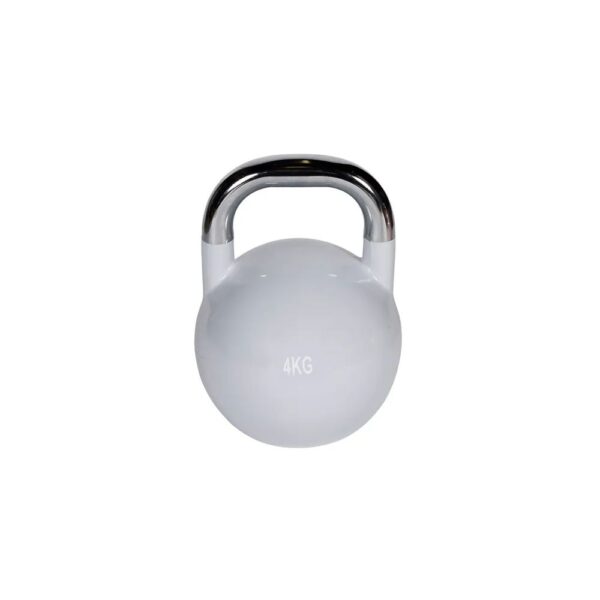
Competition Kettlebell | for competitions
- 4 to 32 kg
- 12 steps
- Height always 28 cm
- Handle spacing 33 mm
- from CHF 40.-
Here, only the number changes as you increase the weight, not the feel: height, diameter, and grip remain identical across all levels. Anyone increasing the weight in 2-kg increments doesn't have to relearn the technique every time. For pure home fitness, that is not necessary.
Ideal for: technical training, high repetition counts, and all with competitive ambitions.
Select weightWhat changes as well
How much bigger does the sphere get with each weight?
With cast iron, the kettlebell grows with the weight, and noticeably so: the 8 kg ball is 19.5 cm high, the 24 kg ball 27 cm. That is 7.5 cm more ball that has to pass between your legs during the swing, and the reason why a jump from 8 to 24 kg feels not only heavier, but also clunkier. At the same time, the handle grows from 33 to 37 mm, which is the actual stumbling block for small hands and high repetition numbers. None of this happens with the competition kettlebell: at any weight, it measures 28 cm in height, 21 cm in diameter, and has a 33 mm handle. Its 33 mm handle corresponds exactly to that of the 8 kg cast iron ball, meaning the handle of a beginner weight, even though it can contain up to 32 kg. Anyone who does a lot of single-arm and high-repetition work gains more from this than the price difference might suggest at first glance.
| Cast Iron Weight | Height | Ball diameter | Handle diameter |
|---|---|---|---|
| 4 kg | 16.5 cm | 9 cm | 29 mm |
| 8 kg | 19.5 cm | 12 cm | 33 mm |
| 12 kg | 22 cm | 14 cm | 34 mm |
| 16 kg | 24.5 cm | 16 cm | 35 mm |
| 20 kg | 25 cm | 17 cm | 36 mm |
| 24 kg | 27 cm | 18 cm | 37 mm |
| 32 kg and more | 28.5 cm | 20 cm | 39 mm |
For the choice of weight, this means two things. First: If you are unsure whether 16 or 20 kg, it is often not your strength that decides, but your hand. Second: Anyone stacking multiple bells in a corner should allow for about 20 cm of width per heavy bell. The exact dimensions of each tier are listed on the product page of the Cast iron kettlebell in the Variant Information tab.
The Honesty Check
How you know your weight is wrong
You can tell it is too light when the swing comes from the arms: the ball flies because you are pulling it up, not because your hips are throwing it. A second sign is that you are out of breath after twenty repetitions, but feel nothing anywhere the next day. You can tell it is too heavy by three things: your lower back rounds at the bottom of the movement, the kettlebell bangs against your forearm during the clean instead of resting softly, and you can no longer exhale properly overhead. If any of these happen, you drop back one level, not two. And a tip against my own sales: if after two weeks you notice that a single bell is simultaneously too light for swinging and too heavy for pressing, you do not need a new design, but a second weight in the same series. That is by far the most common feedback after the first purchase, and it costs less than most people fear.
A special case is rehab, physio, and group classes. There, the question is not how much you can move, but what can safely be left out. In this area, 2 to 6 kg are completely normal working weights, and the Soft kettlebell with sand core is built for this. You can find more matching devices in the Rehab and physio category.
The order
If you buy only one kettlebell: which weight?
If you are buying exactly one kettlebell, take 8 kg as a woman and 16 kg as a man. That is the level at which both ends of the repertoire still work: heavy enough for the swing to come from the hips, light enough for the clean and press to be performed cleanly on day one. Experience shows that the second kettlebell comes after two to three months and is two levels higher, at 12 to 16 kg or 24 kg respectively, because swinging strength increases significantly faster than pressing strength. You won't need a third level until you work with two arms or feel gaps between the first two. Anyone who knows this sequence doesn't buy the same thing twice. That is precisely what often happens: the second kettlebell is chosen only one level heavier, is also too light after four weeks, and ends up sitting unused in the corner.
An exception applies to high-pulse strength training: those who do intervals, circuits, and hybrid formats get further with a lighter ball and more repetitions than with a heavy one. Matching accessories can be found in the Conditioning category.
Four typical cases
What is worth it for whom
Beginner with no strength training background
Start at 8 kg, second weight at 12 kg. Since the increments should remain small, a series with 2-kg increments works best: View model with rubber coating.
Beginner with some strength training experience
Start at 16 kg, second kettlebell at 24 kg. Since you want to go beyond 32 kg in the long run, the series with the largest range is worth it: Cast iron in 4-kg increments.
apartment, rehab, group therapy
Working weights between 2 and 8 kg, floor protection more important than maximum strength. The lightest series covers that: Soft Kettlebell from 2 to 12 kg.
Hybrid and competitive sports
24 kg as working weight, 16 kg for technique and high repetitions. Same size across all levels: View competition kettlebell.
If you're still undecided about the design, the Overview of all buying guides Go on. And if you just don't want to commit to the weight, a look into the Kettlebell category the fastest way to see all available levels side by side.
Frequently Asked Questions
Kettlebell weight: the short answers
What kettlebell weight for beginners?
Women start with 8 kg, men with 12 to 16 kg, referring to the swing and squat respectively. For overhead exercises, you go down one level. These levels are deliberately not the lightest in the range: a bell that is too light tempts you to pull the swing from your arms instead of letting your hips do the work.
What kettlebell weight for women?
Without a strength training background 8 kg, with training experience 12 to 16 kg. For overhead pressing and the Turkish get-up, you are looking at 6 to 12 kg. If only one kettlebell is an option, 8 kg is the level with which the entire basic repertoire works.
Is 8 kg enough to start?
For women yes, for most men no. 8 kg quickly becomes too light for swings and squats once the technique is down. As pure technique weight or for overhead exercises, however, an 8 kg kettlebell is a sensible second bell next to a heavier weight for men as well.
Is 16 kg too heavy for beginners?
Not for men with some training experience, but usually yes for women without a strength background. The test is the movement, not the number: If your lower back rounds during the swing or you can no longer exhale cleanly overhead, you drop back down to 12 kg.
What weight for the kettlebell swing?
The swing can handle the heaviest weight in your repertoire. Women typically range from 8 to 16 kg, men from 16 to 24 kg. That is about two levels heavier than the overhead press, because here the entire hip rather than a single shoulder accelerates the bell.
Are there 10 kg kettlebells?
Yes, but not in every series. 10 kg, 14 kg, and 18 kg are available in the rubber-coated series, the competition kettlebell, and, up to 12 kg, the soft kettlebell. The cast iron and urethane series go in 4 kg increments and therefore skip straight from 8 to 12 kg.
When should I increase to the next weight?
If you can manage three sets of twenty clean repetitions and feel nothing the next day, always increase by just one level and only for one exercise at a time. With the swing, the breakthrough usually comes after a few weeks, while overhead pressing takes significantly longer.
Is your level set?
All weights from 2 to 48 kg are ready for shipment in the Swiss warehouse in Liestal.
Buy kettlebells