



How to train
for HYROX
Running eight kilometers with eight workout stations in between—this competition format is identical worldwide. That means you know exactly what weights are coming your way. And you can set up the exact equipment you use to prepare for it. Everything you need for it in one place: Buy HYROX equipment.
Anyone preparing for a HYROX competition is training eight fixed stationsSki ergometer, sled push and shove, burpee broad jumps, rowing, farmer’s carry, sandbag lunges and wall balls. The weights will follow three steps — white, grey and black. Whoever knows their level knows down to the exact kilo what equipment they need for it.
Trademark notice: HYROX® is a registered trademark of HYROX World GmbH, Hamburg. We use the brand name on this page solely in a descriptive manner to indicate which competition format our own products are suitable for as training equipment. Fitcom AG and Fitness Flohmarkt have no business relationship with HYROX World GmbH, do not hold a license, and do not distribute any official or HYROX-certified products or services. All equipment shown here is sold under our own brands.
Basics
What the format requires
The principle is simple and relentless: You run one kilometer, complete one station, run the next kilometer, complete the next one—eight times. In the end, you’ve run 8 km and completed eight strength stations, always in the same order.
Exactly this Reproducibility This is what sets HYROX apart from other competition formats: There are no surprises on competition day. Anyone who trains the eight movements in the order they appear in the competition and practices running between them has an advantage over someone with the same level of fitness who only knows the exercises in isolation.
For training, this means: you don't just need any equipment, but the correct weights. 24-kg kettlebells feel different after running 5 km than 20-kg kettlebells do — and in competition, the only thing that counts is what you've practiced beforehand.
The Key
Three weight levels — find yours
Most people believe there are separate weights for each class. In reality, there are only three steps, color-coded, and men in the open class use the exact same loads as women in the pro class. That makes your purchasing decision much easier.
- Pushing a sled 102 kg
- Pulling a sled 78 kg
- Farmer's Carry 2 × 16 kg
- Sandbag 10 kg
- Wall Ball 4 kg
- Target altitude 2.70 m
- Pushing a sled 152 kg
- Pulling a sled 103 kg
- Farmer's Carry 2 × 24 kg
- Sandbag 20 kg
- Wall Ball 6 kg
- Target altitude 2.70 / 3.00 m
- Pushing a sled 202 kg
- Pulling a sled 153 kg
- Farmer's Carry 2 × 32 kg
- Sandbag 30 kg
- Wall Ball 9 kg
- Target altitude 3.00 m
Two things to remember: The sled weights are always included including sled — with a body weight of 50 kg, you need around 100 kg of plates for the grey level. And the target height for the wall ball depends on gender, not category: 2.70 m for all women, 3.00 m for all men.
All weight and distance specifications on this page are taken from the publicly published HYROX rulebook (as of July 2026) and serve as a guide for your training. Only the current information provided by the organizer on hyrox.com is binding. We assume no liability for completeness and up-to-dateness.
For two
Doubles — equal weights, shared work
The most common misconception of all: in doubles, the weights are cut in half. They are not. A doubles pair pushes the same sled, carries the same kettlebells, and throws the same ball as an individual competitor. The distances also remain identical—50 m sled, 200 m carry, 100 wall balls. The only thing that is shared is the Work.
For the equipment, this means: A doubles team needs exactly the same equipment as a singles player. Those who train in pairs do not buy less — only the way they structure their workouts changes.
| Doubles class | Weight category | Pushing a sled | Farmer's Carry | Sandbag | Wall Ball |
|---|---|---|---|---|---|
| Women's doubles | White | 102 kg | 2 × 16 kg | 10 kg | 4 kg |
| Men's Doubles | Gray | 152 kg | 2 × 24 kg | 20 kg | 6 kg |
| Women's Doubles Pro | Gray | 152 kg | 2 × 24 kg | 20 kg | 6 kg |
| Mixed Doubles | Gray | 152 kg | 2 × 24 kg | 20 kg | 6 kg |
| Men's Pro Doubles | Black | 202 kg | 2 × 32 kg | 30 kg | 9 kg |
Important for interracial couples: Mixed Doubles is running on gray level — that is, the weights used in the men’s open class, for both partners. Women competing on a mixed team therefore train with significantly heavier weights than they would in their own open class: 2 × 24 kg instead of 2 × 16 kg for the carry, and 20 kg instead of 10 kg for the sandbag. For the wall ball, the target height remains gender-specific—2.70 m for women, 3.00 m for men.
What changes in doubles
It's not about the load, but the process. These rules determine how you should work together during training:
On the Road Together
They run together every eight kilometers—if one runs ahead, they receive a time penalty. They also enter and leave each station together. So if you run alone during training and only meet up at the stations, you’re not practicing what counts in the competition.
Free layout
You decide for yourselves how to divide the work—50/50, 70/30, or an entire station at a time. The usual approach is „You go, I go,“ with sections of your own choosing. The partner who is resting must remain standing; kneeling, sitting, or lying down is not allowed.
Never pass forward
Kettlebells and sandbags may only be handed over laterally or backwards during transitions, never forward. For the wall ball, the flying transition is forbidden — the ball goes to the floor or is handed over by hand.
Behind the Worker
During sled pushes, lunges, and burpee broad jumps, the resting partner runs behind the working partner, not beside them. During the burpees, they also place their hands where their partner's feet landed.
Station by station
The eight stations and what you'll need for them
The order is set. Three stations are performed without additional weight, five with—and it’s precisely these five that determine what equipment you’ll put in your home gym.
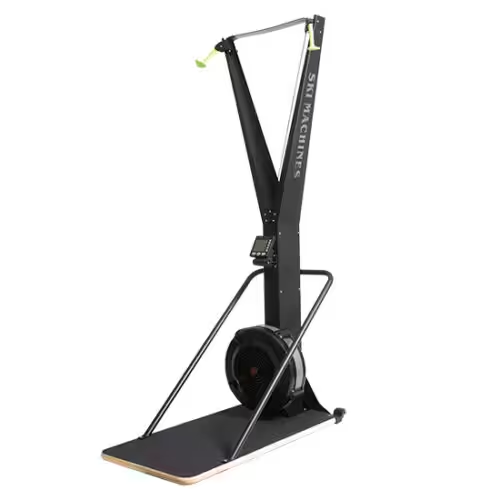
Ski ergometer
The start: 1000 meters on the ski ergometer, powered by the core and upper body. The resistance is preset to level 6 for all classes and may be changed freely. Both feet must remain on the platform.
Suitable for follow-up training: Ski Ergometer — CHF 645.00
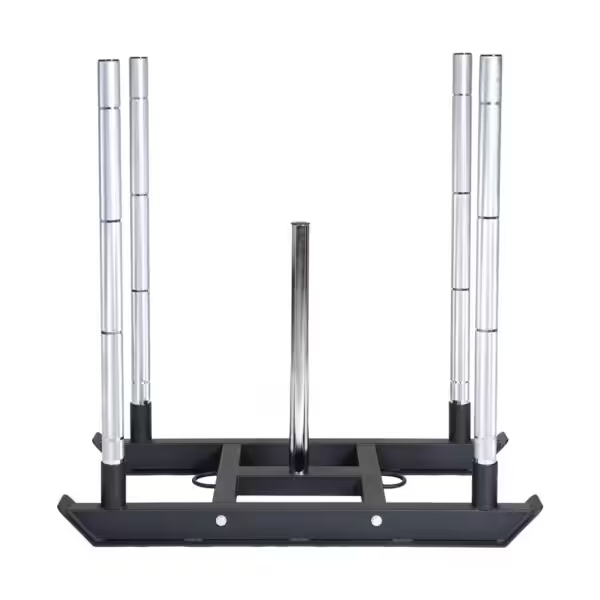
Pushing a sled
The station where most races are decided. Loaded sled over four tracks of 12.5 meters each — including the weight of the sled. The surface makes an enormous difference: competition carpet brakes significantly more than smooth flooring.
Suitable for follow-up training: Competition Sled — CHF 295.00 + Bumper plates

Pulling a sled
The same sled, now pulled toward you hand over hand on a rope — standing, not sitting or kneeling. Back, grip strength, and footwork are the deciding factors. The rope length is important: one track measures 12.5 meters, and the rope must span this distance. For competition-like training, you therefore need the 15-meter version — 6 meters is only enough for rope climbing.
Suitable for follow-up training: Sled Rope 15 m — CHF 65.-

Burpee Long Jumps
Burpee, long jump, then another burpee—until you’ve covered 80 meters. Depending on your jump distance, that’s 35 to 50 repetitions. Your chest must touch the ground on every burpee, and both feet must lift off and land at the same time. All you need is a floor that can handle it.
Suitable for follow-up training: The Right Flooring — Go to the Flooring Buying Guide

Rowing
1,000 meters on the rowing machine, also with resistance set to 6 and the footplate in position 4—both of which can be adjusted as desired. You may take breaks in between, but do not leave the seat until you have completed the distance.
Suitable for follow-up training: AirRower Rowing Machine — CHF 645.00
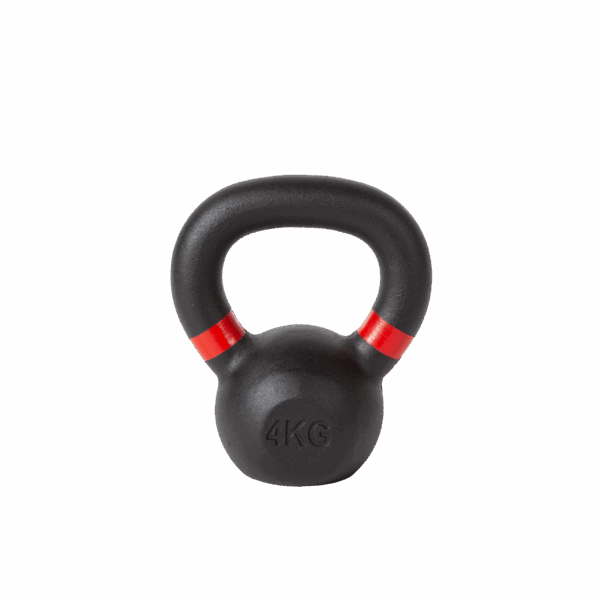
Farmer's Carry
Two kettlebells, 200 meters, arms straight at the sides. Putting them down is allowed as long as the kettlebells do not drift forward. At the end, they must stand upright in the marked box — otherwise, there is a time penalty. The classic among grip strength stations.
Suitable for follow-up training: 2 Kettlebells Cast Iron — from CHF 16.- or Competition — from CHF 40.-
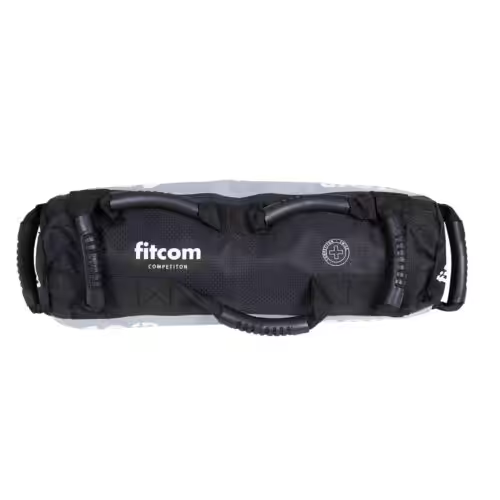
Sandbag lunges
Lunges over 100 meters, sandbag on the back. The back knee must clearly touch the ground on every repetition, and at the top you stand up fully upright. Intermediate steps are not allowed — and the bag must never be put down or rested on the feet.
Suitable for follow-up training: Competition Sand Bag — from CHF 65.-
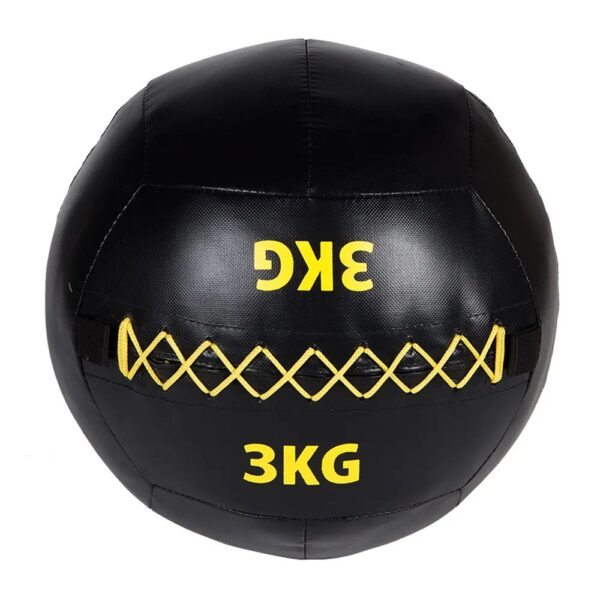
Wall Balls
The final station, and the one with the greatest time differences between athletes of equal fitness. 100 repetitions in each category: from the deep squat — hips below knee level — throw the ball at the target. Target height 2.70 m for women, 3.00 m for men.
Suitable for follow-up training: Wall Ball — from CHF 35.-
And the 8 km in between? Running is the part that beginners underestimate the most. Running eight kilometers fresh is doable for any recreational runner — running one kilometer after a 152 kg sled and another after 100 wall balls is a completely different story. Those who train indoors cover this with a self-powered treadmill ab.
Two Paths
What do you really need?
Not everyone has to replicate all eight stations at home. The crucial question is what you already find in the studio — and what you are missing there.
The Five Weight Stations
The five loaded stations are what is usually missing in normal studios. Anyone who only has these at home and does running, rowing, and skiing outdoors or in the gym covers the critical part of preparation. Prices for the grey level.
- Competition Sled CHF 295.-
- Sled Rope, 15 m CHF 65.-
- 2 × Kettlebell 24 kg from CHF 16.-
- 20 kg sandbag from CHF 65.-
- 6 kg Wall Ball from CHF 35.-
- Bumper plates for loading from CHF 20.-
The Complete Setup
If you want to set up all eight stations at home or in your own studio, you'll need to add the three machines and the space. This will allow you to practice the entire routine in the order it's performed in competition.
- Ski ergometer CHF 645.-
- AirRower rowing machine CHF 645.-
- Assault Runner Pro CHF 4,115.-
- Sprint Track Turf 10 m CHF 1,290.-
- Multiplay artificial turf from CHF 950.-
- Flooring — to the buying guide →
Everything side by side
Station, Weight, Product
| Station | Distance | White | Gray | Black | Appropriate Exercise Equipment |
|---|---|---|---|---|---|
| Ski ergometer | 1000 m | — | — | — | Ski ergometer |
| Pushing a sled | 50 m | 102 kg | 152 kg | 202 kg | Sled + Discs |
| Pulling a sled | 50 m | 78 kg | 103 kg | 153 kg | Sled + Rope |
| Burpee Long Jumps | 80 m | — | — | — | Flooring |
| Rowing | 1000 m | — | — | — | Rowing machine |
| Farmer's Carry | 200 m | 2 × 16 kg | 2 × 24 kg | 2 × 32 kg | 2 Kettlebells |
| Sandbag Lunges | 100 m | 10 kg | 20 kg | 30 kg | Sandbag |
| Wall Balls | 100 reps. | 4 kg | 6 kg | 9 kg | Wall Ball |
Frequently Asked Questions
Equipment for HYROX preparation
What weights do I need for my class?
There are three levels. White for women in the open division: sled 102 kg, Farmer’s Carry 2 × 16 kg, sandbag 10 kg, wall ball 4 kg. Gray Open to men and women Pro: 152 kg, 2 × 24 kg, 20 kg, 6 kg. Black for men Pro: 202 kg, 2 × 32 kg, 30 kg, 9 kg. The Overview at the top displays all values next to each other.
Is Fitness Flohmarkt an official HYROX partner?
No. We are neither partners nor licensees of HYROX World GmbH, and we do not sell official or certified HYROX products. All equipment shown here is our own product. We only mention the brand to show you which equipment is suitable for training for the stations of this competition format.
Are the weights halved in doubles?
No — that is the most common misconception. A doubles pair moves the exact same loads and the exact same distances as a solo competitor. Only the work is shared: you switch off at each station however you want. For the equipment, this means that a pair needs the exact same gear as a solo athlete.
What weights apply to mixed pairs?
Mixed Doubles is running on gray level, so on the weights of the men's open division — for both partners. Specifically: sled 152 kg, Farmer's Carry 2 × 24 kg, sandbag 20 kg, wall ball 6 kg. For the female athlete, this means a significantly heavier workout than in her own open division. Only the target height for the wall ball remains gender-dependent.
Is one sled enough for all levels?
The Competition Sled weighs 50 kg and holds up to 150 kg in plates — for a total of 200 kg. This covers the white level (102 kg) and the grey level (152 kg) with room to spare. For the black level at 202 kg, you are mathematically two kilos short; you will then be training just under competition weight.
Which kettlebells do I need exactly?
Always two identical — worn on both sides. 2 × 16 kg for the white, 2 × 24 kg for the grey, 2 × 32 kg for the black level. The Cast-Iron Kettlebells cover all three weights. Anyone who also swings and pushes is better off with this than with a pure carrying device.
How many Bumper Platess do I need for the sled?
Subtract the dead weight of the sled from the target weight: for the gray level you need around 100 kg of plates, for the white one about 52 kg. In practical terms, that means about four to five 20 kg bumper plates. You can find details on the selection in Bumper Plates Buying Guide.
On what surface do I pull and push the sled?
The ground significantly determines the resistance — on smooth concrete, the sled glides much easier than on competition surfaces. Those who want to train realistically take Artificial turf or a sprint track. Which flooring suits your room is in the Flooring buying guide.
What is the difference between Wall Ball and Slamball?
A Wall Ball is large, soft, and made for throwing and catching — exactly what the station needs. A slam ball is built for hard throws to the ground and does not bounce back. For 100 wall reps, the wall ball is the right choice; all weights have the same diameter of 35 cm, so the throwing feel remains the same.
Do I need my own tow rope?
Yes, the rope does not belong to the sled. When pulling, you haul it in hand over hand while standing — for that, you need a heavy-duty rope with a carabiner attachment. Pay attention to the length: one pull track measures 12.5 meters, which is why the 15-meter version of the Climbing / Sled Rope the right choice. The 6-meter version is only suitable for rope climbing.
Do I necessarily have to include running in my training?
Definitely — half of the competition is about that. What matters is not whether you can run 8 km at a stretch, but whether you can get back into a running rhythm after a difficult station. Anyone who can run outside doesn't need equipment for that. For studio and winter training, a self-powered treadmill, because the pace comes from you and not the engine.
Where do I start if the budget is limited?
With the weights, not the machines. Kettlebells, sandbag, and wall ball together cost less than a single ergometer and cover three of the five loaded stations. You can find rowing and skiing in almost every gym; sled work and heavy weights usually not. That is precisely where owning your own equipment pays off the fastest.
How much space do I need for the sled?
The sled itself measures 109 × 61 cm with a height of 108 cm. More crucial is the track: in competition, there are four sections of 12.5 meters each. At home, a shorter distance with more repetitions is sufficient—10 meters out and back adequately simulates the workload. However, without a pulling and pushing surface, the sled remains unused.
Is the Competition version worth it, or is the standard version enough?
With the sandbag and the sled, doing the exercises competition-style is worth it because the form and handling closely mirror the equipment used in competition — and that is precisely what you are training for. With kettlebells, it depends: Competition kettlebells have the same size across all weights, which makes switching more pleasant. For pure carrying, they are enough Cast-Iron Kettlebells completely.
Train what counts in competition
All stations, all weight classes — ready to ship from our Swiss warehouse. We provide personal advice when putting together equipment for your studio or club.
For the competition training rangeTrademark notice: HYROX® is a registered trademark of HYROX World GmbH, Hamburg. It is mentioned on this page solely for descriptive purposes to indicate which competition format the Fitcom AG products shown here are suitable for as training equipment. There is no licensing, partnership, or other business relationship between Fitcom AG or Fitness Flohmarkt and HYROX World GmbH. All products shown are Fitcom AG’s own products and are neither manufactured, tested, nor certified by HYROX. Information regarding weights, distances, and rules reflects the organizer’s publicly published specifications (July 2026); only the current information on hyrox.com is binding.