



Fitness Flohmarkt · Guide
Competition Kettlebell vs. normal Kettlebell: the difference
Same ball, different price? Not quite. Here, the dimensions of both types are compared side by side, along with the values from the official competition rulebook and a clear answer on when the higher price is worth it.
In short
A competition kettlebell has the same size at every weight: 28 cm high, 21 cm in diameter, handle 33 mm. A standard cast iron kettlebell grows with the weight, from 16.5 cm at 4 kg to 28.5 cm at 32 kg. Therefore, your technique remains constant with the competition bell, whereas with the cast iron bell it shifts slightly with each increment.
The core in three points
What is the difference between a competition kettlebell and a standard one?
The difference lies in three things: size, grip, and price. A Competition Kettlebell measures 28 cm in height and 21 cm in diameter for every weight, the handle has a constant diameter of 33 mm and a circumference of 104 mm. A 4 kg bell is therefore exactly the same size as a 32 kg bell, the difference lies solely on the inside. A normal cast iron kettlebell, on the other hand, grows with the weight: at 4 kg it is 16.5 cm high and has a 29 mm handle diameter, at 32 kg it is 28.5 cm and 39 mm. Then there is the material. The competition series is made of cast steel and manufactured to a fixed external dimension, the normal series of cast iron in one piece without weld seams. This affects the price: For the same weight of 4 kg, the bell costs in Kettlebell selection as Competition CHF 40.-, as Cast CHF 16.-.
Everything else follows from these three points. Anyone who wants to see the designs including the urethane and soft variants side by side can find them in the Kettlebell Buying Guide. For a direct comparison of the two designs in question, this table is sufficient:
| Feature | Competition | Standard cast iron kettlebell |
|---|---|---|
| Material | Cast steel | cast iron, one piece |
| Height | 28 cm at any weight | 16.5 to 28.5 cm, depending on weight |
| Sphere diameter | 21 cm for any weight | 9 to 20 cm, depending on weight |
| Handle diameter | 33 mm for any weight | 29 to 39 mm, depending on weight |
| Handle circumference | 104 mm for any weight | 91 to 123 mm, depending on weight |
| Weight classes | 12 steps, 4 to 32 kg | 12 steps, 4 to 48 kg |
| Gradation | 2 kg to 20 kg, then 4 kg | consistently 4 kg |
| Color coding | whole ball, by weight | Grip by Weight |
| Price from | CHF 40.- each | CHF 16.00 each |
Both designs have a flattened bottom, meaning they stand stably without tipping for Renegade rows or push-ups on the bell. Both are uncoated and therefore need to be set down in a controlled manner rather than dropped.
The rulebook
What mass does the competition standard prescribe?
These dimensions come from the sport of kettlebell lifting, not from the fitness industry. The International Union of Kettlebell Lifting stipulates in its 2017 competition rules, Section 4.2: Height 280 mm, diameter of the kettlebell head 210 mm, handle diameter 32 mm. Section 4.3 allows for a weight deviation of no more than 50 grams, which is less than two per mille for a 32-kg kettlebell. The same regulations specify exactly four colors: 12 kg dark blue, 16 kg yellow, 24 kg green, and 32 kg red. According to Section 1.3, competition is held with 16-, 24-, and 32-kg shot put balls; according to Section 6.4, a set lasts ten minutes on a platform measuring at least 1.5 by 1.5 meters. This ten-minute duration explains the entire design: Anyone performing a hundred or more repetitions over such a long set wants to find exactly the same grip and the same contact point on the forearm for every shot put.
The ball in the product range hits the body mass precisely with a height of 28 cm and a diameter of 21 cm. At the grip, it measures 33 mm instead of the 32 mm from the regulations, one millimeter more. For training, technical work, and preparation, this does not matter, but it is a reason to remain honest: competition size is not the same as federation approval. Anyone competing in a championship should clarify the approved equipment with the organizer beforehand, because every federation has its own specifications and tolerances.
The growing sphere
How much does a standard kettlebell grow with its weight?
Significantly stronger than most expect. Across the cast iron series from 4 to 48 kg, the bell increases by 12 cm in height, the diameter grows from 9 to 20 cm, and the handle circumference from 91 to 123 mm. This becomes clear with a single number: the lightest 4 kg competition bell is 28 cm high, making it the exact same height as a 28 kg cast iron bell. Seven times as heavier, the same size. Practically speaking, this means two things. First, at each cast iron step, the bell rests slightly differently against your forearm, which you feel during cleans and snatches, but hardly at all during swings. Second, the grip changes as well: a 32 mm difference in circumference between the lightest and the heaviest bell is a lot when you are doing high-repetition, single-arm work. The complete values for each level are listed here:
| Weight | Height | Diameter | Handle diameter | Handle circumference |
|---|---|---|---|---|
| 4 kg | 16.5 cm | 9 cm | 29 mm | 91 mm |
| 8 kg | 19.5 cm | 12 cm | 33 mm | 104 mm |
| 12 kg | 22 cm | 14 cm | 34 mm | 107 mm |
| 16 kg | 24.5 cm | 16 cm | 35 mm | 110 mm |
| 20 kg | 25 cm | 17 cm | 36 mm | 113 mm |
| 24 kg | 27 cm | 18 cm | 37 mm | 116 mm |
| 28 kg | 28 cm | 19.5 cm | 38 mm | 119 mm |
| 32 kg | 28.5 cm | 20 cm | 39 mm | 123 mm |
| 36 to 48 kg | 28.5 cm | 20 cm | 39 mm | 123 mm |
It’s interesting to note where the two designs converge: At 8 kg, the cast iron ball has exactly the same grip as any Competition ball—namely, 33 mm with a circumference of 104 mm. So if you start with an 8-kg cast iron kettlebell and later move up to 16 kg, you’ll switch from 33 to 35 mm. In the Competition series, the grip remains at 33 mm. It is precisely this upright grip that justifies the extra cost. Incidentally, just how quickly a kettlebell’s size makes a difference in everyday use is also evident in the Goblet Squat, where the elbows used to hit the thighs with large balls.
Read colors
What do the colors of competition kettlebells mean?
The color replaces reading the number. Because all the bells are the same size, the weight can no longer be recognized by the outline, which is why each level gets its own color. Four of them are laid down in the regulations of the International Union of Kettlebell Lifting, namely 12 kg dark blue, 16 kg yellow, 24 kg green, and 32 kg red. You will find these four worldwide with the same assignment, in the gym as well as at championships. All other levels are convention rather than norm, widespread but not identical everywhere. This has a visible side effect: In the light range, colors appear twice. The bells in the product range feature 6 kg in red and 32 kg also in red, 10 kg in orange and 28 kg also in orange. You still cannot confuse them, because 6 and 32 kg explain themselves when lifted.
| Weight | Color | Stipulated in the regulations |
|---|---|---|
| 4 kg | gray | no, convention |
| 6 kg | red | no, convention |
| 8 kg | pink | no, convention |
| 10 kg | orange | no, convention |
| 12 kg | blue | Yes |
| 14 kg | brown | no, convention |
| 16 kg | yellow | Yes |
| 18 kg | black | no, convention |
| 20 kg | violet | no, convention |
| 24 kg | green | Yes |
| 28 kg | orange | no, convention |
| 32 kg | red | Yes |
The labeling works differently for cast balls: the handle is colored instead of the entire ball, and the ball itself remains black. The rubberized version has the weight additionally printed, front and back.
The decision
When is a competition kettlebell worth it and when is it not?
It is worth it if you want to cleanly repeat the same movement across multiple levels. This applies to three groups: everyone training toward kettlebell sport, technically oriented trainees with high repetition counts in the snatch, clean, and jerk, and gyms that want to offer multiple people the same handling across the entire range. It is not worth it if you are looking for two or three bells for swings, squats, and presses at home. Then you are paying for a feature that you do not use, because with two weights, the jump in size is hardly noticeable. The honest alternative is right next to it: for the price of a 4 kg competition bell, you get a 4 kg cast iron bell plus a rubberized 4 kg bell and still have money left over. There is a second point that no data sheet mentions and that quickly becomes a problem with a full range, namely the space in the training room.
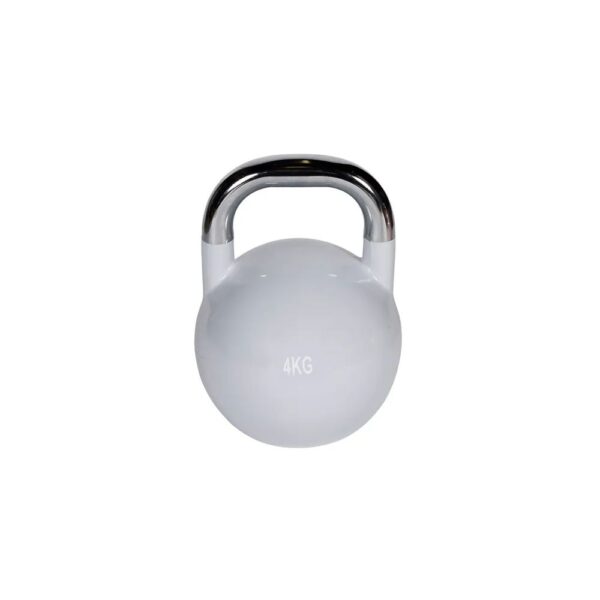
Competition Kettlebell
- Cast steel
- 28 cm height
- 21 cm in diameter
- Handle 33 mm
- 12 steps, 4 to 32 kg
- from CHF 40.-
Height, diameter, and handle remain identical across all twelve levels, graduated up to 20 kg in 2 kg increments. Color-coded over the entire sphere, flattened bottom, price per piece.
Ideal for: Kettlebell sport, highly repetitive technical training, and gyms with a full range of weights.
View competition kettlebell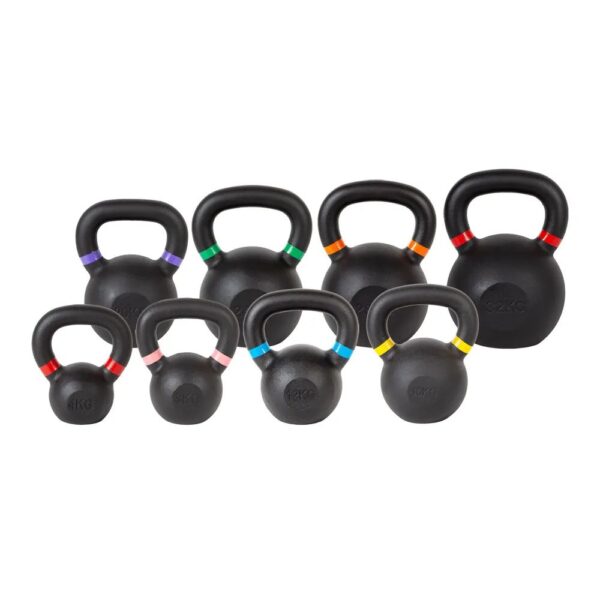
Kettlebell Cast Iron
- Cast iron
- in one piece
- 16.5 to 28.5 cm height
- Handle 29 to 39 mm
- 12 steps, 4 to 48 kg
- from CHF 16.-
Cast without seams, color-coded handle, flattened bottom. As a single series, it goes up to 48 kg, thereby also covering heavy two-handed swings for which there is no step up in the competition series.
Ideal for: Home gym and commercial gym without competition ambition, with progression over the years.
Watch Cast IronThe space requirement can be derived from the storage dimensions. The Kettlebell Rack has two tiers of 147 cm each, making a total of 294 cm of storage length, and according to the manufacturer holds either 12 competition balls or 20 regular ones. Converted, that is about 24.5 cm of shelf width per competition ball compared to about 14.7 cm per cast ball: two-thirds more space for the same number of weights. Anyone planning a continuous row of competition balls should calculate this beforehand. Without a rack, the same applies to floor space, and in that case, it is worth taking a look at a suitable floor protection mat, because both types are uncoated. You can find more equipment for strength endurance sessions in the Conditioning category.
Classification
What is worth it for whom
Kettlebell Sport in Focus
You are training Long Cycle or Snatch for ten minutes and want to change your level without having to relearn the technique from scratch. Then there is hardly any way around the Uniform sphere over, sensibly in two adjacent stages right away.
Home gym, sturdy and affordable
You want to cover swings, squats, and presses and progress over years. The Cast series up to 48 kg costs the least per kilo and covers a range that the Competition series doesn't even offer.
Rental apartment with sensitive flooring
You train on parquet or tile and want neither dents nor discussions. The Version with rubber coating cushions when setting down and offers up to 20 kg in fine 2 kg increments, from CHF 10.00 each.
Studio, club, physiotherapy practice
You are equipping a space for changing people and need order. A continuous row plus Shelf with 300 kg load capacity keeps the balls ready at hand, and the color coding saves explanation time in every lesson.
Frequently Asked Questions
Competition Kettlebell: the most important answers
What is a competition kettlebell?
A competition kettlebell is a kettlebell whose outer dimensions are identical for every weight: 28 cm in height, 21 cm in diameter, and 33 mm in handle diameter. It originates from kettlebell sport, is made of cast steel, and is color-coded by weight across the entire ball because the increments would otherwise be indistinguishable.
What specifically is the difference between Competition and cast iron?
The size and the handle. The cast iron kettlebell grows from a height of 16.5 cm at 4 kg to 28.5 cm at 32 kg, and the handle circumference from 91 to 123 mm. The competition kettlebell remains at 28 cm and 104 mm. In addition, there is the material: cast steel versus one-piece cast iron.
Why is the competition kettlebell more expensive?
Because the outer dimension is fixed and the weight is achieved through the internal structure. Bringing a light ball to a height of 28 cm is more complex than casting a small ball. At the same weight of 4 kg, the competition ball costs CHF 40, and the cast ball costs CHF 16.
Are all competition kettlebells the same size?
Within a series yes, across manufacturers not necessarily. The regulations of the International Union of Kettlebell Lifting specify a height of 280 mm, a body diameter of 210 mm, and a 32 mm handle. The kettlebell in the product range hits the height and diameter exactly and, with a 33 mm handle, is one millimeter above that.
Do I need a competition kettlebell for home?
In most cases, no. The advantage of consistent dimensions only pays off when you maintain the same technique across multiple levels, typically with high repetitions in the snatch, clean, and jerk. For swings, goblet squats, and presses at home, a cast-iron kettlebell works just as well.
What do the colors of the competition kettlebells mean?
They indicate the weight. Four colors are bindingly specified in the regulations: 12 kg dark blue, 16 kg yellow, 24 kg green, 32 kg red. The remaining levels follow a common convention, which is not the same everywhere, however. In the lighter range, colors therefore occur twice.
Do competition kettlebells fit in a standard kettlebell rack?
Yes, but they need more space for that. The two storage levels, each measuring 147 cm, accommodate 12 competition boules or 20 regular ones. That is about 24.5 cm of shelf width per competition boule compared to about 14.7 cm per cast iron boule. Plan for the space requirement before buying an entire set.
Can I drop a competition kettlebell?
Better not. Cast steel is sturdy, but the ball isn't rubber-coated and the paint will get damaged. On tile or parquet, the floor will too. Set the kettlebell down in a controlled manner and put a protective mat underneath for heavy sets; that protects both the floor and the ball alike.
Select a sphere with uniform mass
Twelve increments from 4 to 32 kg, up to 20 kg in 2 kg steps, color-coded and individually selectable.
View competition kettlebellSource of competition values
The stated dimensions, tolerances, and color specifications originate from the rulebook of the International Union of Kettlebell Lifting, 2017 edition, sections 1.3, 4.1, 4.2, 4.3, and 6.4. Status of verification: August 24, 2026. Fitcom AG is neither a member nor a partner of this association, and the kettlebells shown are proprietary products without association approval.