


Fitness Flohmarkt · Guide
Chest Press or Bench Press: Machine or Free Weights?
The machine guides you, the barbell challenges you. Which of the two variants belongs in your gym is decided by four things: budget, space, experience, and the question of whether someone is standing next to you.
In short
A chest press performs the pushing movement on a fixed path and does not need a spotter. Free bench pressing requires more technique, trains the stabilizers as well, and costs a fraction. For the home gym, the free bench with safety arms almost always wins. The machine is worth it for multiple users, in the gym, and for sensitive shoulders.
Definition
What is a chest press and how does it differ from the bench press?
A chest press is a machine that guides the pushing movement in front of the chest along a predetermined path: you sit upright or slightly reclined, the handles run in bearings or joints, and the load is attached to a weight stack or weight plates. The equipment in our Plate-Loaded Category working with plates instead of selectorized weights because the load feel is closer to that of free weights. With the bench press, on the other hand, you lie flat and move a free barbell that can drift in all directions. The crucial difference is therefore not the musculature, but who controls the path of motion: with the machine, the design; with free pressing, your shoulder and core muscles. Everything else follows from this single thing.
A detail that often goes unnoticed: good chest press machines have converging arms. The handles come together inward as you press, just like your arms would with dumbbells. A rigid, parallel path of motion, on the other hand, quickly feels cramped if you have broad shoulders.
Muscle building
Chest press or bench press: Which one builds more chest muscle?
For pure muscle building, there’s little difference between the two variations, as long as you push yourself close to muscle failure and gradually increase the load over several weeks. The difference lies in what else happens. With the free-weight bench press, your shoulder blade stabilizers, core, and small stabilizing muscles all engage—otherwise, the bar would wander. This makes the exercise technically more challenging and the first few weeks tougher, but it translates better to everything else you do with free weights. On the machine, this component is eliminated. You can focus entirely on your chest, work your way through to the final reps in a controlled manner, and don’t need anyone to take the bar off for you. If you want to efficiently build muscle mass in your chest, you actually have an advantage on the machine. If you want to get strong, there’s no getting around free weights.
The honest counter-ad: If your budget is under CHF 1,000.- and you are the only person in the room anyway, a chest press is the wrong investment. Buy a bench with safety arms instead or a R-SERIES Power Rack with safety bars set. Which rack design fits in your room is determined by the Rigs and Racks Buying Guide with all dimensions. Conversely, anyone returning after shoulder surgery or who for other reasons does not want a free barbell over their face will find the Realleader Chest Press LD-1001 the safe choice.
Cost and space
How much do the machine and the free bench cost, and how much space do they need?
A new chest press costs around six times as much as a complete free-weight press station, whereas in terms of space they take up almost the same amount. Calculated with regular prices: The Competition weight bench for CHF 490.- plus this Bumper Plate Set with Olympic Bar at CHF 395.- results in CHF 885.- for a finished station. The machine is priced at CHF 4,990.-, and because it is loaded with weight plates, the same CHF 395.- is added on top: CHF 5,385.-. That is a factor of 6.1. When it comes to space, the picture surprisingly reverses. The machine measures 135 x 155 cm, which is 2.09 m² of footprint. The competition bench, with its lateral safety arms, requires 160 x 180 cm, or 2.88 m². In terms of floor plan, the machine is the more compact solution.
| Solution | Regular price, device | Weights needed | Footprint | Hedging |
|---|---|---|---|---|
| Realleader Chest Press LD-1001 | CHF 4,990.- | 50 mm disks | 135 x 155 cm (2.09 m²) | Foot pedal and fixed track |
| Competition weight bench | CHF 490.- | Bar and discs | 160 x 180 cm (2.88 m²) | Safety Spotter Arms |
| R-SERIES Power Rack plus Premium Adjustable Bench | CHF 885.- | Bar and discs | 152 x 133 cm (2.02 m²) | Safety bars in the rack |
Calculated with the 90 kg set, the bench version is CHF 885.-, the rack version is CHF 1,280.-, and the new machine is CHF 5,385.-. The weights also differ significantly: 153 kg for the machine versus 90 kg for the power rack. Anyone living in a basement who will eventually need to get the equipment back out should factor that in. An overview of all designs can be found in the Weight Bench Category.
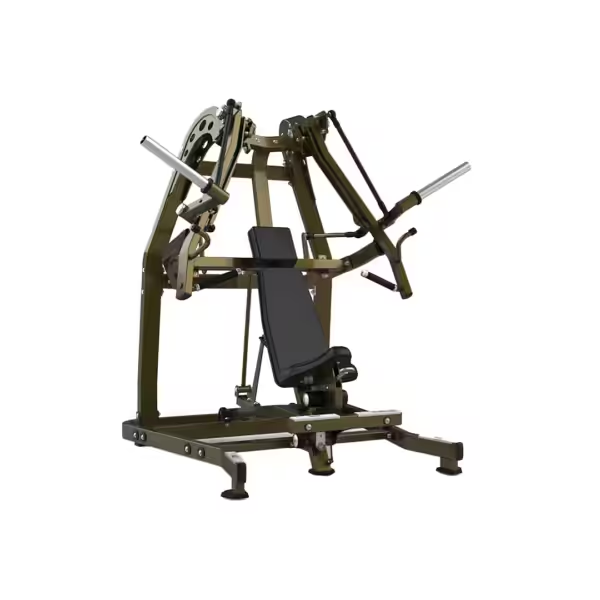
Realleader Chest Press LD-1001
- CHF 4,990.00 regular
- 135 x 155 x 183 cm
- 153 kg
- Art. F-69148
Chest press with converging arms that come together inward during the press. The seat is adjusted to the user's height via a lever, and a foot pedal engages the safety lock for entry and exit. It is loaded with weight plates on both sides, and the frame is made of 80 x 40 x 3 mm steel tubing.
Ideal for: Studios, clubs, and physical therapy practices where many different people push without instruction.
View Chest Press
Competition weight bench
- CHF 490.-
- 500 kg load capacity
- 160 x 180 x 110 cm
- Art. F-83185
Flat bench with height-adjustable barbell rest and safety spotter arms that catch a failed repetition. This allows you to press heavy even when working out alone, without needing a full rack in the room. Band pegs for resistance bands are integrated, frame made of powder-coated steel.
Ideal for: Home gyms where bench pressing is the main exercise and no one is there to spot.
View Competition-BankDumbbells
Dumbbell Chest Press: When Dumbbells Are the Better Choice
The dumbbell chest press is the compromise between both worlds and the most sensible entry point for most home gyms. Two dumbbells move independently of each other, which means: each side has to stabilize its own load, strength differences between left and right become immediately apparent, and the wrists are free to rotate. At the same time, in an emergency, you can simply drop the dumbbells next to you, which makes the exercise significantly less critical than a barbell over the chest. The price for this is loadability: from a certain level, you can hardly get the heavy dumbbells into the starting position on your own. Anyone who exceeds 40 kg per hand either needs help or switches back to a barbell or machine. You can find suitable weights in the Dumbbell category.
Learn the dumbbell floor press
If you lack the space for an entire dumbbell rack, an adjustable dumbbell is the alternative. What increments and ranges are available can be found in the Buying guide for adjustable dumbbells.

Premium Adjustable Bench
- CHF 395.-
- 500 kg load capacity
- 135 x 67 x 44 cm
- Art. F-84166
Adjustable bench with seven backrest positions and three seat angles, ranging from flat to almost upright. This covers flat bench, incline bench, and shoulder press with a single piece of equipment. With a dead weight of 50 kg, it stays put even during unilateral sets. It does not have a decline adjustment.
Ideal for: all those who primarily want to press with dumbbells and cover multiple angles.
View bankStore
Incline Chest Press: What the Incline Angle Changes
The Incline Chest Press shifts some of the work from the middle chest to the upper chest and the anterior deltoid. This applies equally to the machine and the bench, with one practical difference: incline press machines are dedicated units with a fixed built-in angle, whereas an adjustable bench provides you with multiple positions using the same piece of equipment. Therefore, anyone who wants to train flat and incline in a home gym doesn't buy a second machine, but rather a bench with an adjustable backrest. In the gym, it is the other way around: there, alongside the flat version, there is often a separate incline unit because during peak hours two people are supposed to press at the same time. For the chest itself, it does not matter whether the angle comes from the bench or the frame.
Specifically, for the home gym, this means: A adjustable bench with seven backrest positions covers flat and incline pressing in an area of 135 x 67 cm. Two machines for the same two angles, on the other hand, take up a good 4 m², if you count the 2.09 m² of the chest press twice.
Brands
Hammer Strength, Technogym, or Realleader: What's behind the brand names
Those looking for a Hammer Strength Chest Press or Technogym Chest Press are usually not looking for the brand, but a specific design principle. Since the nineties, Hammer Strength has stood for plate-loaded machines with independently guided arms, also known as iso-lateral: left and right move separately. Technogym primarily builds machines with weight stacks and fine weight increments, as common in commercial gyms. Both are third-party brands that we mention here only for classification. We do not carry them new. Studio equipment from such manufacturers occasionally appears as used items with us, but irregularly and almost always as a single piece. If you are interested in the design principle rather than the logo, a used machine is often the smartest way to get one.
Used offers change regularly. Find the current selection in the Outlet. Check the individual machine’s condition, adjustments and completeness.
Recommendation
What is worth it for whom
Home gym, alone, limited budget
Free weight bench with safety arms plus 90 kg set. You get a fully functional station for CHF 885.00 and still train safely. Start: Competition Flat Bench with Safety Spotter Arms.
Home Gym with Squats and Pull-Ups
If more than just bench pressing is happening anyway, the rack is the better basis. It secures you, holds the bar, and grows with you. Start: Power rack with safety bars and pull-up bar.
Studio, club or physiotherapy practice
What matters here is that every person can press safely without instruction. That is precisely what the machine is built for. Start: Chest Press LD-1001 with foot pedal lock.
Limited space, flexible use
When the room needs to revert to a living space after a workout, 153 kg of steel is out of the question. A motorized compact machine is then the more realistic option. Start: Digital cable machine buying guide.
Frequently Asked Questions
Chest Press and Bench Press: The Most Important Answers
Is the chest press as good as the bench press for muscle growth?
For building chest muscles alone, yes, provided you go close to muscle failure and increase the load. The difference lies elsewhere: Free bench press also trains the core and stabilizers and transfers better to other free-weight exercises. The machine, on the other hand, allows for controlled sets until the last repetition without a spotter.
Does a chest press machine need its own weight plates?
Yes, for plate-loaded machines. The Realleader Chest Press LD-1001 is loaded on both sides with 50 mm plates, which are not included in the delivery. Therefore, always factor in plates, such as a 90 kg set for CHF 395.-. Machines with a weight stack, on the other hand, do not need additional weight, but are usually more expensive to purchase.
How much space does a chest press machine need?
The Chest Press LD-1001 measures 135 x 155 x 183 cm, which results in a footprint of 2.09 m². In addition, there is space needed for loading on both sides and room behind the seat to get in and out. Roughly calculate double the actual footprint so that you can comfortably move around the machine.
Can I train bench press alone, without a spotter?
Yes, if the bench or rack has emergency safety catches. Safety spotter arms on the bench or safety bars in the rack catch the bar if a rep fails. Without this safety measure, you shouldn't perform heavy sets alone. Dumbbells are the alternative because you can drop them to the sides.
Is a used chest press worth it?
Used equipment can be worthwhile when its condition, adjustments and price suit you. Check bearings, upholstery and that all pins are present. Compare the current price with a suitable new machine.
What is an incline chest press?
An incline chest press is the angled pressing variation where the backrest is elevated. It shifts work to the upper chest and anterior deltoid. On the machine, the angle is fixed, while on an adjustable bench, you choose it yourself.
Ready for your bench press station?
Bench, rack, or machine, everything from a Swiss warehouse. For larger setups, we plan with you.
View benches and racksTrademark Notice
Hammer Strength and Technogym are registered trademarks of their respective owners. Fitcom AG has no licensing or partnership relationship with these companies. The equipment shown in this article consists of our own products. The names are used solely to explain common construction principles.