



Fitness Flohmarkt · Guide
Sandbag Training: Which weight and exercises suit you
A bag of sand looks like the simplest piece of training equipment in the world. On your first attempt to get it cleanly onto your shoulder, you realize it is not.
In short
For starting sandbag training, 10 kg is suitable for most women and 20 kg for most men. The determining factor is not the squat, but shouldering from the floor: this movement limits your weight. The most important exercises are the bear-hug squat, shouldering, sandbag lunges, overhead press, and carries.
Weight
Which sandbag weight is right for you?
Take 10 kg if you are a beginner and weigh around 60 to 70 kg, and 20 kg if you already do regular strength training. The reason is not the squat itself, but the way there: every repetition starts on the ground, and the sandbag must first be lifted to the shoulder or into a bear hug. This shrugging up is the weakest link in the chain for almost everyone, which is why it determines your weight, not your leg strength. A Powerbag in five weight levels covers weights from 5 to 30 kg, so you don’t have to guess when buying one. The rule of thumb is simple: If you can’t lift the bag from the floor to your shoulder in a controlled manner after eight repetitions, it’s too heavy—no matter how easy the squat feels with it. Body weight is only a rough guide here; training experience and core strength are the decisive factors. Those with a background in strength training tend to be one level higher, while those with a background in endurance sports tend to be one level lower.
| Weight | Goes well with | Typical exercises at this level |
|---|---|---|
| 5 kg | technique development, youth training, injury-rehabilitation training | Rotation, stop, first lunges |
| 10 kg | Entry-level for most women, technical level for men | Sandbag Lunges for distance, Overhead Press, Carries |
| 15 kg | intermediate level for strength endurance circuit | Cleans in Serie, Bear-Hug-Squats, Rows |
| 20 kg | Starting point for most trained men | Shouldering, heavy lunges, front carry |
| 30 kg | Advanced, studio, and club operations | Shoulder throws, heavy carries, bear-hug squats |
The test for this takes one minute and works in the store just like at home: sack from the floor to the right shoulder, put it down, to the left, put it down, and do that four times per side. If the last two repetitions are only managed with a rounded back or with momentum from the lower back, you are one level too high. If you are barely breathing after eight repetitions, you are one too low. This test is more reliable than any chart because it measures your weakest link and not your squat max.
Between two levels, take the lighter one. A sandbag is not a piece of equipment for maximal strength, but for sets of 30 to 90 seconds where your heart rate goes up. If you buy too heavy, you end up doing a few sloppy repetitions instead of many controlled ones. And a fair disclaimer: If your goal is to get stronger in fixed steps and measure progress in kilograms, the sandbag is the wrong tool. It cannot be increased in two-kilogram increments and sits a little differently with every repetition. For predictable progression, Cast-iron kettlebells from 4 to 32 kg the better choice. If, on the other hand, you are planning your complete setup for a competition format, you will find all load specifications of the eight HYROX stations in the appropriate buying guide.
Exercises
What exercises do you do with the sandbag?
With a single sandbag you cover lifting, carrying, pushing, pulling, and rotation. The five core exercises are the bear-hug squat, shouldering, sandbag lunges, overhead press, and the distance carry. All five start on the ground and end on the ground, which is what sets sandbag training apart from barbell work: there is no rack-height drop-off and no rack starting point. In addition, the filling shifts with every movement and you constantly have to readjust. This is precisely what makes the exercises more strenuous than the number on the bag suggests. A 20 kg sandbag feels significantly heavier in the overhead press than a 20 kg barbell because you are controlling the load and balance at the same time. For your training plan this means: use the same exercises as with the barbell, but expect significantly less weight and more time under tension. Two movements are added that do not exist at all with a fixed load, namely shouldering and the shoulder throw.
| Exercise | What is burdening her | What you pay attention to |
|---|---|---|
| Bear-Hug-Squat | Legs, torso, upper back | Keep the bag close to your chest; pull your elbows forward and together |
| Shouldering | Full body, explosive hip extension | Switch sides every repetition, otherwise it will be unbalanced |
| Sandbag Lunges | Unilateral legs, core stability | Bag in the neck, lower the back knee in a controlled manner |
| Sandbag Clean | Hip, back, grip | Lift with your legs, not with a rounded back |
| Overhead Press | Shoulders, triceps, core | Keep ribs down, no arched back on the push |
| Bent-over Row | upper back, rear shoulder | Grab handle loops or sack ends, keep back flat |
| Front-Carry over Distance | Torso, breathing, grip | Count distance instead of repetitions, for example 40 m |
| Sandbag Drag | Legs, back, stamina | Only on a robust surface, not on parquet |
| Over-the-Shoulder Throw | full-body, explosive power | Throw only outside or on safety surfacing |
Movements involving rotation and momentum work better if the bag has handle loops instead of just two ends to grip; a Bulgarian Bag with five carrying loops is designed for that. If you see the sandbag as a complement to dumbbells and weight plates, you'll find the right ones Additional weights for different types of training in a single category.
One thing remains the same for all nine exercises: You only count repetitions when they can be counted accurately. For carries and drags, distance is the better unit of measurement; for shouldering, it’s time. Sandbags are a strength-endurance tool, and fatigue sets in first in your grip and breathing, not in the muscles. If you ignore this and work in sets of three like you would with a barbell, you’ll wonder why you’re not seeing results.
Workout
What exactly does a sandbag workout look like?
A viable sandbag workout consists of three to five rounds with four exercises and takes 20 to 30 minutes. You work in time windows instead of repetitions because the bag feels different at the end of a round than it does at the beginning. The structure always follows the same logic: a heavy lifting movement, a leg movement over distance, a pressing movement, and a carrying or pulling movement. This ensures every muscle group is worked once without needing extra equipment. The rest period is important: 60 seconds between rounds, and less only if your technique holds up until the very last repetition. With a sandbag and a three-square-meter area, you have a complete session without a rack, a bench, or changing plates. You can progress in three ways: more rounds, longer intervals, or shorter rest periods. You change the weight last because jumping from 10 to 20 kg will overwhelm your technique long before you lack the strength.
| Sequence | Exercise | Target per round |
|---|---|---|
| 1 | Shouldering, alternating sides | 40 seconds |
| 2 | Sandbag Lunges, Sandbag on back | 20 steps |
| 3 | Overhead Press from the front rack | 8 to 10 repetitions |
| 4 | Front Carry or Bear Hug Hold | 40 meters or 40 seconds |
Three rounds of this are enough to get started; five rounds make for a challenging workout. If you incorporate the bag into a circuit with a jump rope, battle rope, and boxing bag, you’ll find the remaining components in the Conditioning assortment. Most people can manage two to three sandbag workouts per week because the strain comes largely from endurance and grip strength rather than pure muscle fatigue.
Scope of delivery
Does the sandbag arrive full or empty?
That depends on the model, and it’s the question that causes the most frustration in hindsight. The Powerbag Fitness Sand Bag comes pre-filled with metal sand and is ready to use right away. The Competition Sand Bag, on the other hand, is delivered without sand because it’s built to competition specifications and you adjust the weight yourself. You can get sand for this at a hardware store. This isn’t a drawback, but rather a deliberate design choice: An empty bag is easier to ship, store, and adjust in weight. However, it does mean you won’t be able to start training right away when you unpack it. If you’re not aware of this, you’ll find yourself standing there on Sunday evening with an empty nylon bag. That’s why this point takes precedence over all other purchasing criteria—even before material, number of handles, and price. Check the contents of the package with every seller, because both designs are common on the market and the product images look identical.

Powerbag Fitness Sand Bag, CHF 35 to CHF 55
- 5, 10, 15, 20, and 30 kg
- 52 cm long
- 21 cm in diameter
- Nylon, metal sand core
- Item No. F-81645
The standard sandbag for the home gym. It comes pre-filled, has a padded surface and reinforced seams, and—with five weight levels—covers the entire range from technical weight training to heavy lifting exercises.
Ideal for: Getting Started with Sandbag Training, Circuit Training in Your Home Gym, and Anyone Who Wants to Jump Right In.
View powerbag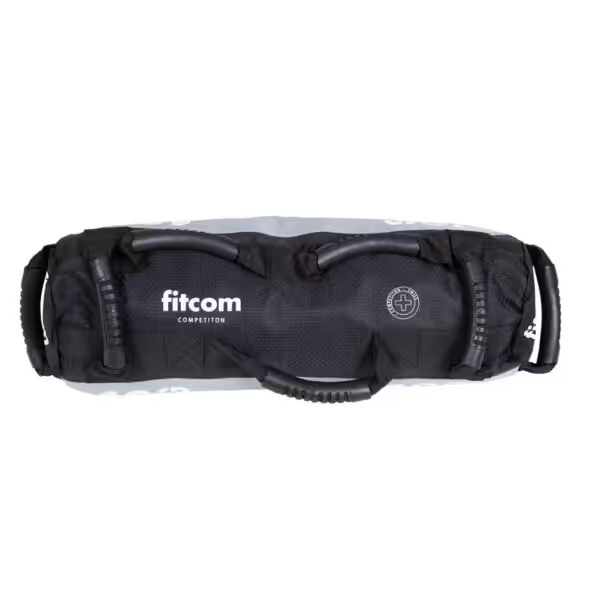
Competition Sand Bag, CHF 65 to CHF 85
- 10, 20, and 30 kg
- 52 to 60 cm long
- 17 to 24 cm diameter
- Nylon, reinforced seams
- Item No. F-92897
Built to the specifications used in competition, with several permanently attached handles. You provide the filling yourself, but this ensures that the handling matches that of the equipment you'll be using on competition day.
Ideal for: Preparation for hybrid competitions, gyms, and anyone who wants to fine-tune their weight on their own.
View the Competition Sand BagIf you’re looking for a sandbag for HYROX or another hybrid format, go for the Competition model, because its length, diameter, and handle placement match the equipment you’ll be using on competition day. For general sandbag training at home, this isn’t a factor; what matters there is that the bag arrives filled and is at the right level.
How much sand you need can be calculated. The 20 kg competition bag measures 60 cm with a diameter of 21 cm. Roughly calculated as a cylinder, this results in a volume of around 20.8 liters. Dry quartz sand from the hardware store weighs 1.4 to 1.6 kg per liter depending on the grain size, calculated at 1.5 kg. Filled to the brim, the bag would therefore weigh around 31 kg. For the 20 kg level, you therefore need about 13 liters, which is a good two-thirds of the volume. A standard 25 kg bag of quartz sand corresponds to about 17 liters and is thus sufficient for a 20 kg fill with some to spare. Incidentally, this tight one-third of air is intentional: A bulging bag behaves like a tree trunk, whereas one that is two-thirds full shifts around and thus trains what you bought it for. Weighing with a bathroom scale while filling instead of counting bags, and using inner liner bags so that no sand sifts through the seam.
Design
Cylinder or half-moon: which design fits your workout?
The cylindrical shape is the standard for lifting,shouldering and carrying,the crescent shape for momentum and rotation.A classic sandbag is an elongated tube that you hug,place on the back of your neck or grip at the ends.A Bulgarian bag is curved,wraps around the shoulders and neck and has loops that you can guide it with without having to clasp it.From this follows the division: If you want to move heavy loads off the ground,take the cylinder.If you want spins,swings and rotations,take the crescent shape.Both designs are available from us from 5 to 30 kg,so the decision really depends on the movement and not the available weight.If you are not sure,take the cylinder: It covers more basic exercises and is the shape that training plans and competition formats refer to.The crescent shape is the specialization,not the standard.
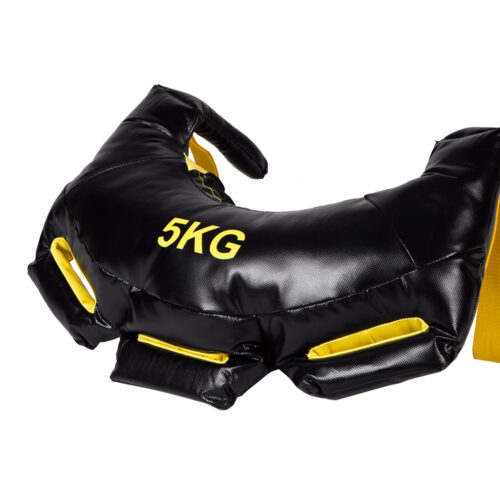
Bulgarian Bag, CHF 35.00 to CHF 55.00
- 5, 10, 15, 20, and 30 kg
- 61 x 55 x 16 cm
- Five grab handles
- Nylon, metal sand core
- Art. F-31632
The crescent-shaped design with tapered ends rests on the shoulders and can be guided by the loops. This enables spins, swings, and rotations that do not work cleanly with a straight bag.
Ideal for: Rotational work, strength endurance while standing, and training in tight spaces with no storage surface.
View Bulgarian Bag| Feature | Classic punching bag | Bulgarian Bag |
|---|---|---|
| Shape | cylindrical, straight | crescent-shaped, curved |
| Handles | Sagging or looping | five grab handles |
| Strength | Lift, shoulders, carry | momentum, rotation, strength endurance |
| Weakness | hardly any rotation possible | unsuitable for heavy ground heaving |
| Weights | 5 to 30 kg | 5 to 30 kg |
Whoever wants both does not buy two bags, but rather one sandbag and complements the rotational work with a kettlebell. Kettlebell category with cast iron, rubber, and competition models covers swings and cleans more reliably than any bag because the center of gravity remains fixed.
Space and ground
Where do you train with the sandbag and what can the floor withstand?
For most sandbag exercises, an open area of two by two meters and a normal ceiling height are sufficient. Do the math: A bag 60 cm long pressed overhead requires about 2.30 m to the top edge for a person 1.80 m tall, so a standard ceiling height of 2.40 m is just barely enough. Things get critical not with the height, but with the floor. A sandbag dropping from shoulder height makes a bigger impression on laminate or a concrete ceiling in an apartment building than you would like. Therefore, the rule is: place it down instead of dropping it, and put a rubber mat under your working area. For distance lunges and carrying exercises, you also need a track of about ten meters, indoors or outdoors. If you don't have that, you work in place with reverse steps, which provides the same stimulus and takes up significantly less space. A ceiling height below 2.30 m rules out standing overhead pressing; in that case, you stick to the push press in a lunge or go outside for it.
The big advantage over dumbbells and weight plates is precisely that: a sandbag doesn't scratch anything, doesn't roll away, and can be used outside on grass or gravel just as well as in the basement. That's why in many home gyms it is the piece of equipment that requires the least infrastructure. If you also work with balls alongside it, it's worth taking a look at the guide on Difference between wall ball, slam ball, and medicine ball, because the same question about the ground and wall appears there again in a different form. The sandbags themselves, along with sleds, chains, and farmer walk handles, are in the Strongman Category, ready for dispatch from our Swiss warehouse.
Maintenance takes little effort, but it needs to be done: check the seams and loops every few weeks, let the bag dry after outdoor sessions, and do not leave it damp in the basement long-term. For models with an inner bag, you also check if sand is collecting at the bottom because a bag has chafed through. A sandbag lasts for years if it stays dry, and becomes a nuisance as soon as sand is lying around the training room.
Classification
What is worth it for whom
Four typical starting situations and the recommendation for them.
Getting Started in Your Home Gym
A sack, a step, no accessories. Women start with 10 kg, men with 20 kg. The pre-filled power bag saves you the trip to the hardware store and is ready for use on the day of delivery.
Hybrid and competition preparation
Train in the load that you will face in competition, and with a bag that feels like the one on race day. That is what the Competition Sand Bag in your weight class Built.
Rental apartment in an apartment building
The punching bag is one of the few quiet pieces of equipment here, as long as you put it down instead of dropping it. Skip throws and drags, stick to squats, lunges, presses, and carries, and put a rubber mat under your work area.
Studio, club, and physiotherapy practice
Here, having multiple weight tiers pays off, because otherwise a mixed-level class fails the hardest participants. A progression of 5, 10, and 20 kg plus a heavy 30 kg bag for the strength section makes sense.
Frequently Asked Questions
Frequently Asked Questions about Sandbag Training
What weight should my first sandbag be?
10 kg for most female beginners, 20 kg for most trained men. What matters is not what you can squat, but what you can cleanly bring from the floor to your shoulder eight times. This movement limits your weight. When in doubt, choose the lighter option.
What exercises can you do with a sandbag?
The five basic exercises are the bear-hug squat, shouldering, sandbag lunges, overhead press, and distance carry. Added to these are cleans, bent-over rows, drags, and outdoor shoulder throws. A single bag thus covers lifting, carrying, pushing, pulling, and rotation without the need for any other equipment.
What do I fill an empty sandbag with?
With dry quartz sand from the hardware store, filled into tear-resistant inner bags. The bags prevent sand from trickling through the seams and allow you to change the weight in increments. Weigh it while filling using a bathroom scale instead of relying on the weight stated on the bag.
How much sand fits into a 20 kg sandbag?
Around 13 liters. The 20 kg bag measures 60 cm by 21 cm in diameter, which is roughly 20.8 liters in volume. Dry quartz sand weighs about 1.5 kg per liter, so filled to the brim it would be around 31 kg. For 20 kg, you thus fill a little over two-thirds.
Is a sandbag suitable for beginners?
Yes, because the movements do not require barbell guidance or a rack, and a mistake when setting it down has no consequences. Starting is still easier with one step below what you think you can handle. The unstable contents make every exercise harder than the printed weight suggests.
What is the difference between a sandbag and a Bulgarian bag?
The shape. A classic sandbag is cylindrical and built for lifting, shouldering, and carrying. A Bulgarian Bag is crescent-shaped, rests on the shoulders, and has five grip loops for spins and rotations. The cylinder is better for heavy ground lifts, while the crescent shape is better for swinging work.
Is one sandbag enough, or do I need multiple weights?
For home training, one is enough. Because you work in time windows instead of maximum attempts, you regulate the intensity via speed, rest periods, and number of rounds. Multiple levels are only worthwhile if several people with different skill levels use the same bag, i.e., in a gym or club.
Start with one level, not three
If you are hesitating between two weights, take the lighter one and work with rounds instead of kilos.
View Powerbag in five weight levelsTrademark notice
HYROX is a registered trademark of HYROX World GmbH, Hamburg. We use the brand name in this article solely for descriptive purposes to indicate which competition format a sandbag is suitable for as a training device. There is no license, partnership, or other business relationship between Fitcom AG or Fitness-Flohmarkt and HYROX World GmbH. The sandbags shown here are proprietary products of Fitcom AG and are neither manufactured, tested, nor certified by HYROX. We do not mention specific load requirements in this article; they can be found in the linked buying guide along with the source and date. The current information on hyrox.com is solely binding.