




Fitness Flohmarkt · Guide
Wall Ball, Slamball, or Medicine Ball: Which ball fits your workout?
Three balls that can be of equal weight and yet are built for completely different movements. Here is how you can tell the difference and which ball makes sense for you.
In short
A wall ball is large, soft, and built for throwing and catching. A slam ball is small, hard, and does not bounce back, designed for throws to the ground. A classic medicine ball lies in between: compact, easy to grip, for rotation and rehab. The difference lies in the shell, diameter, and bounce, not the weight.
If you are looking for a ball for functional training, you will come across three product types that look almost identical on the shelf. The difference only becomes apparent on the first throw. Anyone who buys the wrong ball will notice it either in their fingers or on the wall. The large, soft Wall ball with nylon cover is the standard for throws against the wall, the hard rubber ball for throws to the ground. This article explains which ball belongs to which training goal. If you are planning your complete setup for competition training, you will find all the weights of the eight HYROX stations in the appropriate buying guide.
Difference
What is the difference between a wall ball, a slamball, and a medicine ball?
The three balls differ in three respects: cover, diameter, and rebound behavior. A wall ball has a soft, double-stitched nylon cover over a sand core and measures 35 cm regardless of its weight. It is built so that you can catch it again after throwing it against the wall without injuring your fingers. A slam ball has a thick rubber cover with a sand-and-air filling, is significantly smaller, and does not bounce back upon impact. Precisely this makes it the ball for hard throws onto the ground. A classic medicine ball lies in between: a compact rubber sphere with a textured surface, intended for rotations, partner throws, and rehab exercises. The weight therefore tells you nothing about the ball type. A 6 kg wall ball and a 6 kg slam ball weigh the same, but are made for two completely different movements.
| Feature | Wall Ball | Slamball | Medicine ball |
|---|---|---|---|
| Shell | Nylon, double-stitched | Rubber, thick-walled | Rubber, textured |
| Core | Sand | Sand and air | Sand |
| Diameter | 35 cm for all weights | 24 to 40 cm depending on weight | 22 to 28 cm |
| Weights | 3 to 15 kg | 2 to 60 kg | 3, 5 and 8 kg |
| Rebound | low, easy to catch | none, no bounce | low |
| main movement | Wall toss and catch | Throw on the floor | Rotation, partner throws, rehab |
| Price with us from | CHF 35.- | CHF 8.00 | CHF 20.00 |
Practically speaking, this means: The Wall Ball is the only one of the three that you want to catch a hundred times in a row. The Rubber slam ball is the only one you can safely throw to the ground from an overhead position. And the medicine ball is the only one small enough to handle properly during Russian twists or rotational throws. Anyone who wants to cover all three movements will find the full selection of medicine balls in a category.
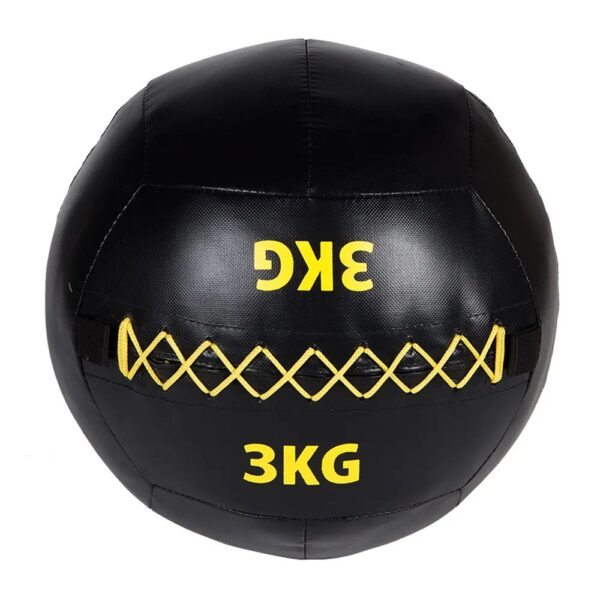
Medicine ball wall ball, from CHF 35.–
- Nylon cover, double stitched
- Sandcore
- 35 cm for all weights
- 3, 4, 6, 9, 12, and 15 kg
The soft, tactile cover is the reason you power through a hundred reps without your fingers giving out. Because the diameter remains the same across all weights, changing the level only changes the mass, not the throwing feel.
Ideal for: Wall balls, overhead throws, and sit-up throws against a solid wall, both in the home gym and in the studio.

Slamball rubber medicine ball, from CHF 8.-
- Rubber case, non-slip
- Filling of sand and air
- 24 to 40 cm depending on weight
- 2 to 60 kg in twelve increments
No bounce means the ball stays where it lands. This makes slams controllable and prevents the ball from bouncing back into your face after you throw it. However, it is not intended for throws against a wall.
Ideal for: Ball slams, rotational floor slams, and heavy carries without a rack and without a free wall.
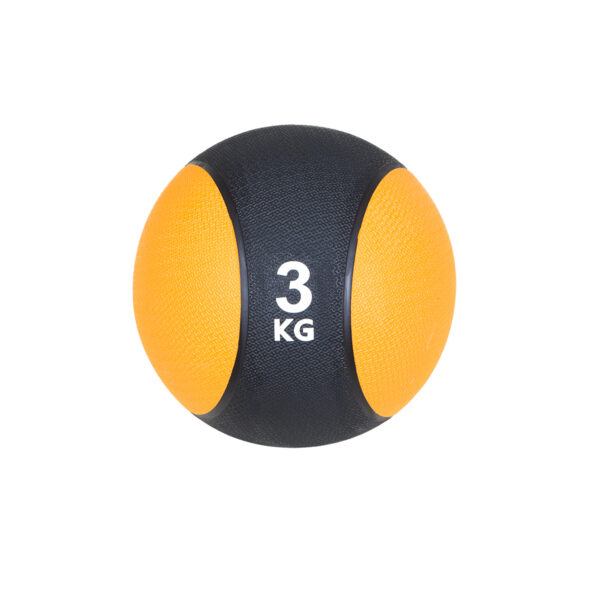
Medicine Ball, starting at CHF 20.00
- Rubber, textured surface
- Sandcore
- 3 kg / 22 cm, 5 kg / 22.5 cm, 8 kg / 28 cm
- Color-coded by weight
The smallest of the three balls. That’s exactly what makes it ideal for exercises where you want to roll the ball rather than throw it: Russian twists, sit-ups with added weight, standing rotations, and partner exercises during rehab.
Ideal for: Core and rotational training, physical therapy, and group classes for participants of varying skill levels.
Weight
What is the correct weight for a wall ball?
To get started, 4 to 6 kg for women and 6 to 9 kg for men are realistic choices. What matters isn’t how much you can lift once, but how much you can still lift cleanly to the target height after twenty repetitions. Wall balls are a strength-endurance exercise, not a maximum strength exercise. If your last throw no longer reaches the target or you can no longer catch the ball securely, it’s too heavy. In CrossFit workouts, 9 kg for men and 6 kg for women are the standard weights; in the HYROX competition format, the weights are 4, 6, or 9 kg depending on the category. One advantage of this ball: All six weights have the same diameter of 35 cm. This means you can switch weight levels without having to adjust to a new throwing sensation. If you’re training alone, it’s better to use a medium weight than two extremes.
| Weight | Diameter | What this level is suitable for |
|---|---|---|
| 3 kg | 35 cm | Introduction, youth training, technical work, and core exercises |
| 4 kg | 35 cm | Beginner Women, High Repetition Counts, Women's Open Competition Weight |
| 6 kg | 35 cm | Beginner Men, Women's CrossFit Target, Men's Open and Women's Pro Competition Weight |
| 9 kg | 35 cm | CrossFit Qualifying Standard for Men, Men's Pro Competition Weight |
| 12 kg | 35 cm | Heavy throws, strength endurance, targeted overweight in training |
| 15 kg | 35 cm | Strength Training, Partner Drills, Gym and Club Operations |
To be honest: If you're buying just one ball and can't decide between two weights, go with the lighter one. A ball that's too heavy will cause you to shorten your squat and throw from your back, and then you'll end up working a different muscle group than you intended. The Wall Ball in Six Weight Levels They're also available as a set of light and heavy weights if you're working out as a pair.
Competition
Which wall balls are used at HYROX?
At HYROX, the ball weight depends on the category, and the target height depends on gender. According to the official Singles Rulebook for the 26/27 season, women in the Open class perform 100 reps with a 4 kg ball at a target height of 2.70 m; women in the Pro class and men in the Open class use a 6 kg ball, while men in the Pro class use a 9 kg ball. Men in both classes throw to a height of 3.00 m. The number of repetitions is 100 in all singles classes. Wall balls are the eighth and final station, so you’ll be approaching the ball with tired legs and a tired grip. When it comes to preparation, this means one thing above all else: Train with the competition weight and at the competition height; otherwise, your throwing rhythm won’t be right on race day. If you’re between two weight classes, it’s better to train with the heavier ball and compete with the lighter one.
| Class (Singles) | Ball weight | Target altitude | Repetitions |
|---|---|---|---|
| Women | 4 kg | 2.70 m | 100 |
| Women Pro | 6 kg | 2.70 m | 100 |
| Men | 6 kg | 3.00 m | 100 |
| Men's Pro | 9 kg | 3.00 m | 100 |
Doubles and Relay: Same balls, shared work
In doubles, the weights are not halved. A pair throws the same ball and completes the same 100 repetitions as an individual competitor; only the work is shared. How you divide it is entirely up to you, but flying handovers are not permitted: the ball either touches the ground or is handed over by hand. For the equipment, this means that a doubles pair needs the exact same ball as an individual competitor.
| Doubles class | Level | Ball weight | Target altitude |
|---|---|---|---|
| Women's doubles | White | 4 kg | 2.70 m |
| Men's Doubles | Gray | 6 kg | 3.00 m |
| Women's Doubles Pro | Gray | 6 kg | 2.70 m |
| Mixed Doubles | Gray | 6 kg | 2.70 m for her, 3.00 m for him |
| Men's Pro Doubles | Black | 9 kg | 3.00 m |
In the relay, four people share the race, and one person takes on all 100 wall balls completely. The other three stand at the station during that time and then cross the finish line together. Ball weight and target height follow the category in which the team is competing. For the sandbag lunges before that, however, you need a different piece of equipment, sensibly a Competition Sand Bag in your weight class.
Target area
Do you need a wall ball target?
A wall ball target is the marked target area that you must hit on every repetition. At home, you do not need a purchased product for this. A strip of tape or a marker at a height of 2.70 or 3.00 meters serves the same purpose, costs nothing, and can be removed without a trace. More important than the target is the wall behind it. It must be able to withstand the impact of a 9 kg ball a hundred times in a row without plaster crumbling or shelves shaking. Drywall, lightweight walls, and anything with installations behind them are therefore ruled out. A solid target is worthwhile where multiple people are throwing at the same time and the target height must be identical for everyone, such as in studios, boxes, and clubs. There, it is less about the marking itself and more about ensuring the wall does not get damaged and the height does not need to be measured before every class.
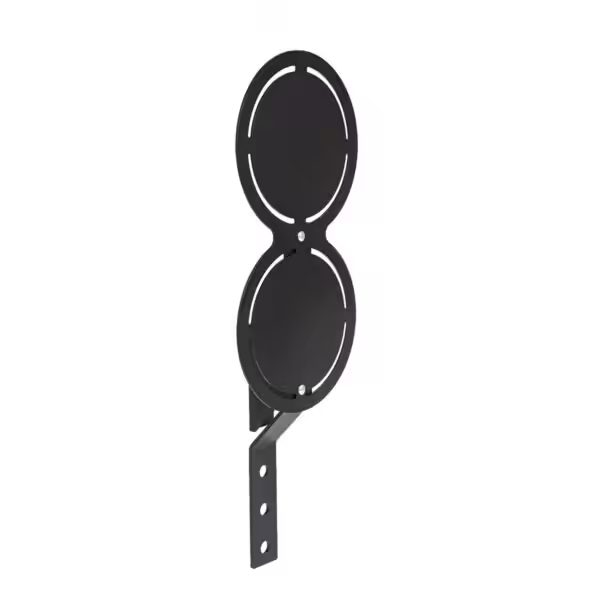
R-SERIES Wall Ball Double Target, CHF 95.-
- Two target altitudes at one station
- Steel, matt black
- Screw set included
- For R-SERIES rigs
The attachment is bolted directly to an existing rig and offers two target heights so that women and men can throw at the same station. It requires a compatible rig and does not work as a standalone part on a free wall.
Ideal for: Boxes and gyms that already have a rig set up and want a fixed, clean target surface.
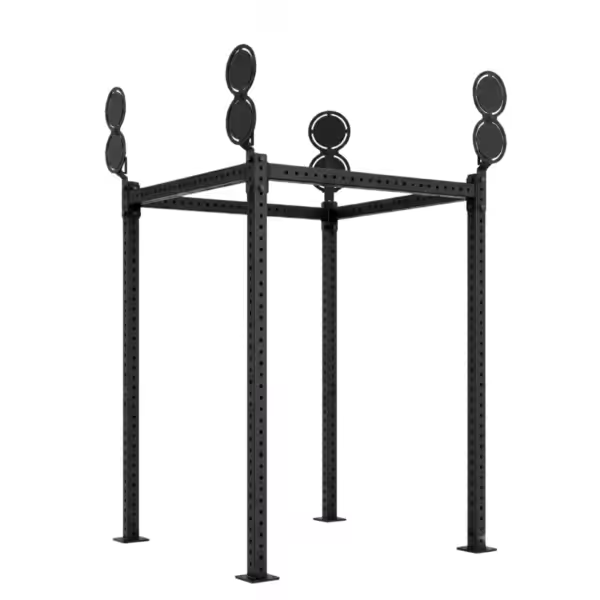
Freestanding Wall Ball Rig, 4 Stations, CHF 990.-
- Four throwing stations
- Double targets included
- Steel, powder-coated
- Intended for ground anchoring
Four people throw simultaneously, completely without wall mounting. That takes up space, but solves the most common problem in studios and conversions: there is no wall that can withstand a hundred throws per person.
Ideal for: Studios, boxes, and training areas without a suitable wall that want to set up a multi-station competition rig.
Both parts belong in the Hybrid assortment, along with sleds, sandbags, and the rest of the equipment for competition formats.
Slamball
How heavy should a slam ball be?
In slamball, the opposite of wall-ball logic applies: here, what matters is what you can explosively accelerate, not what you catch a hundred times. For overhead slams, 6 to 10 kg is a good start for most people, while 4 to 6 kg is enough for pure conditioning sessions with high repetitions. Heavy balls starting at 20 kg belong in strength and strongman training, where they are lifted, carried, and thrown over the shoulder rather than slammed. Unlike the wall ball, the diameter increases with the weight, ranging from 24 cm for the lighter versions to 40 cm for the heaviest ball. Therefore, a heavy slamball is not only heavier, but also noticeably more unwieldy. If you are unsure, go with the lighter option. The stress during a slam comes from acceleration, not from mass.
| Weight | Diameter | Typical application |
|---|---|---|
| 2 kg | 24 cm | Technology, rehabilitation, youth training |
| 4 kg | 24 cm | Conditioning sessions with a high repetition count |
| 6 kg | 24 cm | Introductory slams, circuit training |
| 8 kg | 24 cm | Standard weight for ball slams |
| 10 kg | 24 cm | Explosive Slams, Rotational Throws |
| 12 kg | 27 cm | Power slams, advanced |
| 15 kg | 27 cm | Power slams, partner exercises |
| 20 kg | 30 cm | Transition to Strength and Strongman Training |
| 30 kg | 32 cm | Lifting, carrying, shoulder throws |
| 40 kg | 38 cm | Strongman, Atlas-Stone-like exercises |
| 50 kg | 38 cm | Strongman, studio and club operations |
| 60 kg | 40 cm | Heaviest model, pure power device |
The twelve weight levels for the rubber ball cover two very different applications with it. Everything up to 15 kg is a throwing device, everything above that is a lifting and carrying device. This distinction is more important when purchasing than the pure number.
Home
Slamball or wall ball: which ball for the home gym?
If you have to choose a ball for home, the wall decides. If you have a solid, free wall with enough height, get the wall ball. It covers wall balls, overhead throws, sit-up throws, and partner throws, and it is the only one of the three with which you can properly train for competition and CrossFit standards. If you don't have a suitable wall, but do have a sturdy floor, get the slam ball. Slams are one of the few high-intensity exercises that work without a wall, without a rack, and without overhead clearance. You don't need both at the same time in the beginning. What you do need in both cases is a surface that can handle impact and noise. On laminate, parquet, or a concrete ceiling in an apartment building, the ball will become a problem long before it breaks.
A Connect+ Rubber Floor under the drop zone absorbs part of the impact and, above all, protects the floor underneath. Anyone working out in a rental property should not view this as an accessory, but as a prerequisite. Wall balls and slams are loud, and a rubber floor doesn't make them silent, but it makes a noticeable difference. What thickness your drop zone needs is in the Flooring buying guide, the rest of the conditioning equipment from the jump rope to the battle rope can be found in the Conditioning assortment.
Classification
What is worth it for whom
Beginner in the home gym
A ball, medium weight, firm wall. Women start with 4 or 6 kg, men with 6 or 9 kg. The wall ball is the more versatile choice here because, in addition to wall balls, it also covers core exercises and partner tosses. Better to buy one ball and a proper floor than two balls and no floor.
Who trains for a competition format like HYROX
Train with the ball weight of your category and mark the target height precisely. A second, heavier ball for overweight sessions helps, but is optional. What is more important is that you practice the hundred repetitions in a fatigued state, not rested at the beginning of the session.
Rental apartment without load-bearing wall
Wall Balls bounce away realistically here. A light slam ball from 6 to 10 kg plus rubber flooring gives you the greater part of the training effect without risking plaster or the neighbors. For core work, a small one is also enough Medicine ball in 3, 5 or 8 kg.
Gym, club or boxing gym
What matters here is that several people throw at the same time and at the identical height. Several weight classes in stock, fixed target areas and a freestanding four-person wall ball station resolve this permanently if no suitable wall is available.
Frequently Asked Questions
Frequently asked questions about wall balls, slam balls, and medicine balls
What is the difference between Wall Ball and Slamball?
A wall ball has a soft nylon shell and a diameter of 35 cm and is built for throwing and catching against the wall. A slam ball has a hard rubber shell, is smaller, and does not bounce back upon impact. It is made for throwing on the ground, not against the wall.
What is the weight of the wall ball at HYROX?
According to the season 26/27 singles rulebook, women open throw 4 kg, women pro and men open 6 kg, and men pro 9 kg, 100 repetitions each. In doubles, the same weights apply as in singles, and in the relay, the values of the category in which the team competes.
What is the height of the wall ball target?
The target height is 2.70 m for women and 3.00 m for men, in both the open and pro classes. At home, a marking at this height is sufficient. A purchased target is especially worthwhile where multiple people are throwing at different heights at the same station.
Are the weights halved in doubles?
No. A doubles pair throws the same ball and completes the same 100 repetitions as a singles competitor, only the work is shared. So you need the exact same equipment. A flying change is not allowed, the ball hits the ground or is handed over by hand.
Can I throw a slam ball against the wall?
Better not. The slamball is hard, compact, and without a cushioning shell. It puts significantly more stress on the wall than a wall ball and is harder to catch. For throws against the wall, the soft wall ball with a 35 cm diameter is the right choice.
How heavy should a slam ball be?
For ball slams, 6 to 10 kg is a good start for most people; 4 to 6 kg is enough for high repetitions. Starting at 20 kg, the ball becomes a lifting and carrying device rather than a throwing tool. When in doubt, choose the lighter option, as the strain comes from acceleration.
Do all wall balls have the same diameter?
For our wall ball, yes: All weights from 3 to 15 kg measure 35 cm. The throwing and catching feel remains the same across all levels, only the mass changes. With the slam ball it is different, there the diameter grows from 24 cm up to 40 cm with the weight.
Is a medicine ball the same as a wall ball?
No. A wall ball is a type of medicine ball, but not every medicine ball is a wall ball. The classic medicine ball is smaller, has a diameter of 22 to 28 cm, and is suitable for rotation, core work, and rehab. It is too small for throws against the wall.
The next step
Once you know which movement you want to train, the choice is quickly made: wall and catching means wall ball, floor and force means slam ball.
Trademark notice
HYROX is a registered trademark of HYROX World GmbH, Hamburg. We use the name in this article solely for descriptive purposes to indicate the ball weights and target heights you’ll use to prepare for this competition format. There is no licensing, partnership, or other business relationship between Fitcom AG or Fitness Flohmarkt and HYROX World GmbH. The balls, targets, and rigs shown here are Fitcom AG’s own products and are neither manufactured, tested, nor certified by HYROX. The weights, target heights, and repetition counts listed reflect the publicly published versions of the Singles, Doubles, and Relay rulebooks for the 26/27 season. Only the current information on hyrox.com is binding.