


Fitness Flohmarkt · Guide
Dumbbell exercises: the full-body workout in six movements
Two Compact dumbbells allow many exercises for your legs and upper body. This guide combines six into an adaptable full-body routine, with image sequences, exercise order and a simple progression scheme. Allow room for the bench, movement paths and a clear carrying route as well as the dumbbells.
Learn Bulgarian split squats: rear-foot support, distance and controlled technique
In short
Goblet squats, Romanian deadlifts, bench presses, single-arm rows, shoulder presses and farmer’s walks combine squatting, hip hinging, pushing, pulling and carrying. The three sets in the table are an example, not a requirement for everyone. Adapt volume, load and exercise selection to your experience and goal.
The selection
Which dumbbell exercises cover the whole body?
These six exercises are an example of a full-body routine. The goblet squat bends your knees and hips, the Romanian deadlift emphasises hip extension, bench and shoulder presses push horizontally and overhead, rows pull, and farmer’s walks carry. Biceps and triceps assist pulling and pushing. Additional exercises may suit your goal. Bench presses and supported rows need a suitable bench or a deliberately chosen alternative. For dumbbell designs, see the Buying guide for adjustable dumbbells.
Dumbbell biceps curls: learn the rotating and hammer grips
Learn renegade rows with stable dumbbells
| Exercise | Movement pattern | Primarily trains | Dumbbells | Bank required |
|---|---|---|---|---|
| Goblet Squat | Squats | Thighs, buttocks, torso | 1 | no |
| Romanian deadlift | Hip extension | Back of the legs, buttocks, lower back | 2 | no |
| Dumbbell bench press | Press horizontally | Chest, anterior shoulder, triceps | 2 | yes; floor press as an alternative |
| One-arm dumbbell row | Pull horizontally | Upper and middle back, biceps | 1 | Bench or outrigger |
| Shoulder press | overhead press | Shoulders, triceps, core | 2 | no, standing |
| Farmer’s Walk | Wear | Grip strength, core, neck | 2 | no |
Technique
The six exercises in image sequences
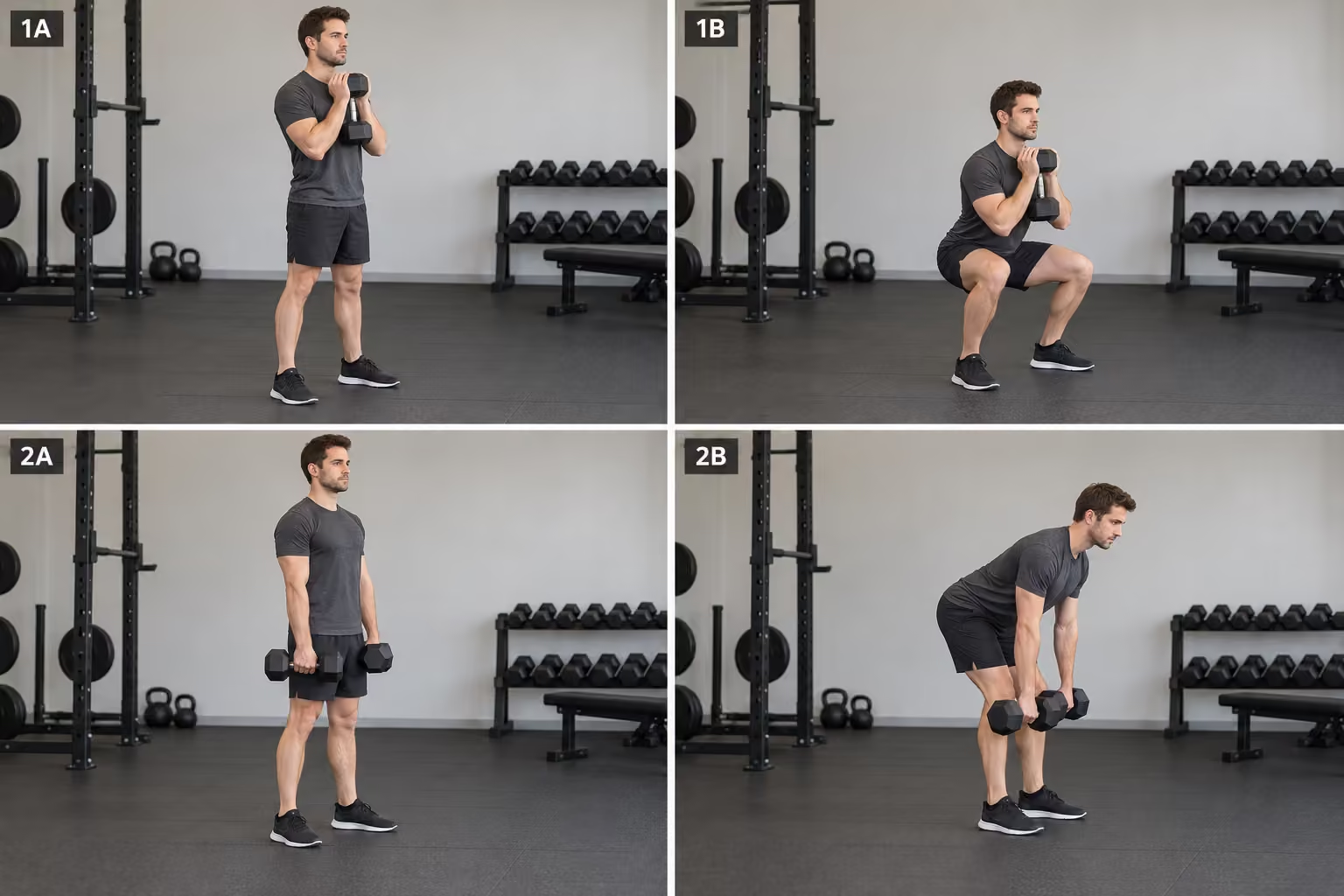
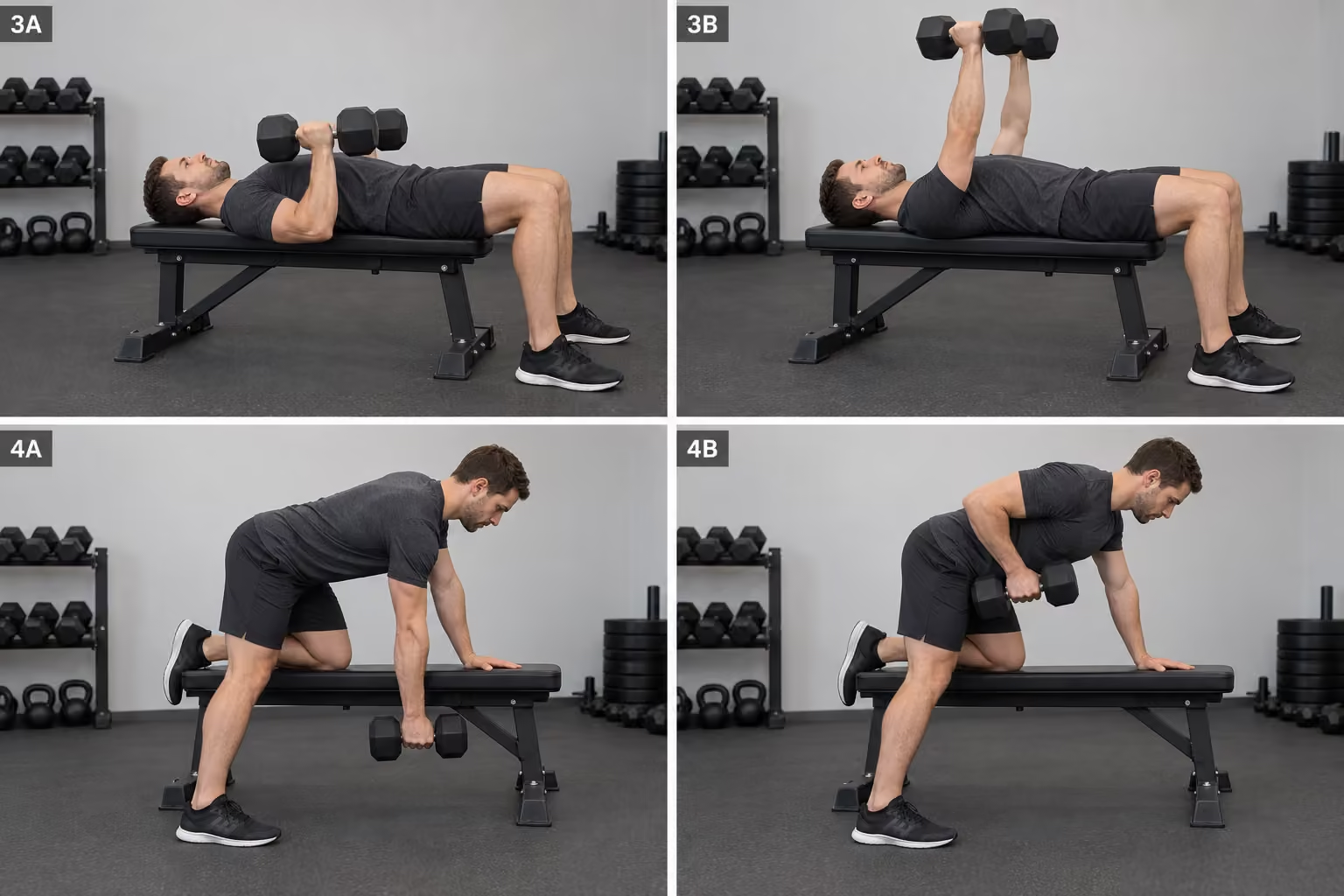
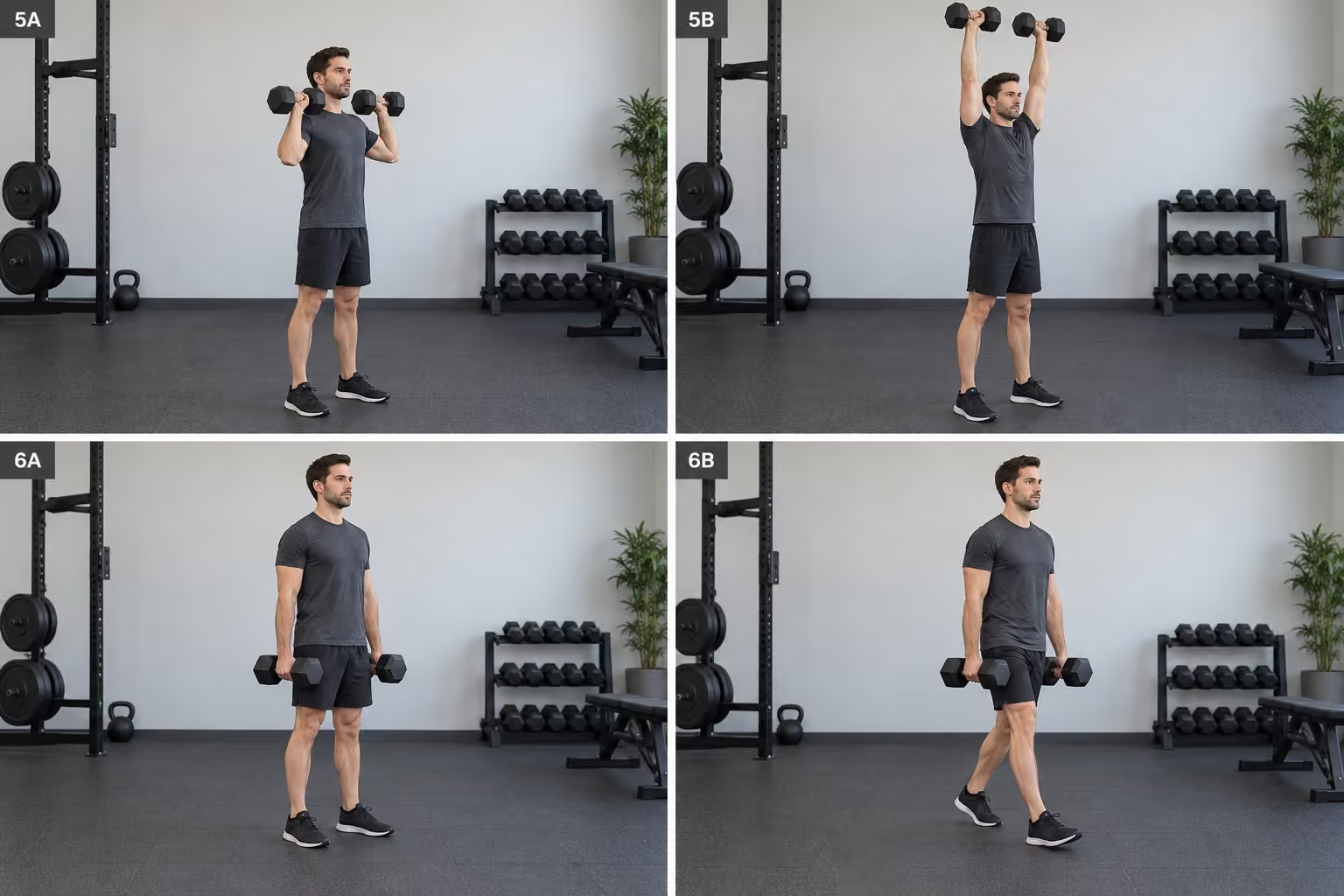
The AI-generated image sequences show two positions per exercise. The notes below explain the movement. Use a range you can control; stop the exercise if it causes pain.
1 · Goblet squat
1A: Hold one dumbbell close to your chest with a stable stance. 1B: Bend your knees and hips under control, keeping your feet loaded. Lower only as far as you can maintain posture and balance, then stand up again.
2 · Romanian deadlift
2A: Stand with two dumbbells in front of your thighs. 2B: Push your hips back, keep a slight knee bend and guide the dumbbells close to your legs. Return before losing your back position; reaching the floor is not required.
Dumbbell Romanian deadlift: learn the hinge, weight path and range
3 · Dumbbell bench press
3A: Lie securely on the bench, feet on the floor, dumbbells beside your chest and forearms roughly vertical. 3B: Press up under control, then lower again. Choose a depth that keeps your shoulder position stable.
4 · Single-arm row
4A: Support one hand and knee securely on the bench, with the free hand holding the dumbbell below your shoulder. 4B: Draw your elbow back alongside your torso. Lower under control without rotating your upper body, then switch sides.
Single-arm dumbbell row: bench support, pulling path and mistakes in detail
5 · Shoulder press
5A: Start with the dumbbells at shoulder height and a stable torso. 5B: Press overhead without compensating with a pronounced back arch. Lower under control; adapt load and range to your shoulder mobility.
Dumbbell shoulder press: seated setup, standing position and pressing path in detail
6 · Farmer’s walk
6A: Pick up one dumbbell in each hand under control and stand tall. 6B: Walk with steady steps along a clear route. Keep the loads beside your body and finish before grip or posture deteriorates.
The order
In what order do you train the six exercises?
The table starts with goblet squats and Romanian deadlifts, followed by bench presses, rows, shoulder presses and farmer’s walks. This is one possible order. Move an exercise earlier if it is a priority or its technique still needs considerable concentration. For later shoulder presses, choose a load you can control despite the earlier work. Farmer’s walks come last here so tired hands do not limit your rows. Bench presses and supported rows suit a suitable weight bench; without a bench, choose floor presses and a suitable supported row variation.
Learn the dumbbell floor press
| Position | Exercise | Sets and repetitions | Why here |
|---|---|---|---|
| 1 | Goblet Squat | 3 x 8 to 12 | Squats at the start of the example routine |
| 2 | Romanian deadlift | 3 x 8 to 12 | Add hip extension |
| 3 | Dumbbell bench press | 3 x 8 to 12 | Horizontal pushing |
| 4 | One-arm dumbbell row | 3 x 8 to 12 per side | Upper-body pulling |
| 5 | Shoulder press | 3 x 10 to 15 | Choose load in light of the preceding work |
| 6 | Farmer’s Walk | 3 x 30 to 40 meters | Carrying after pulling exercises |
Count both sides for single-arm rows: three sets for each table row produce 21 individual work bouts. An example of 40 seconds of work and 90 seconds of rest per bout gives about 45.5 minutes. Warm-up, side changes and adjustments come on top. Actual duration depends on pace, rest and volume. Start with fewer sets if needed and rest enough to control the next one.
The sources of error
Which mistakes cost you the most during dumbbell exercises?
A common mistake is using a range you can no longer control under load: letting the shoulder roll forward during bench presses or jerking your torso up during rows. Choose load and range to keep your position stable. For single-arm exercises, you can start with the weaker side and match repetitions on both sides. Set every dumbbell down under control. A rubber coating does not authorise dropping it; follow product and flooring instructions even for fixed dumbbells. A suitable Dumbbell rack makes storage easier.
| Exercise | What you pay attention to | What typically goes wrong |
|---|---|---|
| Goblet Squat | Dumbbell close to the sternum, heels on the floor | Upper body tilts forward, heels lift off |
| Romanian deadlift | Dumbbells along the legs, knees only slightly bent | Rounded back, dumbbells drifting forward |
| Dumbbell bench press | Shoulder blades back and down, elbows around 45 degrees | Lowered too much, shoulder rolling forward |
| One-arm dumbbell row | Draw your elbow back; keep your torso still | Torso rotation, pulling only with the arm |
| Shoulder press | Keep ribs down, stop dumbbells above shoulders | swayback as a compensatory movement |
| Farmer’s Walk | Walk upright, do not shrug your shoulders | Unsteady steps, leaning torso or opening grip |
The progression
How do you progress when the exercises get easier?
Increase repetitions first, then weight: work up through your chosen range while maintaining control. Once you repeatedly reach the upper end in all planned sets with some reserve, test the next suitable load. You do not have to increase every week. A large jump may be too much; keep the current weight or use finer increments. For designs and increments, see the adjustable dumbbell comparison.
| Step | What to look for | Next session |
|---|---|---|
| 1 · Repetitions | The chosen load remains controllable | Add individual repetitions within the range |
| 2 · Weight | Repeatedly reaching the upper end in every set, with reserve | Test the smallest suitable load increment |
| 3 · Recheck | You can maintain the movement and lower end of the range | Keep the new load; otherwise continue with the previous weight |
For farmer’s walks, first increase the planned distance or time while maintaining posture, then increase load if needed. Change one variable at a time so you can assess its effect.
Being honest pays off in one area: With goblet squats and deadlifts, at some point the bottleneck isn't leg strength, but rather your grip and the question of how you even get the load into position. Anyone who wants to seriously train heavy there will get further with a barbell and rack than with even bigger dumbbells. That is not a weakness of the program, but rather its limit.
The equipment
What you train that with
The illustrated variations need two dumbbells, a stable bench and clear movement space. If storage is limited, you can choose the adjustable dumbbell 24 kg with twist handle at CHF 125.- each, with 15 settings from 2.5 to 24 kg, adjusted in the cradle. Fixed Hex dumbbells from 1 to 60 kg avoid adjustment steps, but multiple weights need more storage. The 40 kg version with 17 settings starts at 5 kg. Check the starting weight, highest load and increments for each exercise.
Recommendation by situation
What is worth it for whom
You start in the living room
Allow a clear area for movement and a suitable carrying route. You can replace bench presses with floor presses; rows need stable support or a suitable variation. Choose the right starting dumbbell weight for each exercise.
You want to train with a bench
A stable bench enables the illustrated bench press and supported row variations. Check stability, support area, stated capacity and room to get on and off. The Weight Bench Category shows the selection.
You are training as a pair
Two people using different working weights may need additional dumbbells. For suitable pairs and settings, see the guide to building a dumbbell set. Base the quantity on your exercises.
Frequently Asked Questions
Dumbbell Exercises: The Most Important Answers
Which dumbbell exercises can you do at home without a bench?
Goblet squats, Romanian deadlifts, standing shoulder presses and farmer’s walks need no bench. Carrying still requires a clear route. Replace bench presses with floor presses; for rows, choose stable support or a variation you can control.
Are the dumbbell exercises available as a PDF?
You can save this page as a PDF using your browser’s print function. The exercise-order table contains sets and repetitions; the image sequences and progression scheme complete the instructions. After later changes, you need to generate a new saved PDF.
How many exercises should a full-body dumbbell workout include?
The six exercises here are an example. How many you need depends on your goal, experience, weekly plan and available volume. Additional calf or arm work may be useful; a shorter session is not automatically ineffective.
Do I need two dumbbells for every dumbbell exercise?
Goblet squats and single-arm rows use one dumbbell each in this plan. The illustrated deadlift, bench press, shoulder press and farmer’s walk variations use two. Check the selling unit: a unit price is not a pair price.
How long does a full-body workout with dumbbells take?
It depends on sets, pace and rest. Three sets per exercise, including both rowing sides, produce 21 individual work bouts. An example of 40 seconds of work and 90 seconds of rest gives about 45.5 minutes, plus warm-up and adjustments. Fewer sets shorten the session.
Two dumbbells, six exercises, your routine
Compare dumbbells by design, weight settings and selling unit. Check each product for its current price and availability.
Buy dumbbells