


Fitness Flohmarkt · Guide
T-Bar Row: Machine, Landmine, or Corner?
Three ways lead to the same train movement, and between the cheapest and the most expensive there is a difference of over 500 francs. Which one suits your room, your windows, and your budget is explained in this guide, complementing the Buying guide for rigs and racks.
In short
For most home gyms, the landmine is the right choice: a mount starting at CHF 45 plus a rowing handle turns your existing barbell into a T-bar row. A dedicated machine for CHF 590 is worth it if the station can remain in place and multiple people train on it daily. The bare corner is a temporary solution.
Basics
What is a T-bar row?
In the T-bar row, one end of the barbell is anchored to the floor, and the other end holds the plates. You stand over the bar, grip it just in front of the plates, and pull it in a semicircle toward your abdomen. Because one end is fixed, some of the balancing work is eliminated, allowing you to pull heavier than with free rowing. It trains the entire upper back: latissimus, trapezius, rhomboids, and rear deltoids, plus the biceps and forearms as helpers. Exactly in this anchorage lies the difference to barbell rowing, which gets along without a fixed pivot point. For the setup, there are three ways that differ greatly in price and space requirements: a dedicated machine from the category Plate Loaded, a landmine attachment for your existing barbell or the bare corner of a room. All three produce the same movement, but they differ in price, footprint, and how much weight you can safely load in the end.
In English catalogs, the fixed machine is listed as a T-bar row machine, while in our product range it is called a rowing machine. Both refer to the same station with a fixed pivot point and attachable handles.
The comparison
Device, landmine, or corner: what fits in your gym?
The decision depends on three figures: space, weight capacity, and the diameter of your weight plates. A dedicated machine is permanent, ready for immediate use, and offers the most grip positions, but costs CHF 590.- and occupies a fixed area. A landmine attachment ranges between CHF 45.- and CHF 59.-, uses the barbell and plates you already have, and can be stowed away. The corner without an attachment costs nothing, but does not guide the barbell: it slips sideways, scuffs the wall, and limits you on weight. For most home gyms, the landmine is therefore the best compromise, while for studios and clubs, it is the machine. Anyone wanting to first find out whether the exercise even fits into their routine starts with a slip-on rowing handle and upgrades later. The table compares the four approaches using values from the current product range.
| Away | Costs | Space requirement | resilience | Panels | Goes well with |
|---|---|---|---|---|---|
| Own equipment (ATX T-Bar Row) | CHF 590.- | 181 x 78 cm, firm | 300 kg | 30 mm standard | studio, club, daily use |
| Landmine (T-Bar) | CHF 59.- | 35 x 35 cm, removable | 200 kg | 50 mm | Home gym without rack |
| Landmine for Rack (R-SERIES Attachment) | CHF 45.00 | no additional area | No manufacturer's information | 50 mm, hole 51 mm | Anyone who already has a rack or rig |
| Landmine handle | CHF 29.00 | Corner plus pole length | bounded by wall and floor | 50 mm | Interim solution for a few weeks |
Calculate the combination with: Mount and handle together cost CHF 88 on the floor and CHF 74 on the rack. Both remain well below the price of the equipment, but assume that a 50 mm bar including plates is already there.
The device
When is it worth getting your own T-bar row machine?
It's worth having your own device if the station can remain in place and multiple people will use it. The ATX T-Bar Row measures 181 x 78 x 55 cm and therefore permanently occupies 1.41 m² of floor space. The landmine attachment comes in at 0.35 x 0.35 m, or 0.12 m². The unit therefore requires a good eleven times as much area, and in return you get a double ball-bearing lever guide, ten adjustable grip widths, a knurled foot platform, and five support feet to prevent tipping. The station can support up to 300 kg, is certified according to EN 957, and is therefore approved for studio use. One thing to check before ordering: the loading pin is designed as standard for plates with a 30 mm inner diameter and is 36 cm long. If your gym runs on 50 mm plates, check beforehand whether your plates will fit on it. Otherwise, you will buy a station that does not match your remaining equipment.
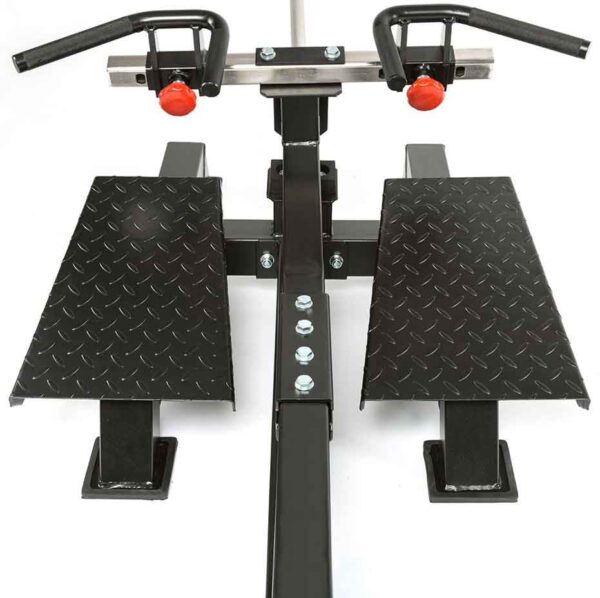
ATX T-Bar Row | Rowing machine
- CHF 590.-
- 181 x 78 x 55 cm
- Max. load 300 kg
- 30 mm diameter, 36 cm long
- Ten grip widths
- EN 957
The dual ball-bearing guide makes the pull smooth, the ribbed platform maintains footing even during heavy sets. Five support feet distribute the load, and nothing needs to be bolted down.
Ideal for: Studios, club weight rooms, and home gyms where the floor space remains permanently clear.
To the rowing machineThe landmine
Landmine: which recording do you need?
The recording decides where you row and how much you are allowed to put on. The Landmine T-Bar is a 35 x 35 x 35 cm steel body with a firmly welded carry handle: you place it in the corner or in the middle of the room, insert the 50 mm bar, and get started. It is rated for up to 200 kg, and because it takes up only 0.12 m², it disappears behind the door after training. Anyone who already has a rack or rig doesn't need it: The R-SERIES Landmine Attachment weighs 3.5 kg, has a 51 mm hole for Olympic bars, and is placed directly into the grid pattern, along with the rest Rack accessories. It doesn't take up any extra space, and you set the pivot point yourself to the height that matches your pulling angle. Both variants share the same advantage: you are rowing with the barbell and plates that are already in the room anyway.
If the bar is still missing, you need one with a 50 mm plate sleeve. In our range, the selection spans from the 153 cm short compact bar to the Olympic version, as seen under 50 mm barbell bars. Shorter shafts require less swing room, longer ones give you more loading space in front of the grip.
Landmine training with four full-body exercises

Landmine T-Bar | barbell holder
- CHF 59.-
- 35 x 35 x 35 cm
- For 50 mm bars
- Max. load 200 kg
- Steel, powder-coated
No rack, no drilling, no fixed location. The welded handle turns repositioning into a one-handed operation, and the mount stands just as stably in the corner as it does in the middle of the room.
Ideal for: Home gyms without a rack and rooms that double as living spaces again after the workout.
For landmine clearance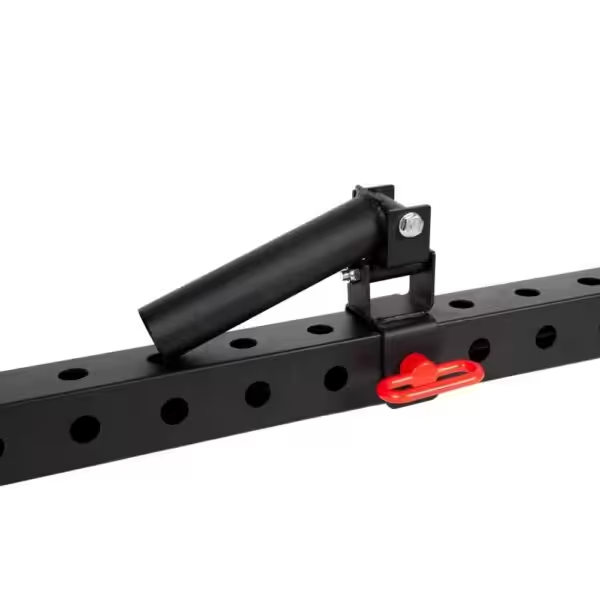
R-SERIES Landmine Attachment
- CHF 45.00
- 10 x 10 cm, 3.5 kg
- 51 mm hole
- Height selectable in the grid
- Steel, powder-coated
Fits every R-SERIES rack and rig. Because the mounting point is located in the perforated grid, you determine the height of the pivot point and the angle of the pull yourself.
Ideal for: all those who already have a rack or rig set up and do not want to sacrifice any additional floor space.
To the rack attachmentThe handles
Which T-bar row handle is right for you?
The grip determines which part of the back does the main work. A narrow, parallel grip keeps the elbows close to the body and targets the latissimus and lower trapezius fibers. A wide grip turns the elbows outward and hits the rear deltoids and upper back harder. You will start most favorably with the Landmine Landmine for CHF 29.--: 50 cm wide, with a slightly pronated hand position that relieves strain on the wrist. Anyone who does heavy work reaches for the ATX Parallel Rowing Handle with a 28 mm grip thickness and a load rating of up to 400 kg, the highest value in this selection. All handles fit onto bars with 50 mm weight sleeves, and you don't need any tools. Because they can be swapped in seconds, you can perform narrow and wide sets in the same workout, thereby covering your entire upper back without needing a second machine.
| rowing handle | Grip | Width | Weight | resilience | Price |
|---|---|---|---|---|---|
| Landmine Landmine | tight, slightly pronated | 50 cm | not specified | not specified | CHF 29.00 |
| ATX Single-Hand Rowing Handle | one-armed | 7.5 cm | 2.6 kg | 300 kg | CHF 49.00 |
| ATX Parallel Rowing Handle | parallel | 28 cm | 4.8 kg | 400 kg | CHF 95.- |
| ATX wide row handle | wide, pronated | 95 cm | 7 kg | 300 kg | CHF 99.- |
Consider the chain: The weakest value in the assembly applies. A handle rated up to 400 kg is of little use if the floor attachment beneath it is only rated for 200 kg.

Landmine Grip | T-Bar Row Grip
- CHF 29.00
- 50 cm wide, 60 cm deep
- For 50 mm bars
- Slightly pronated hand position
- Steel, powder-coated
The fastest way to the T-bar row, when the bar and plates are already there. The slightly rotated hand position takes pressure off the wrist without changing the grip width.
Ideal for: the entry-level option and everyone who wants to try out first whether the movement fits into their program.
To the landmine handle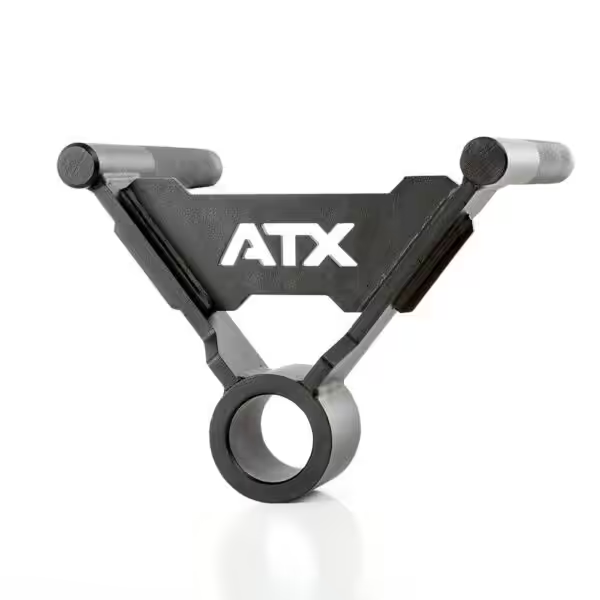
ATX Parallel Rowing Handle | T-Bar Row
- CHF 95.-
- 23 x 28 x 21 cm, 4.8 kg
- Grip thickness 28 mm
- Max. load 400 kg
- EN 20957
Narrow parallel grip with knurled surface. The 400 kg weight rating and dead weight of 4.8 kg show what the grip is built for: heavy pulling without any play in the material.
Ideal for: Advanced users, clubs, and studios with high frequency and heavy sets.
To the parallel gripThe corner
What you need to watch out for when doing corner row
Rowing in the bare corner works, but it has three catches. First, the end of the bar slips sideways when pulling as soon as the floor is smooth. A folded towel or a piece of rubber mat underneath helps, but it is no substitute for a fixation. Second, the bar works against the wall: in plaster corners, a visible notch remains after a few weeks, while in concrete corners, the bar suffers instead. Third, the guidance is missing; you stabilize the end yourself and therefore load less than you actually could. For the first few weeks, this is fine. As soon as you row regularly, the attachment for CHF 59.- is the purchase that will be felt the fastest. And if your lower back caves in during heavy pulls instead of staying straight, a look in the Guide to hyperextension in addition, because then there is a lack of strength in the posterior chain.
Recommendation
What is worth it for whom
Home gym without rack
Barbell and plates are here, a rack is not. Then the freestanding floor mount the most direct route. It stands without assembly, holds up to 200 kg and can be carried away after use.
The rack or rig is already set up
Then you don't need a second surface. The attachment for the perforated grid costs CHF 45, weighs 3.5 kg, and turns the existing rack into a rowing station.
Studio, club, physiotherapy practice
For changing users, adjustability and stability are what count. The fixed rowing machine with ten grip widths is built for this, certified according to EN 957, and can withstand loads of up to 300 kg.
Wide pull for the upper back
Anyone who specifically targets the rear delts and traps complements the wide rowing handle with a 95 cm span. It fits on the same bar as the close grip, so you are just changing the attachment.
Frequently Asked Questions
T-Bar Row: The most important answers
What are the benefits of the T-bar row?
It builds width and thickness in the upper back because the fixed end of the bar takes over part of the balancing work and you can concentrate on the pull. This allows for higher loads than with free rowing variations. In addition, you can vary the grip width and thus the stimulus using attachable handles without changing the exercise.
Which muscles does the T-bar row work?
Mainly the latissimus, trapezius, rhomboids, and rear deltoids. Biceps and forearms assist as helpers, while the core and glutes maintain the bent-over position. How the load is distributed depends on the grip: narrow and parallel emphasizes the latissimus, while wide shifts the work to the upper back and rear shoulders.
Do I need a landmine attachment for the T-bar row?
It is not mandatory, but it makes sense. Without a mount, you wedge the end of the bar into a room corner, where it can slip and damage the wall. A floor mount for CHF 59.– or a rack attachment for CHF 45.– gives the bar a real pivot point. Both fit bars with a 50 mm plate sleeve.
Which grip is suitable for the T-bar row?
For starters, a narrow, slightly pronated grip starting from CHF 29.– because it relieves strain on the wrist and targets the latissimus well. For heavy sets, a solid parallel grip with a 28 mm thickness and rated for up to 400 kg. A wide grip with a 95 cm span is the addition when the upper back needs more stimulation.
Do 50 mm weight plates fit on a T-bar row machine?
That depends on the device. The ATX T-bar row comes standard with a weight horn for plates with a 30 mm inner diameter and a length of 36 cm. Anyone who runs a gym with Olympic 50 mm plates should clarify this before ordering. Landmine attachments bypass the issue because your own 50 mm barbell goes there.
How much does a T-bar row cost?
The entry point via a clip-on rowing handle starts at CHF 29.- if the bar and plates are available. With a floor attachment it is CHF 88.-, on the rack CHF 74.-. A dedicated rowing machine costs CHF 590.-. Prices as of August 2026; you can find the current value on the respective product page.
Is a used studio equipment worth it?
Anyone looking for studio models, such as from Gym80, will find used rowing and pulling machines in the second-hand section of our plate-loaded category. Before buying, you should check three things: the condition of the bearings, the diameter of the weight horn, and the footprint in relation to your space. Studio equipment is heavy and rarely moves alone.
Build your setup
Landmine attachments, rowing handles, and fixed rowing machines are in one category with us, sortable by price and available from a Swiss warehouse.
Regarding the plate-loaded machines