




Fitness Flohmarkt · Guide
Multi-gym or individual machines: what really belongs in the home gym?
A station for everything or multiple devices side by side: The decision is not made based on the training plan, but on floor space, ceiling height, and budget. Here are the figures that make the difference, and in Buying guide for rigs and racks then the designs in detail.
In short
A multi-gym bundles several guided exercises at a weight stack, while single-station machines each cover one movement. For the home gym, the combination of rack, bench, and free weights almost always wins: more exercises in less space and a lower entry price. A true multi-gym is worth it where multiple people want to train with guided support at the same time.
The terms
What is a multi-gym and what are single-station machines?
A multi-gym is a device that combines several guided exercises on a common weight stack, typically lat pulldown, rowing, pressing, and butterfly. You move a pin and switch exercises without loading plates. Single-station machines go the opposite route: each machine does one movement, but with gym geometry and its own weight stack. In between is the third type, which is the most frequently chosen for the home gym, namely the rack with free weights. It does not guide the movement, but secures it. In the product range, you will even find this distinction reflected in the filters: racks are listed there as a separate type of multi-gym, while guided machines are under Plug-in weights. Anyone looking for a home gym therefore means three very different things depending on their idea: a compact home unit with a small weight stack, a studio station with multiple stacks, or simply a rack on which everything hangs. The table below sorts the designs by how much space they take up and what they can do.
| Type | Resistance | Scope of exercises | Typical footprint | Shop entrance |
|---|---|---|---|---|
| Free weight rack | Weight plates | very wide, unguided | 1.76 to 2.02 m² | CHF 295.- |
| Rack with cable pulley | Weight plates plus cable machine | broad, partly guided | around 2 m² | CHF 2,490.- |
| Cable pulley station | Stack weight 90 kg | guided pulling exercises | 1.39 m² | CHF 1,990.00 |
| Multi-Jungle-Station | five weight blocks | very broad, guided | about 15 m² | Project business |
| Single machine | custom weight block | a movement | 2 to 4 m² per device | from the second-hand inventory |
The core decision
Why the rack usually wins in the home gym
For the home gym, a rack with a bench and free weights beats the classic multi-gym in almost every category that matters at home. A rack covers squats, bench presses, overhead presses, rows, deadlifts, and pull-ups—precisely the exercises that build strength. A home multi-gym, on the other hand, guides you through a fixed range of movements, and the weight stack has an upper limit that you will reach after one to two years. With a rack, the resistance continues to grow with every weight plate. Added to that is the difference in entry-level price. The R-SERIES Power Rack costs CHF 490.-, holds 500 kg and comes with safety bars that catch a failed repetition. It is usefully complemented by an adjustable bench from the Weight Bench Category and a basic set of weight plates. With that, you cover more exercises than with any home gym and retain the option to expand the setup year after year instead of having to replace it at some point.
The honest opposite: Anyone who does not want to work with a barbell or who trains with guided resistance on purpose after an injury will not get much joy out of free weights. In that case, a guided machine is the better choice, or you go the route of adjustable dumbbells, like the one Buying guide for adjustable dumbbells describes.
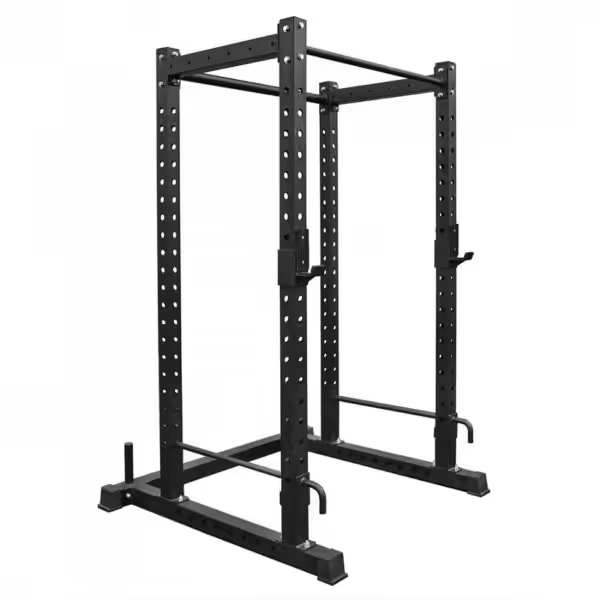
R-SERIES Power Rack
- 500 kg load capacity
- 152 × 133 × 214 cm
- 90 kg net weight
- Perforated grid 26 mm
- CHF 490.-
Four posts, adjustable safety bars, J-hooks, and a pull-up bar are included in the delivery. The barbell and plates come separately. Minimum ceiling height 215 cm, plus clearance above the bar if you want to do pull-ups.
Ideal for: all those who train hard and heavy with the barbell on a regular basis while being all alone in the basement.
View power rackSpace and Statics
How much space does a multi-gym really need?
Space requirements are the point where most home gym plans fail, and they can be calculated in advance. A power rack measuring 152 cm wide and 133 cm deep occupies 2.02 m² of floor space. The entry-level model measuring 143 by 123 cm comes to 1.76 m². A multi-gym with five weight stacks, on the other hand, measures 470 by 322 cm, which is 15.1 m², and thus requires around seven and a half times the area of a power rack. In both cases, there is also the clearance space all around, for a rack at least 2 by 2 m in total. The second figure that is often forgotten: the height. The Home Rack Essential is 210 cm high, the power rack 214 cm. Measure your basement ceiling before you order, and add 30 to 40 cm of clearance above the pull-up bar for pull-ups, depending on your height. All measurements are on the product pages in the Rack category.
And the floor load: A cable machine weighing 217 kg stands on an area of 132 by 105 cm, which is 1.39 m². That comes out to around 156 kg per square meter before you even add a single dumbbell. In a basement with a concrete floor, that's not an issue; with a wooden beam ceiling in the attic, you should have it checked beforehand.

Home Rack Essential
- supports up to 300 kg
- 143 × 123 × 210 cm
- 1.76 m² floor space
- no ground anchorage
- CHF 295.-
Entry-level model with pull-up bar and barbell rests up to 300 kg. Stands freely in the room, without bolting. Designed for bodyweight exercises and regular strength training, not for maximum lift attempts in the triple-digit range.
Ideal for: deep cellar rooms and anyone moving from the multi-gym concept to a rack on a small budget.
View Home RackPrice and finish
How much does a multi-gym cost compared to individual equipment?
Getting started with a rack setup begins at CHF 295.-, a combination of a rack and an integrated cable pulley is CHF 2,490.-, a studio-quality cable tower is CHF 1,990.-, and guided single-station machines with their own weight stack are in the four-figure range per device. However, the crucial difference is not the starting price, but what happens afterwards. A multi-gym is finished upon purchase, whereas a rack grows with you. Via the 26 mm hole pattern, dip bars, a landmine, or a Single-pulley cable machine for CHF 165.- in addition, if the training requires it, and not already with the first purchase. Anyone who wants the cable machine without a weight stack will find a third option in a motorized device; how that works is explained in the Buying guide for the digital cable machine. With a home gym, on the other hand, you pay for all the functions upfront, even the ones you will never use, and afterwards you can neither deselect them nor add to them.
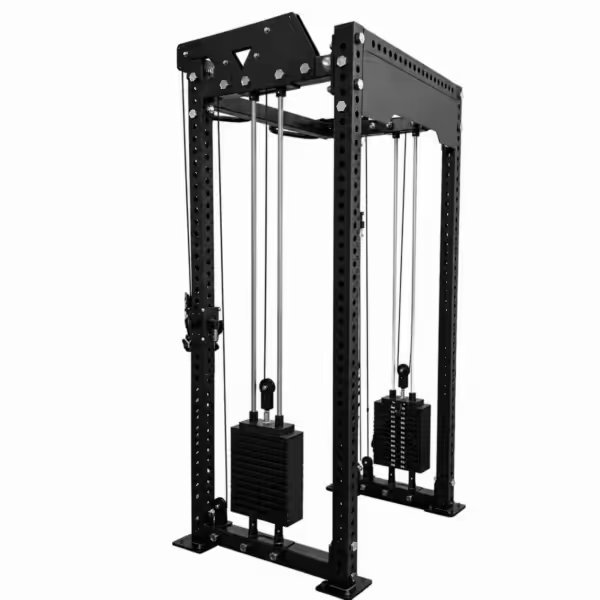
Multi Power Rack & Cable Pulley
- Rack plus cable pulley
- height-adjustable pulleys
- free barbell exercises
- Assembly on request
- CHF 2,490.-
The training station for anyone who can't decide between free weights and cable exercises. Squats, bench press, and shoulder press in the rack, lat pulldown, rowing, and triceps on the integrated cable pull, all on a single footprint.
Ideal for: well-equipped home gyms designed to replace a multi-gym without giving up the barbell.
View training stationBuy used
Is a used home gym worth it?
A used home gym is a good idea if you have seen it beforehand and were able to check the wearing parts. Unlike a rack, which essentially consists of steel, a home gym contains parts that age: steel cables, pulleys, guide rods, upholstery, and selector pins. A snapped cable is replaceable, but a weight stack with a worn-out guide practically is not. Therefore, check whether the cables run smoothly along their entire length, whether the pulleys turn quietly, whether the upholstery seams are holding, and whether the selector pin fits without play. Also, ask for the brand and model to ensure that spare parts are available. Used equipment is constantly changing here; for example, we currently have a Kettler multi-gym used available for CHF 350 in the product range. At this price, a used station is a fair alternative to a rack as soon as guided movements are your goal.
Important for all second-hand items: They show signs of use, and a viewing in the showroom in Liestal is the most honest way to get a clear picture. For a machine with a weight stack, this is more worthwhile than for any other piece of exercise equipment.
When it is worth it
When a real multigym is worth it: Gym, club, practice
A multi-gym shows its strengths where multiple people need to work out in a guided manner, one after the other or simultaneously, without anyone having to change plates or have a technique explained. This applies to gyms, club rooms, corporate fitness facilities, and physiotherapy practices. The pin can be switched in two seconds, the movement is guided, and the briefing takes one minute instead of a training session. Multi-jungle stations with multiple weight stacks are built for precisely this purpose, and that is exactly why they require their 15 m². Anyone who has less space, but still wants to work out with guided movements, is better off with a single cable tower: The ATX Single Tower Multi Cable Machine accommodates 90 kg of stack weight in 1.39 m², covering most of what a home strength station is typically bought for: lat pulldown, rowing, triceps, curls, and rotations, all on the same tower and with 5 kg increments.
One caveat applies: The equipment shown here is powder-coated steel for indoor use. Anyone wanting to train outdoors needs equipment built for the weather and should discuss this with us in advance.
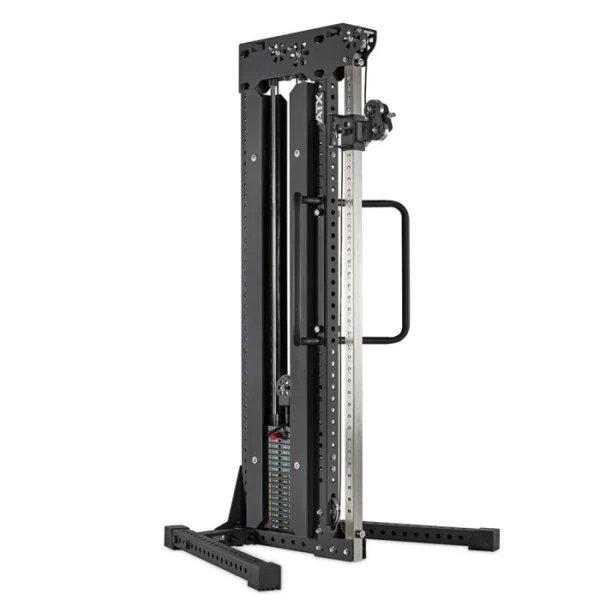
ATX Single Tower Multi Cable Pulley Station 90 kg
- 90 kg stack weight
- Graduation 5 kg
- 37-way height-adjustable
- Swivel range 170°
- 132 × 105 × 229 cm
- CHF 1,990.00
Cable crossover machine in certified studio quality with hard-chrome-plated guide rods and stretch-free steel cables. Compact design without obstructive crossbars, dead weight 217 kg. Pull handles are not included and are selected separately.
Ideal for: Practices, clubs, and ambitious home gyms that want guided cable training but don't have 15 m² to spare.
View train stationRecommendation by profile
What is worth it for whom
Basement entrance
You are starting out, space is tight, and so is the budget. Get a compact rack, a bench, and a basic set of plates. Beginner rack for CHF 295.- is the cheapest sensible start.
Ambitious home gym
You've been training for years, lifting heavy and mostly alone. Then there's no way around safety bars. This Rack with 500 kg load capacity is the foundation, everything else comes later.
Strength plus cable machine
You want a barbell and pulling exercises without setting up two pieces of equipment. The Rack and cable pulley combination solves that on a single footprint and replaces the classic home gym.
Studio, club, practice
Multiple people, varying fitness levels, little induction time. Here, guided stations are the right choice. The Weight stack machines Available new and used, including consultation and planning.
Frequently Asked Questions
Multi-gym and standalone equipment: the most important answers
What is a multi-gym?
A multi-gym is a piece of exercise equipment that combines several guided exercises on a shared weight stack, usually lat pulldown, rowing, pressing, and butterfly. The resistance is selected via a selector pin instead of weight plates. Other names for it are multi-station, home gym, or multi-jungle.
Is a multi-gym good for beginners?
It is usable for getting started, but rarely the best choice. The guided movements lower the barrier, but in return you do not learn free technique and you quickly hit an upper limit with the weight stack. A rack with a bench and plates costs less and will serve you for much longer.
Can I build muscle with a home gym?
Yes. For muscle building, the primary factor is that the resistance increases over time, and a multi-gym also achieves this. The limit lies in the weight stack: once it is maxed out, progress can only be made through repetitions and tempo. Free weights, on the other hand, can be increased indefinitely.
How much space does a multi-gym need at home?
Plan for 2 to 4 m² for the actual footprint and additional clearance all around. A power rack measuring 152 by 133 cm takes up about 2.02 m², while a compact entry-level rack measuring 143 by 123 cm takes up about 1.76 m². Studio stations with multiple weight stacks require a multiple of that.
What is the difference between a multi-gym and a power rack?
A multi-gym guides the movement and provides resistance via a weight stack. A power rack doesn't guide anything, it provides safety: four posts with safety bars catch the barbell if a repetition fails. You bring your own bar and plates and train with free movement instead.
Do I need to bolt a multi-gym to the floor?
Mostly not. Equipment with a heavy weight stack is stable due to its own weight, and a 90 kg power rack is as well. For tipping exercises like pull-ups, we still recommend anchoring it. On sensitive flooring, a protective mat should definitely be placed under the feet.
What breaks down on a multi-gym?
Almost always the moving parts: steel cables, pulleys, and pads. Cables and pulleys are wearing parts and can be replaced as long as the model is still available. It becomes critical with worn-out guide rods in the weight stack, as this is hardly repairable.
Uncertain what fits in your space?
Measure length, width, and ceiling height, and we'll show you the right setup, from a beginner rack to a guided station for the club room.
View all racks