


Fitness Flohmarkt · Guide
Adjustable dumbbells compared: which adjustment system holds up in everyday use?
Discs with a lock, a dial on both ends, or central adjustment at the handle: three designs that differ significantly in durability, speed, and increment steps.
In short
Here you compare adjustment systems: plates with collars, dials at the ends and central adjustment at the handle. Design affects handling, weight changes and care. It does not establish an overall durability ranking without comparative testing. For weight ranges, quantities and accessories, see the Buying guide for adjustable dumbbells.
The three types
What adjustment systems are available for adjustable dumbbells?
Adjustable dumbbells use three design principles, and you can find all three in the category Compact dumbbells. With the plate-loaded system, you slide weight plates onto a short bar and secure them with a collar, just like a miniature barbell. This is the oldest and simplest design, and it still dominates everything under CHF 100 today. With the dial system at both ends, all the plates sit in a storage tray, and you turn a dial on the left and right to the desired setting, whereupon the dumbbell lifts only the selected plates. With central adjustment, the exact same thing happens, only you select the weight using a single dial on the inside of the handle instead of two dials on the outside. This final difference sounds like a minor detail, but it determines how often you have to reach out twice during a workout. Which design makes sense in which weight range is explained by the Buying guide for adjustable dumbbells.
A fourth principle frequently appears in search results: the block system, in which a locking pin runs transversely through a stack of rectangular blocks. The Fitness-Flohmarkt assortment currently does not include a dumbbell of this design, so it will remain at this level of classification here.
| Type | How to choose the weight | Moving parts | Smallest jump |
|---|---|---|---|
| Washers and closure | Attach washers, tighten fastener | only the closure | 2.5 kg (1.25 kg per side) |
| Thumbwheel at both ends | turn two wheels onto the step | two recordings per dumbbell | depending on the model |
| Centrally on the handle | turn a wheel inside on the handle | one mount per dumbbell | depending on the model |
| modular system with plug-in pins | Insert bolts into the step | Bolts and block stacks | depending on the model |
Durability
Which adjustment system holds up in everyday use?
For plate systems, inspect the bar, collars and sleeves. Selector dumbbells also have locking mechanisms, plate supports and a storage cradle. Fewer parts alone do not prove a longer service life. Build quality, appropriate use, maintenance and spare parts also matter. Set adjustable dumbbells down under control; permission to drop them must explicitly apply to the specific product.
The second factor is the number of operating steps that can go wrong. With two separate dials, one end can be set to a different level than the other, which loads the dumbbell asymmetrically and causes it to tilt noticeably when lifted. The central adjustment design inherently rules out this error. For both dial designs, the rule also applies: adjustment is only made while the dumbbell is resting in the cradle.
Pace in training
How many steps does it take you to change weights?
Switching weights on a pair of dumbbells costs you eight locking handles plus changing the plates with the plate-loaded system, four turns with the dial at both ends, and exactly two with the central adjustment on the handle. The math behind this is simple: releasing and retightening two locks per dumbbell side results in four handles per dumbbell, one dial per dumbbell end results in two, and one central dial results in one. Now calculate five weight changes per session, which is normal for a full-body routine with four to five exercises: that results in 40, 20, or 10 hand movements per workout. Extrapolated to three sessions a week and one year, that is around 6,240 hand movements with the plate system versus 3,120 with the dial and 1,560 with the central adjustment. This is not a measurement, but an extrapolation based on design, but it explains why plate sets often stay stuck on a single weight after a few months.
The difference has an impact primarily where you switch weights within an exercise, such as in drop sets, supersets, and warm-up sets. Anyone who instead does three exercises with the same weight will hardly notice the loss of speed. The honest conclusion: If you rarely switch weights, the extra cost for a spin-lock system is hard to justify.
Gradation
How finely does which system grade?
Compare the actual weight ladder of the specific model. Dividing the weight range by the number of settings minus one gives only the average increment, not the smallest or largest. The 24 and 40 kg models have unequal increments within their ladders. With plate systems, the plate pairs used and permitted loading determine the next step. Full model values are in the buying guide.
System examples
Three designs in pictures
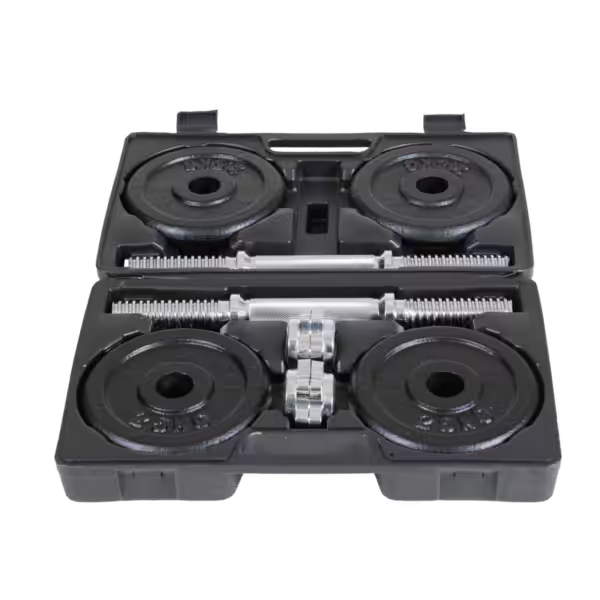
Washers and closure
Load the bar with suitable plates and secure both sides. To change weight, release the collars, swap plate pairs and secure them again.

Thumbwheel at both ends
Select the weight at both ends. Check matching settings, locking and correct seating in the matching cradle.
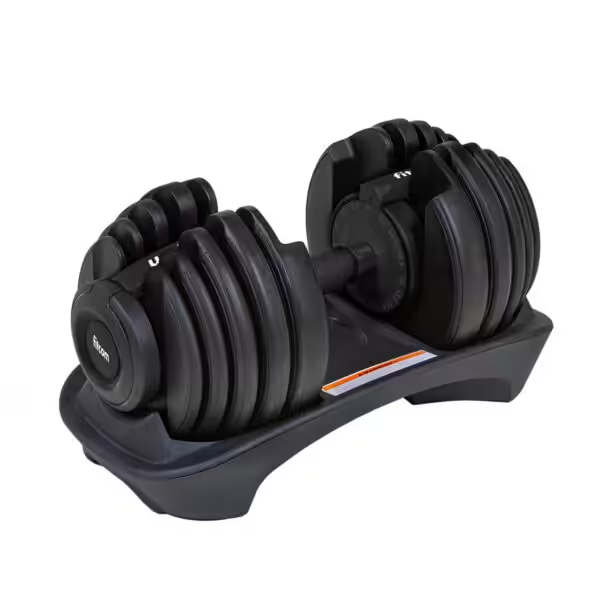
Centrally on the handle
A central selector adjusts the specific model. Check engagement and locking as instructed; the control method alone does not confirm better build quality.
Contraindication
When a disc system is the better choice
A plate-loaded system beats any spin-lock system in three cases, and that is not a matter of taste, but a direct consequence of the design with its few parts. First, on budget: two bars with eight plates and a case cost CHF 75, which is less than a single adjustable dumbbell with a mechanism. Second, in terms of expandability, because you can add more at any time 30 mm weight plates furthermore, while in any rotating system the maximum is fixed in the construction and fundamentally cannot be retrofitted. Thirdly, regarding reparability: A warped closure is a spare part for a few francs, a warped mount is a warranty case. Matching Dumbbell bars with 30 mm They are also available individually if you want to add to an existing set instead of replacing it. The downside remains the time required, and that adds up as soon as you switch multiple times within a single unit.
To choose a specific dumbbell, check its weight ladder, handle dimensions, quantity and accessories in the Buying guide for adjustable dumbbells. The system name alone does not decide which model suits your exercises.
Recommendation by profile
What is worth it for whom
Getting started on a small budget
You want to find out first if you're staying on. Take this Dumbbell set 2x 10 kg in a dumbbell case: robust, expandable, and CHF 75 cheaper than a single adjustable dumbbell.
Daily at home, often changes
Drop sets, supersets, alternating exercises: This is where every saved effort pays off. The 24-inch with central adjustment requires half as many handles per change as the classic design.
Already trained, more load needed
Rowing and lunges will initially feel too easy at 24 kg. The maximum is fixed for both rotary designs, so plan ahead with some reserve. You can find the right advisor for this in the Overview of all buying guides.
Several people training at once
Several fixed dumbbells can be practical for people training at the same time. Dropping them still requires explicit product suitability and an appropriate floor. For adjustable dumbbells, pay particular attention to locking and setting-down instructions.
Frequently Asked Questions
Adjustment systems for adjustable dumbbells: the most important answers
What adjustment systems are available for adjustable dumbbells?
Three designs are common: plates on a short dumbbell bar with a collar, a dial at both ends of the dumbbell, and a central adjustment with a wheel on the inside of the handle. With the two dial-type designs, the unselected plates remain in a storage tray. A fourth principle, the block system with selector pins, is not in Fitness Flohmarkt's product range.
Which adjustment system lasts the longest in everyday use?
An overall ranking is not established without comparative testing. Check the specific product’s parts, build quality, maintenance and spares. Plate systems have different inspection points from selector dumbbells with locking mechanisms and cradles. All should be handled according to their instructions.
What breaks on an adjustable dumbbell?
Possible inspection points include collars, locking mechanisms, plate supports and the cradle. Unusual play, jamming or damaged parts must be addressed before further use. Which parts wear and can be replaced depends on the specific model.
How many steps does it take to change the weight?
For the dumbbell pair, that means eight locking handles plus plate changes for the plate-loaded system, four turns of the dial at both ends and two for the central adjustment at the handle. With five changes per workout, that results in 40, 20 or 10 manual actions. The difference is noticeable primarily during drop sets, supersets and warm-up sets.
Can weight plates be added to adjustable dumbbells?
Only with the plate system. There, you can add more 30 mm plates at any time as long as the bar has space. With both twist designs, the maximum weight is structurally fixed and cannot be expanded: a 24 stays at 24 kg, a 40 at 40 kg. Anyone who wants to progress in this case buys the next larger dumbbell.
Are there adjustable dumbbells with a block system on Fitness-Flohmarkt?
No. The block system with insertion pins and a rectangular block stack is currently not in the product range at Fitness-Flohmarkt. Available are the plate system as well as twist systems with adjustment at both ends or centrally on the handle. For the question of which of these variants makes sense in which weight range, there is a separate buying guide.
Do you know now which system fits?
Then all that's left is deciding on the weight range and quantity. The dumbbell buying guide clarifies both in five minutes.
To the buying guide for adjustable dumbbells