




Fitness Flohmarkt · Guide
How to do Face Pulls correctly: Technique, weight, and the right equipment
The exercise that almost everyone makes too difficult, thereby turning it into bad rowing. Here is how the pull really goes and what you can use to perform it in the gym, the home gym, or completely without equipment.
In short
Face pulls are performed on a cable machine at head height using a rope pulled toward the face: the elbows remain high, the ends of the rope split apart next to the ears, and the shoulder blades come together. They train the rear deltoids, middle trapezius, and external rotators. The weight remains light, and 12 to 20 repetitions are the norm.
Basics
What are face pulls, and which muscles do they work?
A face pull is a pulling movement where you pull a rope at head height toward your face while separating the two ends of the rope. It primarily trains the rear deltoids, along with the middle and lower trapezius, the rhomboids, and the external rotators of the shoulder. It requires resistance coming from the front and above: a cable machine, a digital cable machine or a band at head height. This is precisely the musculature that gets hardly any work during pushing exercises like the bench press and is missing as a counterweight in a push-dominated routine. The appeal of the exercise lies in the combination: it unites horizontal pulling with external rotation of the upper arms, and these two things rarely come together in any single exercise otherwise. Therefore, it is featured at the end of the session in many routines rather than as a main exercise.
Because the load remains small, the face pull also appears outside the weight room, for example as a strengthening exercise in the Rehab and physio category. What it is not: an exercise for mass.
Execution
How do you do face pulls correctly?
Set the pulley at head height or slightly above, attach a rope, grab both ends from above and pull them toward your face so your hands end up next to your ears while your elbows remain at least at hand height. The decisive difference to a rowing movement is the height of the elbows: if they drop below the hands, the face pull turns into a close-grip row to the chest, and the external rotation disappears. The upper body remains upright, the feet are staggered so that the pull does not tip you forward. At the end point, hold briefly and let the rope return in a controlled manner instead of letting it snap back. Five steps, in this order:
- Adjust height: Roll to head height to just above it, so that the pull comes slightly from diagonally above.
- Grab and set up: Grab both ends of the rope with an overhand grip, thumbs pointing backward, and take one or two steps back until the weight is already under tension in the starting position.
- Drag: Drive elbows outward and back, not the hands first. The shoulder blades move together and slightly downward.
- Final position: Hands next to the ears, ends of the rope pulled apart, forearms approximately parallel to the floor, hold for one second.
- Trace back Lower slowly and let the shoulders come forward only at the very end.
Breathing and tempo are unspectacular: exhale on the pull, three to four seconds for a full repetition. Anyone who works faster loses the external rotation first.
Stress
How heavy should face pulls be?
Easy. Face pulls work in the range of 12 to 20 repetitions, and the weight is chosen correctly when you perform the last repetition in the exact same posture as the first one. A useful test for this doesn't need a chart: as soon as you lean your upper body back, use momentum to jerk the weight, or let your elbows drop, the load is too high. In practice, most people end up way below what they pull during rows, and that's not a step backward, but the very point of the exercise. The external rotators are small and fatigue early, while the traps and arms willingly take over as soon as it gets heavy. Exactly this takeover is what you want to prevent. Two to four sets at the end of the session are enough, two to three times a week.
Between two levels you take the smaller one and hold the endpoint one second longer. That costs more than adding two kilos.
Rope and handle
Which rope or handle do you need for face pulls?
A rope, not a rigid handle. Face pulls thrive on the fact that the two hands can move apart from each other at the end point, and that is only possible with a split attachment. A lat pulldown bar or a parallel handle fixes the distance between the hands and takes away the exact part of the exercise that makes it special. A classic triceps rope serves the purpose completely, even though the name points to a different exercise: It is the same attachment, just used differently. The length is important. A short rope forces the hands together, a long one gives room for the end position. Everything else is a question of comfort, and the grip diameter decides that. The entire selection is in the category Cable pull handles.
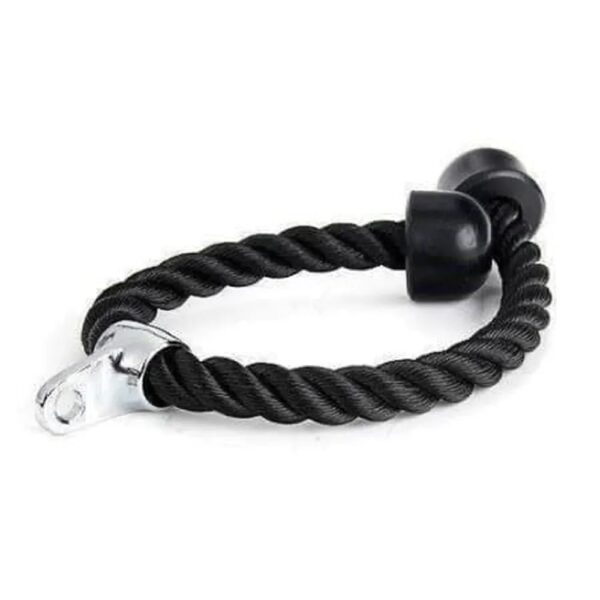
Triceps rope | ideal for triceps training
- CHF 10.00
- 68 cm length
- Nylon
- 28 mm handle
- up to 120 kg
- 0.75 kg
- Art. F-66941
Nylon rope with a chrome swivel. The swivel allows the rope to follow the rotation instead of twisting at the carabiner. At 68 cm, it is long enough for the hands to move significantly apart at the endpoint.
Ideal for: every cable machine in the gym or home gym, and as the very first attachment ever.
View ropeOn the digital cable machine, the classic rope does not fit every connector. That is where the Beyond Power Functional Rope for CHF 80 per roll, a nylon rope with stainless steel attachment from the same system.
Without cable machine
Face Pulls at home: with a band, on a DIY cable machine, or with a dumbbell?
Face pulls work well with a resistance band and a self-built cable setup, but not with dumbbells. The reason is the direction of the load. A dumbbell always pulls vertically downwards, but the face pull requires resistance from the front. Anyone searching for face pulls with a dumbbell therefore inevitably ends up with a different exercise: the bent-over reverse fly. This also trains the rear deltoids, but leaves out the external rotation and strains the lower back in the bent-over position. It works as a substitute, but not as the same exercise. Suitable weights for this are listed under Compact dumbbells. For true face pulls at home, there are two ways, and both cost less than a dumbbell.
The simplest is the band. A long loop band placed around the pull-up bar or rack upright at head height, grab both ends, done. Face pulls with a band even have an advantage: the resistance increases with the stretch and is highest at the end point, which is where the external rotators are supposed to work. What else which band is good for is explained by the Resistance Band Buying Guide, the full selection can be found under Buy Resistance Bands.

Resistance Band | Resistance Bands
- Starting at CHF 7.00
- 104 cm Loop
- 208 cm circumference
- 4 mm thick
- four steps
- Art. F-51521
Long rubber loop band available in four resistance levels. The light resistance level is ideal for face pulls: 1.5 cm wide, blue, with approximately 6 to 14 kg of tension. The heavier bands are designed for pull-up assistance and can make the exercise less precise. A set of three costs CHF 25.
Ideal for: Apartment without appliances, hotel room, warming up before the big day.
View Tapes| Level | Color | Width | Traction | For Face Pulls |
|---|---|---|---|---|
| light | blue | 1.5 cm | about 6 to 14 kg | the right choice |
| medium | red | 2 cm | about 18 to 32 kg | Only for the very strong |
| strong | black | 3 cm | about 27 to 45 kg | too hard |
| extra strong | orange | 6.5 cm | about 36 to 68 kg | too hard |
The second option is worth it if you already have a rack and weight plates. A pull system consisting of a pulley, cable, and weight holder turns it into a pull station: CHF 45 for the system plus CHF 10 for the cable comes to CHF 55, provided you already own 50-mm plates. The weight limit is 150 kg; for face pulls, you’ll need 10 to 20 kg of that. So the limit isn’t set by the equipment itself, but by the point where you hang it.
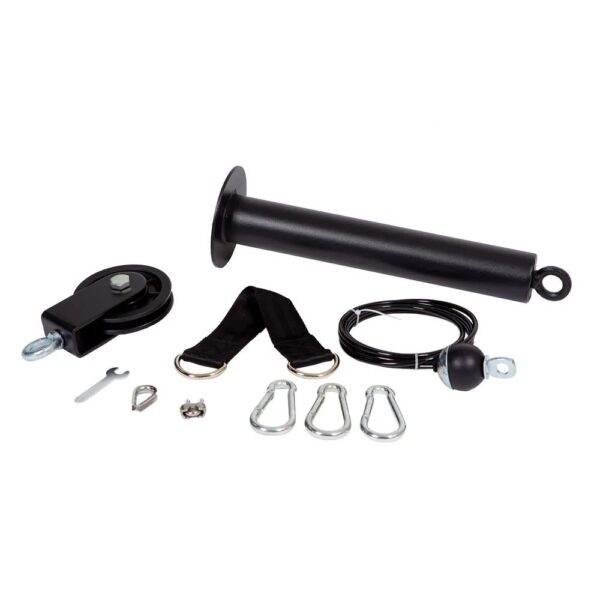
Cable Pulley System | Cable Pulley System
- CHF 45.00
- 50 mm shot
- Steel, powder-coated
- max. 150 kg
- Art. F-93829
Weight-bearing device, cable, pulley, connecting loop, and three carabiners. This turns any sturdy anchor point into a pull-up bar. Grips and ropes are not included.
Ideal for: Home gyms with a rack and 50-mm plates that don't have room for a station.
View the train system| Variant | What you need | Costs | Resistance | Goes well with |
|---|---|---|---|---|
| Cable pull plus rope | Workout station in the studio or home gym, Triceps Cable | CHF 10 for the rope | finely graduated on the block | Studio, large home gym |
| Long loop band | Suspension point at head height | Starting at CHF 7.00 | increases with elongation | apartment, travel |
| DIY rack mount | Rack, 50mm plates, cable system, cable | CHF 55 in total | can be selected per disc | Home gym with rack |
| Digital cable machine | Device plus mount and cable | Device starting from CHF 2,590.- | 2 to 90 kg electronic | small rooms without iron |
Fault pattern
The most common mistakes in face pulls
By far the most common mistake is too much weight, and all others follow from that. As soon as the load increases, the elbows drop, the upper body leans back, and the movement shifts from the rear deltoid to the traps and arms. The second major mistake is the wrong height: if the pull comes from below, the exercise turns into an upright row and the external rotation is lost. You can tell both without a mirror by the fact that you can no longer hold still for a second at the end point. The remaining points are details, but they make the difference between an effective and a pointless exercise:
- Head is pushing forward: The chin moves toward the rope. Head stays where it is, the rope comes to you.
- Rope ends stay together: Without pulling apart, external rotation is missing, then it is close-grip rowing.
- Hollow back The train tilts the pelvis. Keep ribs down, engage the abdomen slightly.
- Wrists bend: Forearm and hand remain in a straight line.
- No stop at the endpoint: That one second is not a stylistic device, it is the part where the small rotators work.
Classification
What is worth it for whom
apartment without appliances
A light loop band fully covers the exercise and fits in the drawer. Start with the blue ribbon.
Home gym with rack
The homemade pull system for CHF 55 is the cheapest addition to the exercise repertoire. The Cable Pulley System hang on to the handlebar.
Studio and Association
Station is there, so only the attachment piece is missing. A second rope saves changing time in the course. The choice is between the Cable accesses.
Physiotherapy and Rehab
Here, fine metering at the lower end matters, not the upper limit. An electronic pull starts at 2 kg in 0.5 kg increments, as can be read in the Voltra Buying Guide.
If you are unsure about device selection, you can find it under all purchasing advisors the comparisons to the other product groups.
Frequently Asked Questions
Face Pulls: The most important answers
What muscles do face pulls work?
Face pulls primarily train the rear deltoids, the middle and lower trapezius, the rhomboids, and the external rotators of the shoulder. Because the pull is at head level and the hands move apart at the end point, an external rotation is added to the pulling movement. Exactly this combination is missing in most training plans.
How heavy should face pulls be?
Light enough for 12 to 20 clean repetitions. The weight is right when the last repetition looks just like the first. As soon as you lean back, use momentum to jerk the weight, or let your elbows drop, it's too heavy. When in doubt, choose the lower setting and hold the endpoint longer.
At what height do you set the cable machine for face pulls?
At head height or just above, so that the pull comes slightly from diagonally above. This height automatically keeps the elbows up and maintains external rotation. If the pull comes from below, the exercise becomes an upright row. The same applies when seated: the pulley is positioned above head height while seated.
Can you do face pulls with a band?
Yes, and for home use that is the simplest solution. Anchor a long loop band at head height, grab both ends, and pull just like on a cable machine. The band resistance increases with the stretch and is highest at the end point, which is where the external rotators are working. The light resistance level is enough.
Do face pulls work with dumbbells?
No. A dumbbell pulls straight down, the face pull needs resistance from the front. As a substitute for the rear shoulder, there is the bent-over reverse fly, which, however, lacks external rotation. Anyone who wants the complete movement needs a band or a cable pull at head height.
How often should you train face pulls?
Two to three times per week with two to four sets each. Because the load remains low and hardly any fatigue occurs in the nervous system, the exercise tolerates more frequency than heavy compound exercises. The usual place is at the end of the session or as a warm-up before a pressing day.
The rope that makes the exercise possible
A split mouthpiece is the only requirement that truly matters. Everything else is technique.
View ropes and handles