



Which Resistance bands Buy?
Mini band, fabric band, resistance band — the names sound interchangeable, the bands are not. Two things are decisive: the design (short loop around the legs or long band for the whole body) and the material (rubber or fabric). After that, the choice is done in a minute.
This is enough for warm-ups, physio exercises, and glute activation. Rubber mini band set for CHF 8.- (3 loops à 25 × 5 cm). Anyone who intensively trains their glutes and legs will take this Fabric Mini Band Set for CHF 15.- — it doesn't roll up, doesn't slip thanks to anti-slip strips, and is latex-free. For full-body training, pull-up assistance, and stretching, it needs the long loop bandsThe Resistance Band Set for CHF 25 covers a tension range of 6 to 45 kg with three bands.
To the polls in 10 seconds
What are you up to?
The decisive difference
Three designs — three different tools
All three are closed loops without handles. The difference lies in their length and material—and thus in the types of exercises that are possible. A mini band is not a substitute for a long band, and vice versa.
Rubber mini-loop
The short rubber loop goes around the thighs, knees, or ankles. Its strength is its fine adjustability: three thicknesses (0.4 / 0.6 / 1.3 mm) result in three clearly graduated resistances — ideal for warm-ups, activation, and rehab exercises. Its weak point: during exercises with high tension, thin rubber can roll up and pinch on bare skin.
Fabric mini loop
Same application position, different material: The wide textile band distributes the pressure across 8.5 cm, does not roll up, and stays in place thanks to anti-slip strips on the inside — even during sweat-inducing sets over sports leggings. The base tension is higher than with the thin rubber loop, but the band is less stretchable. Latex-free, so it is also suitable for those with a latex allergy.
Long loop band
The large band for everything that goes beyond the legs: clamped under the feet for rowing and presses, hung around the pull-up bar as pull-up assistance, as additional resistance for squats and deadlifts, or as stretching assistance. With 6 to 45 kg of tensile force depending on the band, it replaces a small set of dumbbells on the go.
Rule of thumb: Does the exercise work around the legs (Squats, Abduction, Glute Bridges, Monster Walks) → Mini-Loop. Requires the exercise Move over distance (Pull-ups, rowing, pressing, stretching) → long loop band. Anyone who trains both needs both — the sets do not replace each other.
Traction concrete
How much resistance is in the bands?
The resistance band set indicates the tensile force in kilograms — the further you stretch the band, the higher the resistance within the range. Together, the three bands cover 6 to 45 kg and can be combined for more resistance.
And the mini bands? Their resistances are defined as light / medium / strong graded — for the rubber set via the band thickness (0.4, 0.6, and 1.3 mm), for the fabric set via the weave. For leg exercises, the relative gradation is crucial, not the kilogram number: you start light and increase as soon as 15–20 clean repetitions are possible.
The sets in detail
Three sets compared
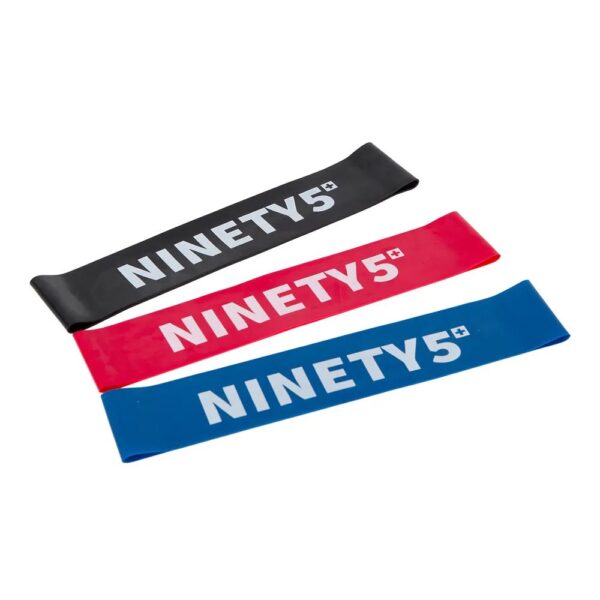
Mini Band Set | 3 Loops CHF 8.00
Three rubber loops in three resistance levels for everything involving thighs, knees, and ankles: abduction, glute activation during warm-ups, coordination, and rehab exercises. At 5 grams per band, the set fits in any jacket pocket—the training tool that's always with you. The most affordable entry into band training.
Ideal for: Warm-up before leg day, physical therapy and rehab exercises, beginners, on-the-go workouts.
View Mini Band Set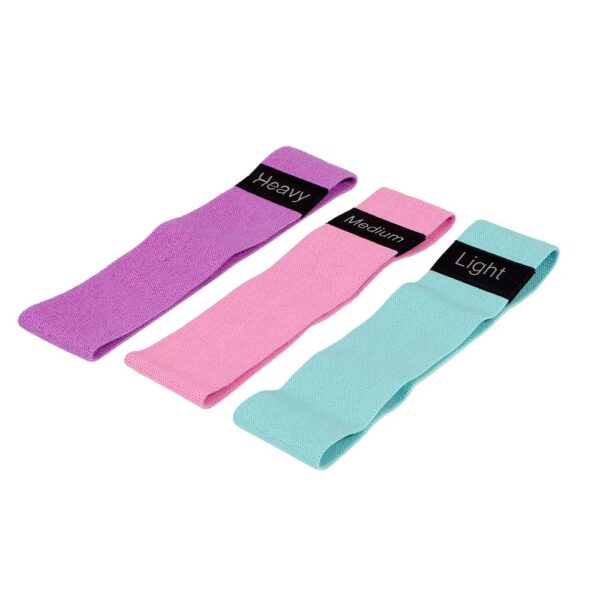
Fabric Mini Band | Set of 3 CHF 15.-
The comfortable option for intense lower-body training: 8.5 cm wide fabric distributes pressure, does not roll up under tension, and stays right where it is supposed to thanks to anti-slip strips on the inside. The three resistance levels can be combined for progressive training. Latex-free — the right choice for sensitive skin or latex allergies.
Ideal for: Glute Bridges, Hip Thrusts, banded squats, booty workouts — anyone who uses mini bands for more than just warming up.
View Fabric Mini Band
Resistance Band Set | Resistance Bands CHF 25.-
Three long loop bands with 6–14 kg (blue), 18–32 kg (red), and 27–45 kg (black) of resistance. As a pull-up aid around the pull-up bar, as additional resistance during squats, deadlifts, and push-ups, or for mobility and stretching — the set covers everything from rehab pulling to heavy resistance and weighs a total of only 0.5 kg. The home gym for your travel bag.
Ideal for: Pull-up progression, full-body workout at home and on the go, stretching and mobility.
View Resistance Band SetEverything side by side
The sets compared
| Set | Design | Material | Mass | Resistance | Operation | Price |
|---|---|---|---|---|---|---|
| Mini Band Set | short loop | Rubber | 25 × 5 cm | 3 levels (0.4 / 0.6 / 1.3 mm) | Warm-up, activation, rehab | CHF 8.00 |
| Stoff Mini Band | short loop | fabric, latex-free | 36.5 × 8.5 cm | 3 levels, combinable | Intensive Glute & Leg Workout | CHF 15.- |
| Resistance Band Set | long loop, 104 cm | Rubber | 104 cm × 1.5–3 cm | 6–45 kg in 3 bands | Full body, pull-up assist, stretching | CHF 25.- |
Anyone who only buys one set and wants to train versatilely should get the Resistance Band Set — it covers the largest selection of exercises. Anyone focusing on lower body training is better off with the fabric Mini Band. And for CHF 8, the rubber mini band is a purchase you will never regret: as a warm-up tool, it belongs in every gym bag.
From real orders
What our customers combine
These combinations appear most frequently together in our orders — they complement each other in training rather than duplicating one another.
Short + long
The most popular combination in the shop: mini-loops for warm-ups and footwork, long bands for pulling exercises and pull-up progression. Together for CHF 33.00, the complete resistance band workout.
- Mini Band Set | 3 Loops CHF 8.00
- Resistance Band Set CHF 25.-
Complete home workout
Resistance bands take up no space, but they do need a foundation. A mat for floor exercises, and depending on your goal, yoga blocks or a suspension trainer for bodyweight exercises.
- NBR exercise mat CHF 19.-
- Suspension Trainer CHF 35.-
- Yoga Cork Bricks CHF 10.00
More than ribbons
When the resistance of the bands is no longer enough at some point: free weights as the next step. With handles instead of loops, the bands are also available as a tube set.
- Resistance Tubes Set CHF 12.00
- aerobic dumbbells Starting at CHF 3.-
- Go to the Kettlebell Guide →
Frequently Asked Questions
Resistance Bands: The Most Important Answers
Which resistance bands should I buy?
That is enough for warm-up, activation, and rehab. Rubber Mini Band Set for CHF 8.-. For an intense glute and leg workout, this is Fabric Mini Ribbon Set the better choice for CHF 15 because it doesn't roll up and doesn't slip. You need the long one for full-body training, pull-up assistance, and stretching. Resistance Band Set with 6–45 kg tensile force for CHF 25.-.
What is the difference between mini bands and resistance bands?
The length — and therefore the application. Mini bands are short loops (25 to 36.5 cm) that are placed around the thighs, knees, or ankles and train the lower body. Resistance bands are 104 cm long loops (208 cm circumference) for pulling exercises over a distance: pull-up assistance, rowing, pressing, stretching. The two designs do not replace each other.
Fabric band or rubber band — which is better?
Use the fabric band for intense leg training, the rubber band for warm-ups. The 8.5 cm wide fabric band does not roll up under tension, does not slip thanks to anti-slip strips, and puts less pressure on the skin—in exchange, it is less stretchable and the resistance levels are graded more coarsely. The thin rubber band (0.4–1.3 mm) allows for finer adjustment and, at CHF 8, costs almost half as much, but can roll up and pinch under high tension.
How many kg of resistance do the bands have?
The Resistance Band Set covers 6 to 45 kg with three bands: blue 6–14 kg, red 18–32 kg, black 27–45 kg — the resistance increases with stretch. The Mini Bands are graded into light, medium, and heavy; for the rubber set, this results from band thicknesses of 0.4, 0.6, and 1.3 mm. For more resistance, bands can be combined.
Which band do I need for pull-up assistance?
The stronger the band, the more body weight it relieves. For the first pull-ups, the black band with 27–45 kg of support is the right choice. Anyone who can already do individual pull-ups and wants to build up repetitions should use the red band (18–32 kg). The blue band (6–14 kg) is the final step before the unassisted pull-up. All three are in the Resistance Band Set contain — this way support grows as progress is made.
Which resistor is right for beginners?
Start with the lightest band and learn the movement with proper form — for mini bands, use the light band; for the resistance band set, the blue one with 6–14 kg. Progress as soon as 15 to 20 clean repetitions are possible. That is why sets of three are more practical for beginners than single bands: the next level is already waiting.
Are the resistance bands latex-free?
The Fabric Mini Ribbon Set is latex-free and therefore the right choice for a latex allergy or sensitive skin. The Mini Band Set and the Resistance Band Set are made of rubber. Anyone who reacts to latex is best off wearing rubber bands over clothing — or directly choosing the fabric band.
Can I build muscle with resistance bands?
Yes — as long as the resistance brings the muscles close to fatigue. With up to 45 kg of tensile force in the strongest band and the ability to combine bands, that is well-suited for beginners and for training on the go. However, the resistance of a band increases with stretching instead of remaining constant; anyone who wants to train heavy in the long term combines bands with free weights like Dumbbells or kettlebells.
How long do resistance bands last?
Several years with proper care. Three main things shorten the lifespan: contact with sharp edges (rings, jewelry, rough pull-up bars), direct sun and heat which make rubber brittle, and overstretching far beyond the nominal length. Check briefly for cracks before each use as a pull-up aid — a band under full tension should never be damaged.
Are the bands suitable for physical therapy and rehab?
Yes — resistance bands are the standard tool in physiotherapy and rehab because the resistance can be finely adjusted and the joints are protected. The Mini Band Set with its lightest level (0.4 mm) and the blue resistance band with 6–14 kg are suitable entry points. Which exercises make sense is in the hands of the treating specialist — you can find further equipment in the category Rehab & Physio.
Ready for your band practice?
Alle Widerstandsbänder an Lager in Liestal, Versand in 1–3 Arbeitstagen ab unserem Schweizer Lager — und für alles darüber hinaus beraten wir dich persönlich.
Buy Resistance Bands