




Fitness Flohmarkt · Guide
Goblet Squat: How to do the beginner squat correctly
The front squat is the exercise with which most people learn to squat with proper form. Here are the technique, starting weight, and most common mistakes.
In short
The Goblet Squat is a squat where you hold a single weight with both hands close to your chest. The counterweight in the front pulls the upper body upright and lets you squat deeper and with better form than without a load. Untrained individuals start with 6 to 8 kg, while regular exercisers start with 12 to 16 kg. Suitable weights from 2 to 48 kg can be found at Kettlebells.
Basics
What is the goblet squat and which muscles does it train?
The goblet squat is a squat in which a kettlebell or dumbbell is held vertically with both hands at chest height, with the elbows pointing downward. The name comes from the posture: you hold the weight like a goblet. It primarily trains the quadriceps and the glutes, as well as the adductors on the inside of the thighs and, because the load hangs in front of the body, the entire core along with the upper back. The difference to the squat with a barbell on the back: the weight in the front acts as a counterweight and automatically keeps you more upright instead of pulling you forward. Which kettlebell is suitable for this is classified by the Kettlebell Buying Guide according to material and weight. Anyone who can hardly get deep freely is often in a better position right away with 8 kg held against their chest.
The effect is not a trick, but physics: the weight in front of the body shifts the center of gravity forward, the pelvis must travel lower between the heels, the ribcage stays up. Exactly this position many cannot find without a weight.
Execution
How do you perform the goblet squat step by step?
The movement requires no prior experience. You place your feet about shoulder-width apart with your toes pointing slightly outward, hold the weight with both hands by the handle or the upper end, and pull it close to your chest so that your forearms are vertical. From there, you bend downward in a controlled manner until your elbows are between your knees, and press back up using the entire surface of your feet. Your back stays straight, your heels stay on the floor. Two to three seconds down, hold briefly at the bottom, up briskly: this tempo makes more out of a light weight than adding more load.
- Feet shoulder-width apart, toes turned slightly outward.
- Lift the weight with both hands and pull it to your chest, forearms vertical.
- Lift chest, tighten abs, look straight ahead.
- Lower over two to three seconds until the elbows are between the knees.
- Keep the bottom short without losing length.
- Push up through the entire foot, squeeze the glutes at the top.
The right weight
What weight do you start with for the goblet squat?
The goblet squat has a different starting weight than overhead exercises: you hold the load with both hands and your legs carry it, so it can be significantly heavier. Beginners and those returning to exercise start with 6 to 8 kg, while those who are regularly active start with 12 to 16 kg. The better measure than any chart is the repetition itself: the correct weight is the one with which you can manage ten repetitions at a consistent depth, with the last two being challenging. If you exceed fifteen clean repetitions, it is time for the next level. If your form wobbles by the third repetition, the level below is the right one.
| Initial situation | Initial weight | Sets x Reps | Next step |
|---|---|---|---|
| Return to training, barely any squat experience | 6 to 8 kg | 3 x 8 | increase starting from 15 clean repetitions |
| Regularly active, squats new | 8 to 12 kg | 3 x 10 | increase starting from 15 clean repetitions |
| Trained, squat is on point | 12 to 16 kg | 4 x 10 | increase starting from 15 clean repetitions |
| Weight training for years | 20 to 24 kg | 4 x 8 | Strength stimulus exhausted, continue with the barbell |
How fine the increments are also plays a role: with 4 kg steps, the jump from 12 to 16 kg is an increase of 33 percent all at once, whereas with 2 kg steps, you go from 12 to 14 kg and thus get by with 17 percent. At some point, the exercise is maxed out, and that is no flaw: anyone holding 24 kg for fifteen clean repetitions is limited by their grip and upper back rather than their leg. Then the load belongs on the back or in a rack. Anyone working with an adjustable dumbbell will find the increments in the Buying guide for adjustable dumbbells.
Kettlebell or dumbbell
Goblet squat with kettlebell or with dumbbell?
Both work, but the difference is measurable. You hold a kettlebell by the handle, and the ball rests compactly between your forearms. You hold a dumbbell vertically by one end, it hangs downward, and it needs more space between your chest and thighs. In numbers: A 20 kg hex dumbbell measures 36.5 cm in length, while a cast-iron kettlebell of the same 20 kg is 25 cm high. That is 11.5 cm that you either lack or do not lack in front of your belly when going deep. Therefore, the kettlebell is the slightly more natural choice for the goblet squat, especially with heavy weights and shorter individuals. Nevertheless, the dumbbell is not a makeshift solution: anyone who anyway Compact dumbbells has at home, does not need to buy anything extra for this exercise.
Add to that the ball size: For the Cast Iron series in Kettlebell selection grows from a diameter of 12 cm at 8 kg to 18 cm at 24 kg. Six centimeters more push the elbows outward and cause them to hit the thighs earlier on the way down.
Technical check
The most common mistakes during the goblet squat
Most mistakes during the goblet squat are posture errors, not strength issues. They almost all occur in the first few repetitions as soon as the weight is slightly too heavy. These five points cover the majority of them.
- Weight too far from the body: The ball moves forward, the back rounds. Pull it toward your chest.
- Heels lift off: You are going deeper than your mobility allows. Stop a hand's breadth higher.
- Knees cave inward: Push your knees actively outward, in the direction of your toes.
- Elbows pointing outwards: They belong down, otherwise the upper body will tip forward.
- No rhythm: Dropping and jerking up costs half the effect. Count down.
Anyone who is unsure films a set from the side. The correction is almost always: one level lighter, the weight closer to the body.
Equipment
What you train that with
For the goblet squat, you need exactly one weight and about one square meter of free space. A kettlebell or dumbbell that you also use for other exercises makes sense. The appropriate equipment is located in the Conditioning category.
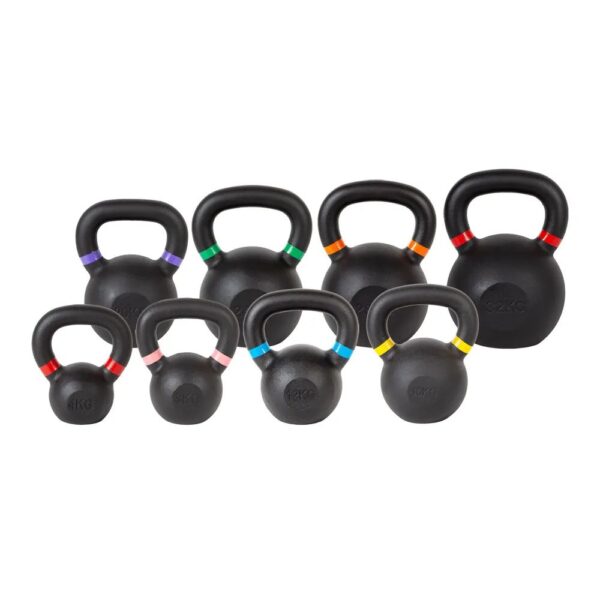
Cast iron, 4 to 48 kg
Twelve steps in 4 kg increments, cast in one piece, from CHF 16 each: Kettlebell Cast Iron.

Fine increments, 4 to 40 kg
Fourteen levels, up to 20 kg in 2 kg increments, from CHF 10.- each: Vinyl-coated kettlebell.
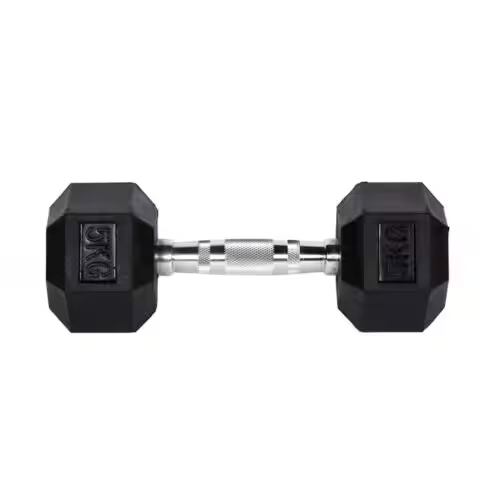
Dumbbell, 1 to 60 kg
Thirty-two steps, handle length 13 cm, starting at CHF 3.00 each: Hex Dumbbell.
Classification
What is worth it for whom
Getting Started with Squats
You want to learn to squat deeper and more upright without overloading yourself with weight. A light kettlebell is enough: with the rubberized beginner ball you get fine 2 kg increments while also protecting the floor.
Increase in the long term
You train regularly and want to improve over the years. Then it's worth the Cast iron kettlebell in 4 kg increments up to 48 kg, because the same series also works for other kettlebell exercises.
Dumbbells already available
You already have dumbbells in the room and don't want to buy anything else. Take one fixed hex dumbbell and hold it vertically against the upper pane. Up to 15 kg, this is the most straightforward solution.
Frequently Asked Questions
Goblet Squat: the most important answers
Which muscles does the goblet squat train?
The Goblet Squat primarily trains the anterior thigh muscles and the glutes. In addition, there are the adductors on the inner thighs and the entire core, because the abdomen and upper back must stabilize the load in front of the body. The forearms are also involved.
How deep should I go on the Goblet Squat?
As deep as you can hold the position. As a guide: at the bottom, the elbows touch the inside of the knees or come between them. If your lower back rounds or your heels lift, you have gone too low and should stop one hand's width higher.
How many sets and repetitions make sense?
Three to four sets of eight to twelve repetitions are the standard for strength and technique. Two sets of ten light repetitions are enough for warming up. For strength endurance, you go for fifteen to twenty repetitions with significantly less weight.
Goblet Squat with kettlebell or dumbbell, which is better?
The kettlebell is a bit more practical because the ball rests more compactly against the ribcage: 25 cm in height for 20 kg compared to 36.5 cm in length for a hex dumbbell of the same weight. The dumbbell works the same way; you hold it vertically by the top plate.
Are goblet squats good for the knees?
For healthy knees, yes, often even better than the free squat: the counterweight in the front keeps the upper body upright and distributes the load more evenly on the knees and hips. If you have existing issues, you should consult a doctor beforehand regarding depth and load.
When do I switch from the goblet squat to the barbell squat?
If you can hold 24 kg for fifteen clean repetitions, then your grip is limiting you rather than your leg, and additional weight in front of the chest provides barely any further stimulus. From that point on, you train squats with a barbell and keep the goblet squat as a warm-up exercise.
Choose the right ball
One kettlebell, one exercise, one clean squat: choose the weight that fits your current level today.
Buy kettlebells