




Fitness Flohmarkt · Guide
Flat bench or adjustable bench: is flat enough for your workout?
The flat bench is the more stable, cheaper, and more compact bench. Whether it is enough depends on a single question: whether your upper body will ever need to be at an incline.
In short
A flat bench is enough if you mainly do bench press, rows, and triceps extensions and go heavy. It is more stable, cheaper, and takes up less space. You need an adjustable bench as soon as incline bench press, shoulder press, or seated dumbbell exercises are added. Rule of thumb: heavy barbell means flat, versatile dumbbell means adjustable.
The demarcation
What a flat bench can do and where its limits lie
A flat bench is a training bench with a permanently welded, horizontal lying surface and no adjustment mechanism. This covers everything that takes place horizontally: bench presses with a barbell or dumbbell, one-arm rows, flyes, triceps extensions, bench dips, and any exercise where you only need the bench as a stable support. Where it stops is just as clear. As soon as the upper body needs to be at an incline, nothing works anymore: incline bench pressing, seated shoulder pressing with back support, and curls on an incline all require an adjustable backrest. A flat bench cannot be cobbled together with makeshift props without the stance becoming wobbly and the load rating becoming void. The dividing line is therefore not between cheap and expensive, but between one training axis and multiple ones. In between lies a third type of design that is often overlooked: the flat bench with a built-in barbell rack, which remains flat but comes with the rack that would otherwise require a separate unit. You can see which benches of all three types are currently available in the Weight Benches Category.
The decision
Is a flat bench enough for your workout?
A flat bench is enough if your routine consists mainly of bench pressing, rowing, and barbell compound exercises, and you are working toward heavier weights. In that case, with an adjustable bench, you pay for a mechanism you rarely use and trade off stability, height, and price as a result. It is not enough if dumbbells are your primary tool. Anyone working predominantly with Dumbbells trains, wants to do incline bench press, supported shoulder press, and seated exercises sooner or later, and there's no way around an adjustable backrest for that. And if you're unsure about this question, that's already the answer: in practice, uncertainty almost always means you want to keep your options open, and then the adjustable bench is the safer purchase. An overview of all product groups where the choice is not obvious is provided by our Buying guide.
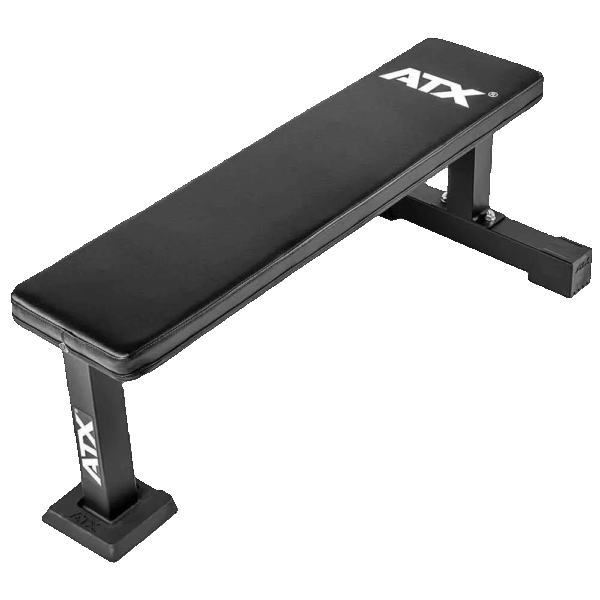
ATX Flat Bench Pro
- Load capacity of 750 kg
- Lying surface 122 x 30 cm
- Height 45 cm
- 21.3 kg
- EN 20957
Welded frame, 5 cm padding, 60 cm wide cross base with rubberized end caps. The flat single-point front foot leaves room for the feet.
Ideal for: Barbell training with a clear focus on bench pressing, in the rack or with a separate rack.
View ATX Flat Bench Pro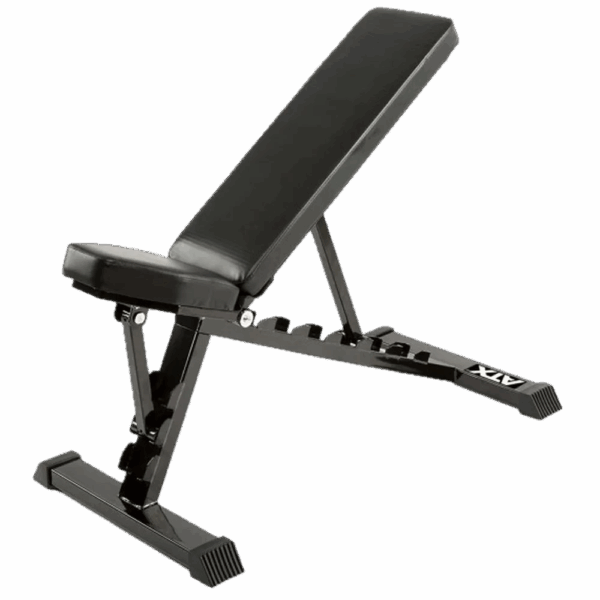
ATX Multi Adjustable Bench 102
- Supports up to 250 kg
- 6-way adjustable backrest, 0 to 89°
- Triple seat
- 21 kg
- Cushion approx. 5.8 cm
The cheapest way to train on an incline at all. Notch rail instead of bolts, 8 x 4 cm square steel, easy to move at 21 kg. The 250 kg weight limit is plenty for dumbbell training, but the bare minimum choice here for heavy barbell training.
Ideal for: Dumbbell workout at home, when adjustable bench and budget matter equally.
View ATX Multi weight bench 102
Premium Adjustable Bench
- 500 kg load capacity
- 7-way adjustable backrest
- Triple seat
- 50 kg dead weight
- Transport rollers
The adjustable bench that largely eliminates the stability disadvantage. A dead weight of 50 kg and a square tube construction keep it steady with a 500 kg weight rating. With a seat height of 44 cm, it remains low enough for proper ground contact.
Ideal for: Home gyms that aim to replicate dumbbell and barbell training on a bench.
View Premium Adjustable BenchLoad-bearing capacity and construction
Why the flat bench holds more weight at the same price
A flat bench can handle significantly more weight for the same price because it lacks the component that is the weak point of every adjustable bench: the adjustment track. An example from our own product range, both benches cost CHF 195. The ATX Flat Bench Pro is rated for up to 750 kg, the ATX Multi Adjustable Bench 102 up to 250 kg. That is three times as much reserve for the same money. The reason is structural, not qualitative: on the flat bench, the pad rests on a continuously welded frame, whereas on the adjustable bench, the backrest rests on a notched adjustment mechanism that is subjected to point loads and requires some play in order to change the angle at all. For you, this doesn't mean that 250 kg wouldn't be enough, because body weight plus barbell remain well below that in most home gyms. It means that the flat bench feels noticeably more stable under heavy load.
Who wants to train with adjustable equipment and still have a reserve pays the difference in steel and weight: The Adjustable Bench with eleven backrest positions weighs 40 kg and carries 500 kg, the premium variant 50 kg with the same rating.
| Bank | Type | Adjustment | Resilient | Footprint | Dead weight | Price |
|---|---|---|---|---|---|---|
| ATX Flat Bench Compact | Flat bench | none | 600 kg | 110 x 45 cm | 17 kg | CHF 175.- |
| ATX Flat Bench Pro | Flat bench | none | 750 kg | 127 x 60 cm | 21.3 kg | CHF 195.- |
| ATX Multi Adjustable Bench 102 | adjustable | 6-way adjustable backrest (0 to 89°), 3-way adjustable seat | 250 kg | 113.5 x 63 cm | 21 kg | CHF 195.- |
| Adjustable Bench Profi | adjustable | Backrest 11-way, seat 3-way | 500 kg | 130 x 75 cm | 40 kg | CHF 295.- |
| Premium Adjustable Bench | adjustable | 7-way adjustable backrest, 3-way adjustable seat | 500 kg | 135 x 67 cm | 50 kg | CHF 395.- |
| Competition weight bench | Flat bench with rack | none (height-adjustable shelf) | 500 kg | 160 x 180 cm | not specified | CHF 490.- |
Mass
Bench height and lying surface: how dimensions change training
The mass of a bench influences your bench press more than the brand name. A useful framework is provided by the competition standard: The Technical Rulebook of the International Powerlifting Federation, effective March 1, 2026, requires the competition bench to be at least 1.22 m long, 29 to 32 cm wide, and a height of 42 to 45 cm to the top of the unloaded pad. The ATX Flat Bench Pro fits right into this range with a 122 x 30 cm pad and a height of 45 cm. With adjustable benches, the height varies more because the mechanism needs space beneath the padding: the Premium Adjustable Bench stays within the range at 44 cm, while the ATX Multi Weight Bench 102 reaches 51.5 cm, putting it 6.5 cm above the IPF upper limit. Length, on the other hand, is rarely the issue: all the benches compared here reach at least 1.10 m, and what matters anyway is simply that the head and buttocks rest on it at the same time.
These 6.5 cm are not a defect, but they have a consequence that almost nobody mentions: The higher the bench, the more likely you are to lose full contact with the floor. At a seat height of 51.5 cm, for people around 1.65 m tall, the heels tend to be in the air as soon as you squeeze your shoulder blades together. This costs stability right where you need it. Therefore, anyone of a shorter build should check the bench height against their own lower leg before buying.
Filing and rack
How does the barbell get onto a flat bench?
A standard flat bench does not have a barbell rack, so you either need a rack around it or a bench with an attached rack. This is precisely where many flat bench purchases go wrong: the bench arrives, and only then does the question arise of how the loaded barbell gets into the starting position in the first place. There are three proper ways. First: place the bench inside a power rack, use the J-hooks as a rack, and set the safety bars at chest height. Second: choose a flat bench with an integrated, height-adjustable rack and safety arms. Third: stick to dumbbells that you position yourself. What does not work is the combination of a heavy barbell, no rack, and training without safety features. Anyone who does not figure this out beforehand will end up lifting lighter than they could because getting into position from a lying posture becomes the actual limitation. Which rack fits your space is explained by the Buying guide for rigs and racks.
The space requirement clearly distinguishes the paths. The compact ATX Flat Bench Compact occupies about 0.50 m² at 110 x 45 cm. The Competition weight bench takes up about 2.88 m² of floor space at 160 x 180 cm, which is almost six times as much. You can find all racks in the Category: Rigs and Racks.

Competition weight bench
- 500 kg load capacity
- Height-adjustable shelf
- Safety Spotter Arms
- Band Pegs
- 160 x 180 cm
The answer for everyone who presses heavy and often alone. The rack can be adjusted to body height, and the height-adjustable safety arms catch a failed repetition. The price is the footprint of a small rack.
Ideal for: Bench press as the main exercise without a training partner, in the basement or in the club room.
View competition weight benchStudio benches and second-hand items
What makes studio benches like a Hammer Strength flat bench different
Studio benches differ from home gym benches in three aspects: padding thickness, frame cross-section, and weld seam finishing. Anyone looking for a Hammer Strength flat bench or comparable studio models is usually looking for precisely this feel: padding that does not compress under load, and a frame that does not budge a millimeter when racking the barbell. However, this also requires an honest assessment: such benches arrive at Fitness Flohmarkts through studio liquidations and surplus stock, so inventory changes constantly and cannot be planned. Anyone waiting for a specific studio brand is better off checking the assortment regularly rather than placing a pre-order. In any case, the features behind the brand name can be verified: a bench certified according to EN 20957 with 5 cm padding, a welded frame, and a 750 kg weight rating covers the same exercises as a used studio bench, is new, and is lower in price.
When buying second-hand studio furniture, two factors are decisive: the upholstery and cover must be intact, and the frame must show no warping. You can check both in two minutes, and both will determine the next ten years.
Recommendation by profile
What is worth it for whom
Beginners with dumbbells
You are training with dumbbells and don't have a fixed routine yet. Take the adjustable bench, even if you are only doing flat presses today. You can get started easily with the ATX Multibank 102; which dumbbells fit the description will be clarified by the Buying guide for adjustable dumbbells.
Bench press as main exercise
Your target is on the pole, not in the corner. Then the flat bench is clearly the better choice: more reserve, lower seating height, more stable stance. The Flat Bench Pro it hits the competition dimensions without you having to pay for a competition bench.
Home Gym with Rack
If the rack is already set up, you don't need a bench with its own rack attachment. Decide based on the variety of exercises: flat if the barbell dominates, adjustable if dumbbells are added. The Premium Adjustable Bench fits between the uprights of standard power racks.
Studio, club and physical therapy
In continuous operation, padding thickness and clearance matter more than the range of adjustment. A combination makes sense: two flat benches for the pressing area, one adjustable bench for dumbbells and rehab exercises. For quantities and setup we advise clubs and businesses personally.
Frequently Asked Questions
Buy flat bench: the most important answers
Is a flat bench enough for muscle building?
Yes. For muscle building, a flat bench is completely sufficient as long as you apply progressive overload. Bench presses, dumbbell rows, flyes, tricep extensions, and bench dips cover the chest, back, and arms. The adjustable bench provides variety and different angles of stimulation, not fundamentally better growth. The decisive factor remains increasing weight or repetitions over time.
What is the difference between a flat bench and an incline bench?
The flat bench has a solidly welded, horizontal lying surface, while the incline bench has a backrest that can be adjusted in multiple steps. The rest follows from this: the flat bench is more stable, lower, and more affordable, whereas the incline bench is more versatile and heavier. Many models on the market are adjustable benches that cover both positions.
How wide should a flat bench be?
A pad width of around 30 cm is right for most trainees. The competition standard of the International Powerlifting Federation specifies 29 to 32 cm, and this window has a practical reason: the pad supports the back while leaving room for the shoulder blades to retract. From about 35 cm onwards, the support restricts the shoulders.
Can I also bench press flat on an adjustable bench?
Yes, every adjustable bench can be brought into the horizontal position. Two differences remain: the seat height is often higher than that of a flat bench, and there is a gap between the back and seat pads that some people find bothersome. Both are matters of getting used to and not a reason against buying.
Does a flat bench need a dumbbell rack?
Only if you are working with the barbell. For dumbbell training, you do not need a rack because you get the weights into position yourself. For barbell bench presses, on the other hand, you either need a rack around the bench or a flat bench with a permanently attached, height-adjustable rack including safety arms.
Is a flat bench suitable for dumbbell training?
Yes, for all lying dumbbell exercises it is even the more stable base: flat dumbbell bench press, flyes, pullovers, and one-arm rows all work on the flat bench. The only exercises missing are those with an upright upper body, meaning incline bench press and seated shoulder press. If these are in your routine, you choose the adjustable bench.
How much does a good flat bench cost in Switzerland?
Sturdy flat benches with studio approval start at around CHF 175.– and are CHF 195.– for models with competition dimensions. Flat benches with an integrated barbell rack and safety arms cost about CHF 490.–. Adjustable benches start at CHF 195.–, but only reach the stability of a good flat bench from around CHF 295.– upwards.
Flat or adjustable: decide by comparison
All flat benches and adjustable benches with dimensions, approvals, and prices, ready to ship from our Swiss warehouse.
Buy weight bench