


Fitness Flohmarkt · Guide
Parallettes: Are they worth it, and which type is right for you?
Two handles, a few centimeters of height, and suddenly push-ups feel completely different. Whether this pays off for you depends on three things: your exercises, your wrists, and your ceiling height.
In short
Parallettes are worth it as soon as you regularly train with your own body weight. They increase the range of motion and keep your wrists straight. Low wooden grips for CHF 25 cover push-ups, L-sits, and planches. High steel parallettes with a grip height of 73 cm for CHF 50 add dips and handstands, but require vertical space.
Basis
Parallettes, are they worth it?
Parallettes are two separate, parallel bars on their own bases that you support yourself on with your hands instead of the floor. The benefit comes from two effects. First, your wrist stays straight instead of hyperextended because you grip a handle rather than placing your flat hand on the ground. Second, your chest hangs below the gripping plane, meaning you go lower than on the floor. This turns a push-up into an exercise with a significantly greater range of motion, and exercises like the L-sit or tuck planche only become properly possible in the first place because the pelvis needs space between and beneath the bars. They are worth it the moment bodyweight training becomes a regular part of your week. Anyone who does twenty push-ups every few weeks will barely notice the difference and doesn't need them.
The price barrier is low. A pair costs CHF 25 or CHF 50 on Fitness-Flohmarkt, depending on the design, and both models are delivered as a pair. So the question rarely depends on the budget, but rather on the design. If you are generally unsure which equipment class fits your setup, the Overview of all buying guides Continue.
Wood or steel
Wooden or steel parallettes: what is the difference?
The difference lies less in the material than in the construction height that comes with it. Wooden parallettes are built close to the ground: you support yourself a few centimeters above the floor, and that is enough for push-ups with a deep drop, the L-sit with bent legs, and the first planche progressions. Wood feels warmer to the touch, absorbs sweat better than painted steel, and is quieter when the grips are on a hard floor. Steel parallettes are built higher and can support heavier loads. The model in the product range measures 73 cm in grip height, supports up to 150 kg, and stands on transverse feet with non-slip rubber caps, indoors and outdoors. For dips, leg raises in support, and straight L-sits, you need precisely this ground clearance.
| Feature | Wooden push-up bars | Parallettes Parallel Bar Trainer |
|---|---|---|
| Item number | F-86235 | F-73777 |
| Price per pair | CHF 25.- | CHF 50.- |
| Material | solid wood | Steel, yellow |
| Handle height | close to the ground, not specified by the manufacturer | 73 cm |
| Max. Load | not specified by manufacturer | 150 kg |
| Adjustable | no | no |
| Stands | Wood, non-slip | transverse, with rubber caps |
| Scope of delivery | 2 claws | 2 Parallettes |
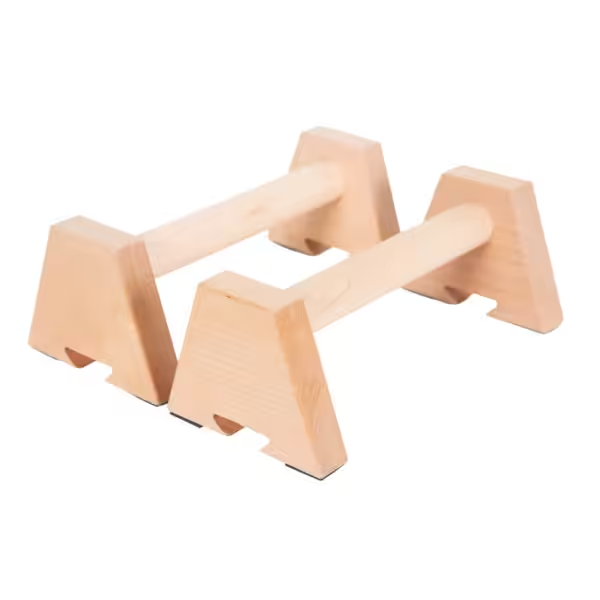
Wooden push-up bars | Pair of parallettes
- CHF 25.-
- solid wood
- Set of 2
- close to the ground
- F-86235
The most affordable way to take the wrists out of hyperextension and deepen the push-up. Solid wood feels comfortable to grip, stands non-slip, and makes no noise on parquet or laminate flooring. For everything that happens on the floor, this is the right design, and it works in any room, regardless of ceiling height.
Ideal for: Push-ups, L-sit, tuck planche, handstand work in rooms with normal ceiling height.
View wooden handles
Parallettes | parallel bars trainer
- CHF 50.-
- 73 cm handle height
- up to 150 kg
- Steel
- F-73777
The tall version with a 73 cm handle height and a 150 kg load limit. This lets you hang freely off the ground in support, which makes dips, leg raises, and straight L-sits possible in the first place. The transverse feet with rubber caps hold firm even on smooth floors and outdoors.
Ideal for: Dips, hanging leg raises, straight L-sits, training on the patio or lawn.
View Barren TrainerIn short: The Wooden push-up bars are the all-purpose couple for everything that happens on the ground, the Steel parallettes bar trainer the pair for everything that needs air under the pelvis. Anyone who trains both ends up buying both, because the designs cannot replace each other.
Overall height and space
How high should parallettes be?
The height determines two things: the exercises that are possible at all, and the space you need. Low handles work in any room because you never stand higher than usual. With high parallettes, on the other hand, you have to account for upward space as soon as handstands come into play. The math is simple: in a handstand, you are standing on the grips, so your height in the room equals approximately your body height plus the grip height. With a body height of 1.80 m and a grip height of 73 cm, that is 2.53 m, and since you don't want your heels tapping the ceiling at the top, you add about 20 cm of clearance. You end up at around 2.70 m. Many Swiss basement rooms are between 2.20 and 2.40 m. There, high parallettes for handstand work are simply the wrong choice.
For everything below the handstand, the opposite applies: the higher the handles, the more room to move. If your basement is low, but you still want to practice handstands, you take the low wooden handles and get the height later outdoors. When you are training under a normal living room ceiling or outside, is the 73 cm high steel variant the more versatile purchase.
Parallettes Workout
Which exercises can you do on parallettes?
Parallettes cover the entire pushing side of calisthenics training, from the first clean push-up to the planche. The typical progression follows a fixed order because each stage requires the shoulder and core tension of the previous one. You start with deep push-ups between the handles so the shoulders get used to the increased range of motion. Next comes the support hold with tucked legs, from which both the L-sit and the tuck planche develop. Only at the end is the handstand, because it demands overhead shoulder stability. All stages need the exact same equipment, just with varying clearance from the ground. Exactly for this reason, the height of the build is the deciding factor for purchase, not the material.
- Level 1: Push-ups between the handles, lower chest below handle height.
- Stage 2: Hold plank, knees tucked in, 20 to 30 seconds.
- Level 3: L-Sit, first with bent, then with straight legs.
- Level 4: Tuck Planche, shoulders forward over the handles.
- Level 5: Handstand on the grips, first against the wall.
| Exercise | Ground-level wooden handles | Parallettes with 73 cm |
|---|---|---|
| Push-ups, deep descent | Yes | yes, with a long way down |
| Bent-knee L-Sit | Yes | Yes |
| Straight-leg L-sit | Heels touch the floor | Yes |
| Tuck Planche | Yes | Yes |
| Dips | only to a limited extent | Yes |
| Leg raises in support | no | Yes |
| Handstand | yes, in practically every room | only from a ceiling height of around 2.70 m onwards |
Purchase criteria
What you really need to look out for when buying
Four points determine the quality, and price is not among them. First, the footprint: the feet must be perpendicular to the direction of the grips, otherwise the device will tip sideways as soon as you correct yourself in a handstand. Second, the grip diameter: grips that are too thick will fatigue your forearms before your chest and shoulders get to work. Third, the load limit, which must support your body weight with a margin for safety because jumping up into a handstand briefly creates a multiple of that force. The steel version is rated for 150 kg, while the manufacturer does not specify a value for the wooden version. Fourth, the surface: non-slip feet only help if the floor itself does not give way. On carpet, narrow feet sink in and the equipment becomes unstable.
On hard surfaces, a mat is worthwhile to prevent scratches and dampen impact sound. You can find suitable products under Fitness floor protection mat. Small parts such as wrist wraps, straps, and lifting aids are in the category Fitness accessories.
Honest boundaries
What parallettes cannot do
Parallettes train exclusively the pushing side. Anything called pulling does not work with them: no pull-ups, no rows, no back development. Therefore, anyone who trains exclusively with parallettes builds an imbalance that becomes noticeable in the shoulders after a few months. The second limitation is progression. Once the push-up between the handles has become too easy, there is no weight increment like with dumbbells, only more difficult variations or added weight on the body. And the third limitation is mundane: on soft ground or uneven grass, every pair of parallettes wobbles, no matter how well built it is. Anyone who trains exclusively outdoors should find a firm, flat spot beforehand.
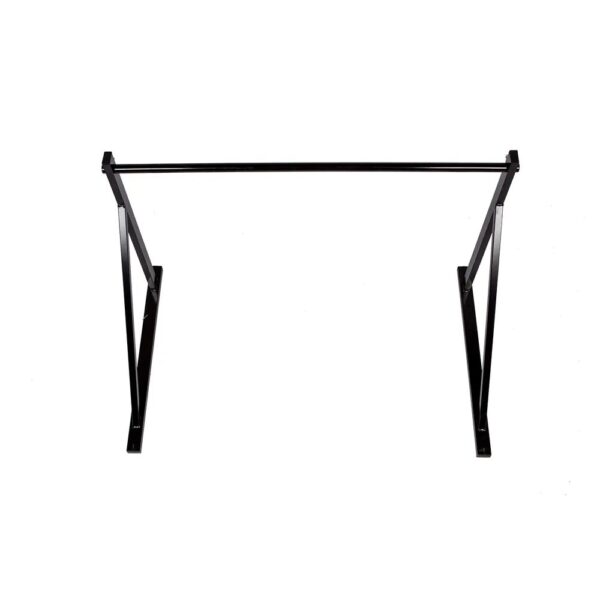
Pull Up Bar | CrossFitness Pull Up Bar
- CHF 70.-
- 133 cm wide
- 77 cm wall clearance
- up to 200 kg
- F-93323
The addition, not the alternative. For wall mounting including mounting hardware, with a 3 cm grip diameter and enough clearance from the wall for various grip options. Together with a pair of parallettes, you have pushing and pulling covered, and for less money and space than any weight bench.
Ideal for: Pull-ups, chin-ups, and leg raises, as the second half of a bodyweight setup.
View pull-up barThose who prefer a flexible draw side use instead of a fixed rod the Wooden gymnastics rings with a 23.5 cm diameter and a 200 kg load limit. And if you still lack the strength for your first pull-ups, the Resistance Band Buying Guide, which band loses how much body weight.
Recommendation by profile
What is worth it for whom
The Beginner
You are doing push-ups, your wrists hurt, and you want your first L-sit. For CHF 25.- you get with the Wooden parallettes, set of 2 everything you need for it.
The Advanced
Planche, handstand, and dips are on the schedule, and you're training under a normal apartment ceiling or outside. Then the tall steel parallettes with a 150 kg load capacity the right choice.
The complete home gym
You want to cover push and pull in a corner without setting up a rack. Parallettes plus the wall-mounted pull-up bar together result in a complete bodyweight setup on a good two square meters.
Studio, club, physiotherapy practice
You need several pairs that are stackable and can withstand a lot. The steel version is built for this, and in Conditioning assortment you will find rings, boxes and ropes for the same area.
Frequently Asked Questions
Parallettes: The Most Important Answers
What are the benefits of parallettes?
Parallettes deliver two things: straight wrists and a greater range of motion. Because you grip a handle instead of placing your flat hand on the floor, hyperextension in the wrist is eliminated. And because your chest sinks below the level of the handles, the push-up becomes a significantly deeper exercise. In addition, L-sits, tuck planches, and handstands only become possible on handles.
Are parallettes suitable for beginners?
Yes, provided you can do proper push-ups on the floor. The greater depth of descent makes the exercise harder, not easier, which is why the device is not an entry point to strength training, but rather the next step. Anyone who cannot yet do ten proper push-ups is better off practicing them on the floor first and with elevated hands on an edge.
Can you do dips on parallettes?
Yes on high parallettes, only to a limited extent on low ones. For dips you need clearance under your buttocks, and that only occurs at a grip height like the 73 cm of the steel version. With low wooden grips, the legs stay in the way, which is why only heavily bent variations work there.
How much do parallettes cost in Switzerland?
At Fitness Flohmarkt, the solid wood pair costs CHF 25, and the steel pair with a 73 cm handle height costs CHF 50. Both prices are per pair, not per piece. Both models are in stock in Liestal and can also be picked up locally by arrangement.
Do I need a mat under the parallettes?
Yes on parquet, laminate, and tiles, no on rubber flooring. A mat protects against scratches from the feet and dampens impact sound, which makes all the difference in rented apartments. On carpet, a solid board is actually mandatory because otherwise narrow feet will sink in and the appliance will wobble sideways.
How much weight can parallettes hold?
The steel variant in the range has a maximum load capacity of 150 kg. This value should exceed your body weight with a margin, because jumping up into a handstand or lowering yourself quickly temporarily exerts significantly more force on the handles. The manufacturer does not specify a load capacity for the wooden variant.
Ready for the first L-sit?
Both designs are in stock in Liestal, along with rings, pull-up bars, and everything else for bodyweight training.
View conditioning range