




Fitness Flohmarkt · Guide
Farmer's Walk: Technique, Weight, and How to Get Started
Lifting heavy, walking upright, setting down with control. The Farmer's Walk looks like nothing and is still one of the most honest strength exercises of all.
In short
During the farmer's walk, you hold an equal weight in each hand and walk a set distance with your arms long, core tight, and shoulders down. It trains grip strength, core, upper back, and legs simultaneously. As a starting point, carry about a quarter of your body weight in each hand for 20 to 30 meters, for three sets.
Basics
What is the farmer’s walk and which muscles does it work?
The Farmer's Walk is a carrying exercise: you take a weight of equal heaviness in each hand, stand up straight, and walk a predetermined distance with it without losing your posture. It doesn't train a single muscle group, but rather an entire chain. Forearms and fingers hold the load, upper back and shoulder blade muscles prevent the shoulders from rolling forward, abs and obliques keep you upright, and glutes and legs provide the locomotion. What kind of load is even suitable for this is classified by the Kettlebell Buying Guide by material and weight range. The second effect is grip strength, and it is the reason why the exercise is underestimated: Anyone who wants to deadlift or row heavier rarely fails because of their back, but rather because of their hand. The farmer's walk trains precisely this weak point without you needing an extra session for it.
Added to this is a reference to everyday life: shopping bags, toolboxes, moving boxes. Nothing in Conditioning assortment is so close to what you're constantly doing anyway.
Execution
How do you perform the Farmer’s Walk correctly?
The procedure is brief, the difficulty lies in the picking up and the setting down. You place the two weights next to your feet, squat down with a straight back like in a deadlift, grab them, and stand up with both legs at the same time. At the top, you pull your shoulders back and down, tense your core, and let your arms hang long without bending them. Then you start moving: short, controlled steps, gaze straight ahead, keep breathing calmly instead of holding your breath. The weights don't swing, they hang. At the end of the distance, you set them down in a controlled manner, again with a straight back and both legs. The most common mistake happens right here: after thirty meters, concentration wanes, and the load is dropped with a rounded back. Count the setting down as part of the set, not as quitting time.
- Weights next to the feet, stance hip-width apart.
- Straight back, grip, stand up with both legs.
- Shoulders back and down, core tight, arms long.
- Short steps, eyes straight ahead, steady pace.
- Stop at the end of the track, then dismount.
- Lower in a controlled manner, keep your back straight.
The right weight
What weight do you use for the farmer's walk?
When doing the farmer’s walk, you calculate in proportions of your body weight instead of absolute numbers, because your core and grip carry the load, and both scale with height. As a starting point, you take about a quarter of your body weight per hand, so at 75 kg that's about 20 kg on the left and right, and thus 40 kg in total. Those who train regularly end up at 40 to 50 percent per hand after a few weeks. However, the better standard than any chart is posture: the correct weight is the one with which you can walk the planned distance without your shoulders dropping forward, your back rounding, or you starting to take choppy little steps in the second half. If the dumbbell slips out of your hand after just ten meters, the core is not the problem, but the grip. In that case, you stay at that weight and shorten the distance.
| Initial situation | Weight your hand | Distance or time | Sentences |
|---|---|---|---|
| Onboarding, first weeks | about 25 % of body weight | 20 to 30 m | 3 |
| Trained regularly | 40 to 50 % | 30 to 40 m | 3 to 4 |
| Power-driven, heavy | 60 % and more | 15 to 20 m | 4 to 5 |
| strength endurance | 25 to 30 % | 45 to 60 seconds | 3 to 4 |
At what point the grip becomes the limiting factor also depends on the grip thickness. The handle of the Cast-Iron Kettlebell grows from 29 mm at 4 kg to 39 mm from 32 kg, while the Farmer Walk Handles measure 32 mm throughout. This 7 mm difference explains why you carry heavier with handles than with balls of the same weight: the thick handle tires the hand before the core gets tired. The same posture principle applies to Goblet Squat, but here you are walking instead of bowing.
Variants
Suitcase Carry or Farmer’s Walk: what is the difference?
During the Farmer's Walk you carry two equally heavy weights, during the Suitcase Carry only one in one hand, like a suitcase. The difference sounds small and changes the exercise completely. With two weights, the forces on the left and right cancel each other out, the spine is loaded straight down, and you can work significantly heavier. With one weight, the load pulls to one side, and the lateral core muscles on the opposite side have to resist so that you do not tip to the side. The Suitcase Carry is therefore not a toned-down version, but a different exercise: less total load, more work for the oblique abdominal muscles and core. Practically speaking, this means: for strength and grip you take the Farmer's Walk, for core stability and lateral balance the Suitcase Carry with about half the weight. Anyone who only owns a single dumbbell starts with the Suitcase Carry anyway.
Equipment
What you train that with
You need two weights of equal weight with handles and a clear path, everything else is just comfort. Fixed dumbbells are the most straightforward: constant grip thickness, they sit steadily in the hand, and after setting them down they stay put. Kettlebells work too, but they hang lower and are more likely to bump against your thighs during long strides. If you really want to carry heavy, you can't avoid handles because you can load up as many plates as you need. An honest note on space: the handles are 120 cm long. In a 3-meter-long basement room you'll be turning around every few steps, and that ruins every set. If your path is shorter than about ten meters, you're better off carrying dumbbells or replacing the walking distance with a stationary hold for time. The training stimulus remains almost the same, only the footwork is eliminated.
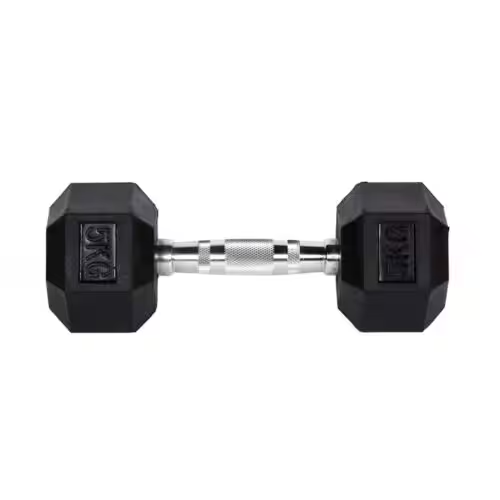
Fixed dumbbell, 1 to 60 kg
32 steps, 13 cm handle length, a 34 mm thick handle for weights from 6 kg, starting at CHF 3 per piece: Hex Dumbbell. The price is per dumbbell.
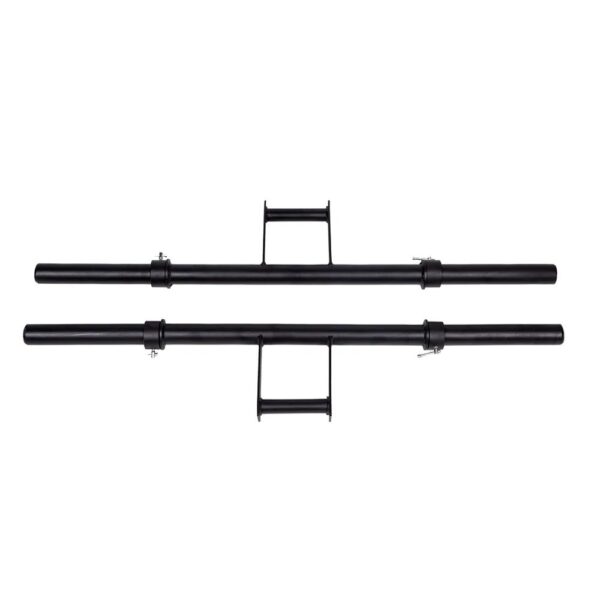
Handles for heavy sentences
120 cm long, 32 mm grip, 7.5 kg dead weight per grip, 50 mm sleeve, CHF 120 per pair: Farmer Walk Handle | Strongman. With two 20 kg plates on each side, that's 47.5 kg per hand, for a total of 95 kg.
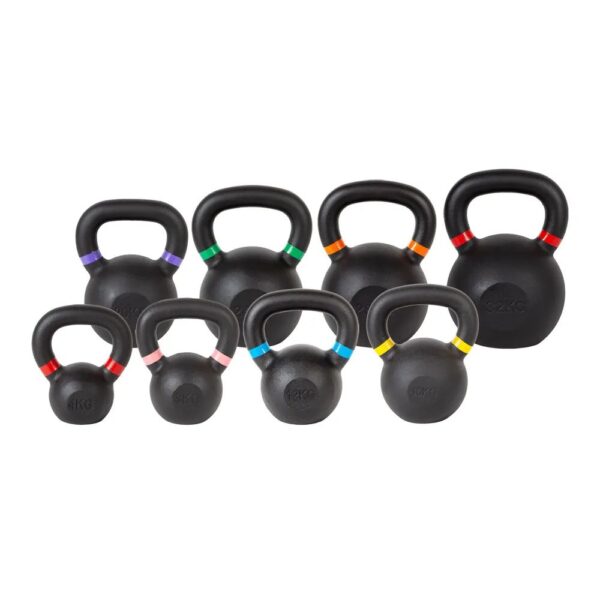
Kettlebell, 4 to 48 kg
Twelve steps in 4 kg increments, cast in one piece, from CHF 16.- each: Kettlebell Cast Iron.
Classification
What is worth it for whom
Little space at home
Not even ten meters at a stretch in the basement or in the apartment? Take two of equal weight Compact dumbbells and work via time instead of distance.
Heavy lifting, outdoors or indoors
You have space and want to lift over 100 kg in total. Then the way leads through handles with a 50 mm attachment from the Strongman assortment plus existing discs.
Kettlebells have already arrived
Two balls of equal weight are completely sufficient. Who Buy kettlebells will, finds the exact area there where the grip limits first.
Frequently Asked Questions
Farmer’s Walk: The Most Important Answers
Which muscles does the farmer's walk train?
The Farmer's Walk trains the forearms and grip, upper back, the entire core musculature as well as glutes and legs. Because everything is under load at the same time, it is considered a full-body exercise. The increase in grip strength is the fastest to be felt.
How much weight for the Farmer’s Walk?
To start, about 25 percent of your body weight per hand, so for 75 kg that's about 20 kg on the left and right. After a few weeks, 40 to 50 percent is realistic. Posture remains crucial: as soon as your shoulders or back give way, it is too heavy.
What is the difference between Farmer’s Walk and Suitcase Carry?
In the Farmer's Walk, you carry two equally heavy weights, while in the Suitcase Carry, you carry only one. Two weights load the spine symmetrically and allow for more load. A single one pulls on one side and challenges the lateral core muscles of the opposite side.
How often should I train the farmer's walk?
Two to three times a week, three to four sets each at the end of the session. It does not belong in the program before heavy deadlifts or rows because it pre-fatigues the grip. It fits best as a finisher.
Do I need Farmer’s Walk handles or are dumbbells enough?
For most people, two dumbbells of equal weight are enough. Handles are worth it as soon as the heaviest available dumbbell becomes too light for you or you want to lift over 100 kg in total. Fixed Hex dumbbells are the easier entry.
Two identical weights, that is all it takes
Choose the level that you complete cleanly.