




Fitness Flohmarkt · Guide
Power Tower: When Pull-Ups, Dips, and Leg Raises Are Worth It in One Machine
Pull-up, dip and leg raise in a single frame: the power tower promises a complete upper-body workout in just over a square meter. Here you can read when this works out, when a device from the Rack category delivers significantly more for the same money and what you need to measure beforehand.
In short
A power tower is a freestanding station that combines pull-ups, dips, and leg raises in a single frame. It is worth it if you train exclusively with body weight and the ceiling height is around 2.60 m or more. As soon as barbells are added or the room is lower, a wall-mounted solution or a rack is the better choice.
Definition
What is a power tower and which exercises can be done on it?
A power tower is a free-standing steel frame that combines three bodyweight stations in one structure: a pull-up bar at the top, two dip bars below it, and padded armrests with a backrest in between for leg raises. It is also sold as a powertower, pull-up station, fitness tower, or exercise tower. Training is done exclusively with one's own body weight; there are no weight stacks and no barbell rack. The appeal lies in the consolidation: instead of buying and setting up three separate devices, there is one station in the room. Typical heights range between around 200 and 235 cm, many models are adjustable in increments, and they additionally feature low handles near the floor for push-ups. Thus, the power tower covers precisely those exercises that are most frequently missing in a home gym because they require a fixed suspension above head height. Those who only want to train their abs, on the other hand, will find among the ab trainers much more compact and affordable solutions.
Together, the three core exercises work almost the entire upper body: pull-ups target the latissimus, posterior shoulder girdle, and biceps; dips work the chest, anterior shoulders, and triceps; and hanging leg raises challenge the abdominal muscles and hip flexors. What is missing are any exercises against a weight that is not your own body.
The core question
Is a power tower worth it for the home gym?
A power tower is worth it when three conditions come together: you train exclusively with body weight for the long term, you have a ceiling height of around 2.60 m or more, and you do not want to or are not allowed to drill into the wall. If any one of these conditions is not met, there is almost always a better solution at the same price. That is because a power tower usually costs between CHF 200 and CHF 500 in Swiss retail, and in that price range you can already get a rack that can do the same three exercises and additionally supports squats and bench presses. The tower's advantage thus shrinks to a single point: it is the most compact freestanding solution that gets by without a drill. Exactly for this reason, Fitness-Flohmarkt deliberately does not carry a classic freestanding power tower in its product range, but rather three setups that perform better depending on the space. Which of these fits your space is explained by the Rigs and Racks Buying Guide with all dimensions in detail.
A calculation example makes the difference tangible: The Home Rack Essential costs CHF 295, is designed for 300 kg, comes with the pull-up attachment and requires no floor mounting. The flip side is part of the deal: a rack is larger and cannot be put aside in a minute.
Space requirement
How much space and ceiling height does a pull-up dip station need?
Ceiling height matters more than floor space. For a clean pull-up, your head needs to go over the bar, and for that, depending on your height, you should allow 30 to 40 cm of clearance above the grip bar. When R-SERIES Half Rack If the bar is positioned at a device height of 230 cm, the pull-up creates a required ceiling height of 2.60 to 2.70 m. Exactly here is where many Swiss cellars fail, which lie between 2.20 and 2.40 m. A freestanding power tower has the same problem because, due to its design, its bar reaches almost to the top edge of the frame. At a construction height of 220 cm, you therefore need around 2.50 to 2.60 m of ceiling, just so your head stays clear at the top. The solution in a low room is therefore not a taller station, but wall mounting, where you determine the bar height yourself and make use of every last available centimeter.
On the floor, the difference is smaller than the advertising suggests: A power tower takes up around one square meter, while the Home Rack Essential, with a width of 143 cm and a depth of 123 cm, takes up around 1.76 m². In addition, there is movement space in front of and behind it, because the legs and torso swing out during leg raises.
| Installation method | Required ceiling height | resting area | Drilling required |
|---|---|---|---|
| Freestanding power tower | from approx. 2.60 m | approx. 1 m² | no |
| Home Rack Essential | from approx. 2.50 m | 1.76 m² | no |
| R-SERIES Half Rack | 2.60 to 2.70 m | 1.44 m² | no |
| Wall-mounted station, foldable | freely selectable | 0.25 m² | Yes |
Security
How to tell if a station is stable enough
The most meaningful figure is not the maximum load, but the ratio of dead weight to footprint. During a pull-up, it is not a static load that applies, but a dynamic one: whoever hangs from the bar or briefly stops at the top turning point exerts a multiple of their body weight onto the frame for fractions of a second. A freestanding device with a dead weight of 25 kg will inevitably wobble during this, regardless of what maximum load is written on the box. Therefore, the most stable solutions are either very heavy or firmly anchored. The ATX Dips and Leg Raise Station solve this via the wall: 350 kg maximum load capacity with a net weight of only 18.5 kg, because the force goes directly into the masonry instead of into four feet. According to the product specification, it is certified according to EN 20957. Conversely, for freestanding devices, the wider the feet and the heavier the frame, the more stable the station stands.
Second, the grip diameter matters: 45 to 50 mm on the dip bars fit comfortably in the hand and distribute the pressure, while thinner tubes dig in during longer sets. Third, the padding: synthetic leather over firm foam lasts for years, whereas cheap, soft padding gives way and leaves you hanging crooked during leg raises.
Honest contraindication
Every wall-mounted solution requires a load-bearing wall. In drywall, plasterboard, or hollow bricks, no pull-up bar will hold permanently, and the mounting hardware isn't included with the ATX device anyway because it has to match the substrate. If you are unsure, choose a free-standing solution and skip the drill holes.
The alternatives
Three Ways to Do Pull-Ups, Dips, and Leg Raises at Fitness Flohmarkt
Because we don't carry a classic power tower, we have three setups that cover the same three exercises, and each has a clear situation it is built for. The first way goes against the wall and combines a Wall-mounted pull-up bar with the foldable dip and leg raise station. The second way remains freestanding and drill-free and is suitable wherever the wall must not be touched. The third way takes a rack as a base and retrofits the missing functions with attachments, with the entire Rack accessories the R-SERIES fits on every rack and rig in the series using the same hole pattern. All three setups are priced in the range of a mid-range power tower, cover the three core exercises, and differ primarily in how much space they take up when idle and how far you can expand later.
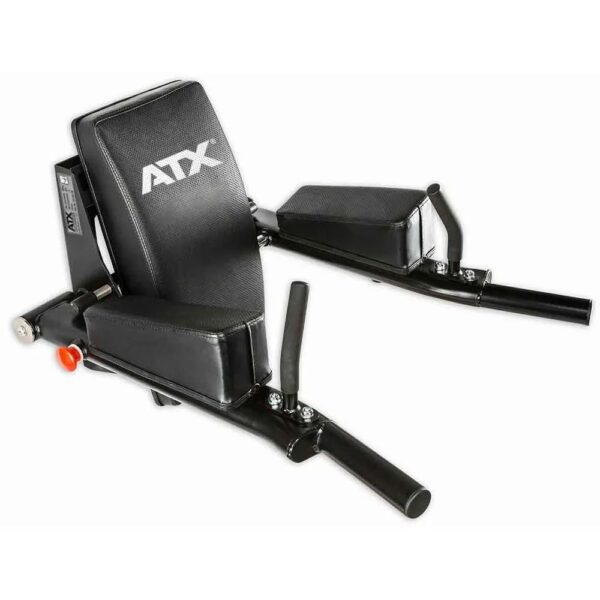
ATX Dips Leg Lift Combination Device | Foldable
- CHF 395.-
- 350 kg
- Grip width 62 cm
- Handle 50 mm
- folded 13 cm
- 18.5 kg
Dips and leg raises on the wall, folded away after training. Unfolded, the station extends 71.5 cm into the room, folded it is 13 cm. That is 58.5 cm of recovered depth over a total width of 70 cm, meaning around 0.42 m² of floor space is freed up again. Mounting hardware is not included in the scope of delivery.
Ideal for: Rental apartment, multipurpose room, and low cellar ceilings, provided the wall is load-bearing.
View wall station
Home Rack Essential | Ideal for Home
- CHF 295.-
- 300 kg
- 210 cm high
- 143 x 123 cm
- Pull-up device
- Steel
The direct replacement for the freestanding power tower when drilling holes is not possible. The pull-up device allows for various grip options, and you train leg raises hanging from the bar. For dips, you need a separate station. In return, the construction supports 300 kg and simultaneously serves as a barbell rack.
Ideal for: Beginners who want to stay freestanding and expand with a barbell later.
View Home Rack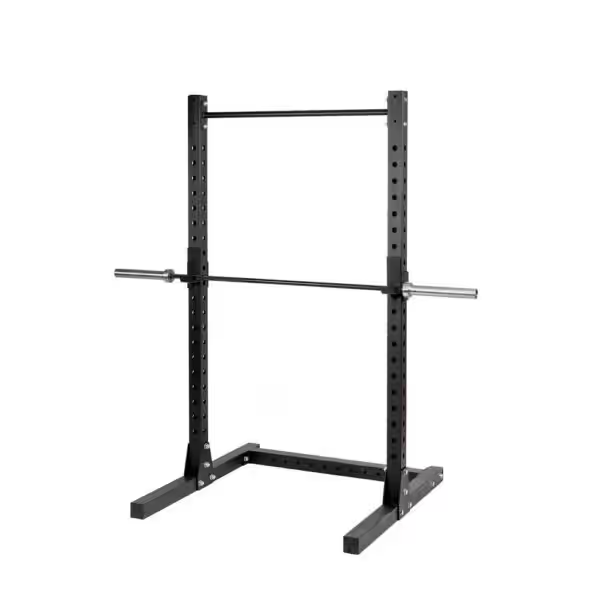
R-SERIES Half Rack
- CHF 390.-
- 500 kg
- 120 x 120 x 230 cm
- Pull-up bar
- J-Hooks included
- expandable
The open design allows full freedom of movement and supports 500 kg. With the R-Series Dip Bars for CHF 95.- dips are included, with ab straps for CHF 25.- the hanging leg raise. Total CHF 510.- for all three power tower exercises plus squats and bench press.
Ideal for: everyone who will foreseeable also train with the barbell.
View Half Rack| Setup | Pull-up | Dip | Leg Lifts | Barbell | Price |
|---|---|---|---|---|---|
| Wall solution: Pull-up bar plus multi-gym | Yes | Yes | Yes | no | CHF 465.- |
| Home Rack Essential | Yes | no | with loops | Storage 300 kg | CHF 295.- |
| Half rack plus dip bars plus straps | Yes | Yes | Yes | Storage 500 kg | CHF 510.- |
Borders
What a power tower cannot do
A power tower covers three exercises and stops there. Legs, lower back, and all pulling muscles in a horizontal plane are left out because the unit has neither a barbell support nor a rack, and the load always hangs vertically against the body. Anyone planning to do squats, deadlifts, or bench presses needs a second piece of equipment anyway, and then you have a tower taking up space whose functions the rack already provides. The second limitation is progression: As soon as you can do more than ten clean pull-ups, you need additional weight or more difficult variations, and both require a station that supports significantly more than your body weight. Conversely, for beginners: Anyone who cannot yet manage a pull-up progresses faster with assistance bands, which the Resistance Bands Buying Guide breaks down by tensile force. A tower alone does not solve this problem; it merely provides the pole.
The third boundary is noise: Freestanding stations transmit every jump as an impact into the floor. In an apartment, a dampened mat is therefore mandatory, and even then, the jump remains audible. Wall-mounted solutions channel the force into the masonry and are noticeably quieter.
Recommendation
What is worth it for whom
Beginners, body weight
You want to learn pull-ups and dips and nothing else. If the wall is load-bearing, the wall-mounted solution is the cheapest clean option. If not, get the freestanding one. Beginner rack for home.
Rental apartment, low ceiling
A freestanding tower doesn't work with a ceiling height under 2.50 m. Set the pull-up bar to the height you need, and add the foldable dip station.
Barbell strength training
A power tower would be a dead end here. Get the half rack and add dips and leg raises later, then you'll have both in one setup and a 500 kg capacity in reserve.
Club, studio, practice
As soon as several people are training at the same time, a single station is not worthwhile. The selection of benches and racks shows from when multiple stations are worthwhile.
Frequently Asked Questions
Power Tower: the most important answers
What are the benefits of a power tower?
A power tower gives you three basic bodyweight exercises at one station: pull-ups for the latissimus, shoulders, and biceps; dips for the chest, anterior deltoids, and triceps; and leg raises for the abdominal muscles. Many models also feature low handles near the base for push-ups. With this, you can train your entire upper body without weights.
What is the difference between a power tower and a multi-gym?
A power tower works exclusively with your body weight and has neither weight blocks nor cable pulleys. A multi-gym, on the other hand, guides the movement via cables and a weight stack that you adjust in increments. The power tower is significantly smaller and more affordable, while the multi-gym covers more muscle groups and allows for finer resistance adjustment.
Does a power tower need to be attached to a wall or floor?
A freestanding power tower does not need to be anchored as long as its dead weight and footprint match the user's weight. With lightweight models under 30 kg, the frame will still wobble during dynamic pull-ups. Wall-mounted stations like the ATX multi-gym transfer the force into the masonry and therefore strictly require a load-bearing wall.
For whom is a power tower not suitable?
It is not suitable for anyone who wants to train with a barbell, for rooms with a ceiling height of less than around 2.50 m, and for advanced users who already work with additional weight. In these three cases, a rack provides more exercises, more headroom, and usually also the better value for money.
Can I do leg raises without a power tower?
Yes. Hanging leg raises work on any stable pull-up bar. Ab straps with carabiners take the weight off your forearms and allow you to work cleanly from the abdominal muscles instead of failing prematurely at the grip. They cost CHF 25 and fit on any bar with a suitable diameter.
Does Fitness-Flohmarkt carry a power tower?
No, we deliberately do not carry a classic freestanding power tower. In the same price range, you can get either a fold-away wall-mounted station, a freestanding entry-level rack, or a half rack with attachments from us. All three cover pull-ups, dips, and leg raises, and offer either more capacity or a smaller footprint.
Measure your blanket first, then decide
Room height, floor space, and wall condition determine which setup is even an option. All racks and rigs are available ready to ship from the Swiss warehouse.
View Rigs & Racks