




Fitness Flohmarkt · Guide
HYROX vs. CrossFit: The Real Difference and What's Right for You
Both formats mix strength and endurance, both hurt, and both are constantly confused. The difference still decides how you train and which Functional training equipment should be with you.
In short
HYROX is a competition format, CrossFit is a training method with its own competition scene. In HYROX you know the sequence beforehand: 8 kilometers of running, 8 stations, worldwide in the same order. CrossFit changes the workout daily and requires technically demanding movements like the snatch or muscle-up. The difference lies in predictability, not in toughness.
The core question
What is the difference between HYROX and CrossFit?
The difference isn’t a matter of intensity, but of category: HYROX is a competition format, while CrossFit is a training method that has evolved into a competitive sport. A HYROX race consists of an 8-kilometer run, divided into eight 1-kilometer segments, with one strength station between each segment. These eight stations are identical worldwide and always follow the same sequence, which is why you can tailor your training exactly to them. The Buying Guide for HYROX Training shows which weights apply in each class. CrossFit, on the other hand, is defined as a method: constantly changing functional movements, performed at high relative intensity and guided by a coach at an affiliated gym. You won’t find out what’s on the agenda for the day’s workout until you get there. In short: One is a clearly defined task with fixed content; the other is a training system that deliberately leaves the content open-ended.
Both formats share a large part of their exercise repertoire. Sleds, kettlebells, wall balls, rowing, and burpees are featured in both. The difference lies in the peripherals: CrossFit incorporates Olympic weightlifting and gymnastics elements, while HYROX adds running. If you’re wondering whether you need to go to a specialized gym for this, the Comparison Between a Gym and CrossFit Continue.
| Feature | HYROX | CrossFit |
|---|---|---|
| What It Is | Competition format, a fitness race | Training method with its own competition setting |
| Origin | Launched in Hamburg in 2017 | A trademark of CrossFit, LLC, based in the United States |
| Procedure | 8 x 1 km running plus 8 stations, fixed order | A different workout every day, no set sequence |
| Previously known | Complete, consistent worldwide | usually not until the day of practice |
| Timeframe | a continuous race without a time limit | Class lasting 30 to 60 minutes, including 10 to 20 minutes of exercise |
| Technical Complexity | low to medium | Moderate to advanced, including pull-ups and muscle-ups |
| Where to Work Out | Home gym, fitness center, outdoors, fitness clubs | mainly at the affiliated gym with a coach |
| Competition Divisions | Open, Pro, Doubles, Relay | Open qualification with advanced levels |
| Distribution | Over 100 events worldwide in 2026 | over 9,000 affiliate gyms worldwide |
Competition
How do the competitions differ?
HYROX is a standardized race, while CrossFit is a competition with a deliberately unknown format. With HYROX, you know weeks in advance which eight stations will be included, in what order, and what weight your class will be lifting. You can compete alone in the Open or Pro class, in pairs in the Doubles, or in teams of four in the Relay. No qualification is required to start, there’s no time limit, and over 98 percent of participants finish their race. In CrossFit, the element of surprise is part of the concept: The challenges are released shortly before the competition, and anyone who wants to advance must qualify through several levels. Because all races are structured identically, you can also compare your HYROX time with others worldwide. That’s why one feels like a fun run and the other like a sport with a league structure.
For your training, this has a practical consequence. A HYROX goal can be planned backwards because the task is set. A CrossFit competition cannot be planned towards individual tasks, but only through broad fitness. Anyone working towards a race for the first time therefore comes with the Equipment for the eight competition stations faster to the destination than with as broad a range of devices as possible.
Technology
Which is more technically demanding, HYROX or CrossFit?
CrossFit is significantly more demanding technically. The eight HYROX movements are intentionally kept simple: pushing, pulling, carrying, throwing, rowing, jumping, running. Anyone who wants to learn them with proper form needs weeks, not years. CrossFit, on the other hand, includes Olympic weightlifting and gymnastics elements. Snatches, clean and jerks, kipping pull-ups, muscle-ups, and handstand push-ups are movements that many practitioners work on for months before they can even perform them under time pressure. Exactly for this reason, CrossFit is organized as an instructor-led class format in which a trainer corrects form and adjusts the load to the individual's level. The trade-off for the simpler HYROX movements is the duration: what is technically easy still becomes hard over 100 repetitions, and even more so after running five kilometers. In return, you can practice the movements unsupervised without putting yourself in danger. Both formats are challenging, therefore, just in completely different ways.
Add up the official block times of a CrossFit class and the difference becomes tangible: 5 to 10 minutes of warm-up, 10 to 20 minutes of strength or technique work, 10 to 20 minutes of workout, and 5 to 10 minutes of cool-down result in a class of 30 to 60 minutes, of which only 10 to 20 minutes are scored workout. The rest is technical work. A race does not know this breakdown.
This leads to an honest counter-statement: If you want to learn Olympic lifting, HYROX training won't get you there. For that, you need a Olympic barbell with 50 mm sleeve and discs that you are allowed to drop in a controlled manner. Weightlifting assortment covers this path, a sled does not.
Entry
Which works better for the introduction?
For beginners with no prior experience, HYROX offers the lower threshold, while CrossFit is the better school. HYROX requires no qualification, no time limit, and no complex movements, and over 98 percent of participants finish their race. Anyone who can run and trains with focus for a few months will make it through. CrossFit has a higher barrier to entry, but delivers something a race format does not: a guided class where every movement is adapted to your level and someone shows you what a squat looks like. If your actual problem is technique and consistency, the box is the faster path. If your problem is motivation and a lack of a goal, a race date is more effective than any membership. And if you are unsure: a race can be tried once and then evaluated at your leisure, whereas a class format requires regularity and a subscription right from the start.
The second point is trivial, but often decisive: you can prepare for a HYROX goal largely on your own, whereas getting started in CrossFit is practically impossible to do alone. For home, a few pieces of equipment are enough to start, such as a Competition-grade punching bag and two kettlebells of equal weight. A box entry, on the other hand, relies on coaching, not equipment.
Combination
Can you combine HYROX and CrossFit?
Yes, and in practice, many people do this. Most of the eight stations consist of movements that regularly occur in CrossFit anyway: sleds, kettlebells, wall balls, rowing, burpees, and lunges. What is structurally missing in many boxes is running volume. Half of a race consists of running, and this workload hardly ever appears in sufficient quantities in short workouts. Conversely, CrossFit gives a pure runner the exact strength base they need for sleds, sandbags, and carries, which cannot be built with running mileage alone. The combination is therefore sensible if you manage it consciously: technique and strength from the class format, running volume and the competition sequence separately and planned. Run uncoordinated alongside each other, however, both programs mainly lead to too much volume, too little progress, and an increased risk of overuse injury.
If you want to achieve both at home, you don't buy two pieces of equipment, but the intersection. Devices that are suitable for strength and endurance at the same time can be found bundled in the Hybrid category.
Equipment
What equipment do you need for which format?
The equipment overlaps to a large extent and diverges in exactly two places. HYROX strictly requires something to push and pull, as well as loads that you can carry over a longer distance without putting them down. CrossFit strictly requires a barbell with drop-weight plates and an overhead pull-up bar. Everything in between, meaning kettlebells, medicine balls, jump ropes, a plyo box, and a durable floor, belongs to both formats equally. If your budget is limited, you are therefore not choosing between two complete setups, but rather deciding which of the two specialty corners you build first. The answer comes from your goal and not your budget: Anyone who has a race date on the calendar buys the sled side first. Anyone who wants to learn technique and lift heavier buys the barbell side first. The four pieces of equipment below each represent one of these two corners.
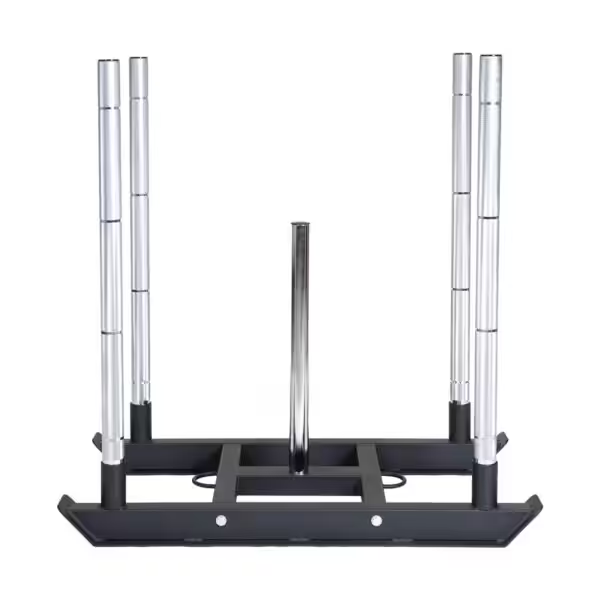
Competition Sled | Weight Sled
- 50 kg dead weight
- up to 150 kg payload
- 109 x 61 cm, 108 cm high
- 50 mm shot
- CHF 295.-
The Competition Sled is the machine most commonly missing in normal studios. Symmetrically built, so it can be used for pushing and pulling without conversion. Weights are not included.
Ideal for: everyone who is training for a race and has a pull or push area.
To the Sleigh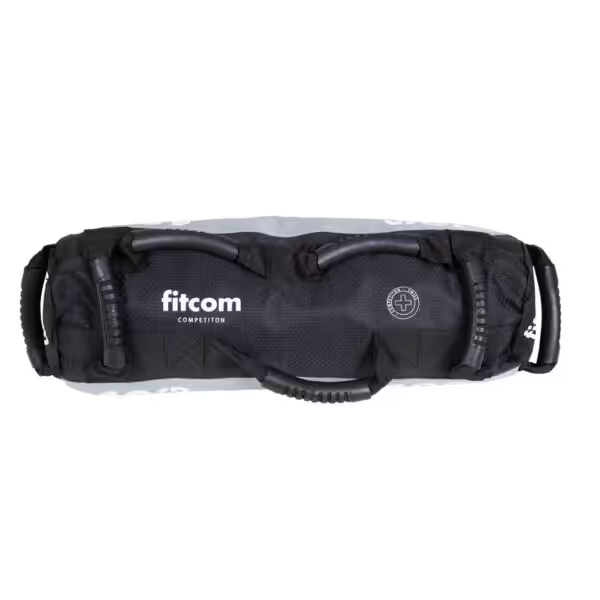
Competition Sand Bag | Powerbag
- 10, 20 or 30 kg
- Nylon, reinforced seams
- 52 to 60 cm long
- delivered without sand
- from CHF 65.-
Shape and handling correspond to the competition equipment, which makes the difference when carrying it on the neck. The sand comes from the hardware store.
Ideal for: Weighted lunges and carry variations in the home gym.
To the sandbag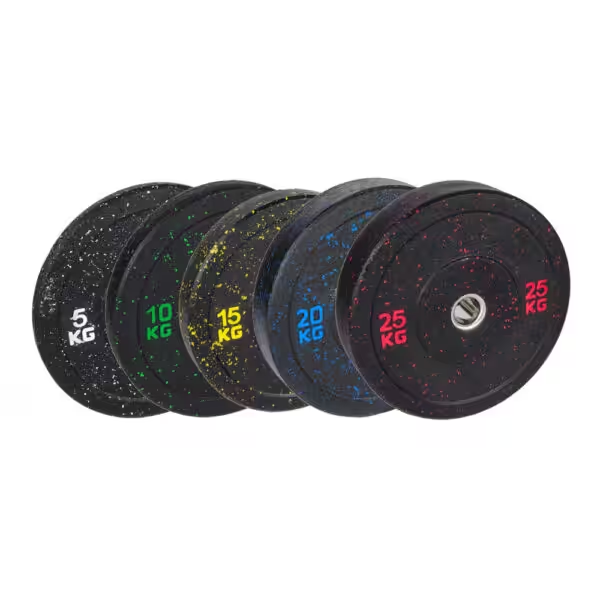
Bumper Plates | HiTemp
- 5 to 25 kg
- Diameter 45 cm
- Inner ring 51 mm
- droppable
- from CHF 20.-
Without drop bumper plates isn't practically feasible for Olympic lifting at home. All weights have the same outer diameter, so the bar is always at the same height. Which rubber hardness is suitable is explained by the Bumper Plates Buying Guide.
Ideal for: Snatch, clean and jerk, and deadlift with a controlled lowering.
To the panes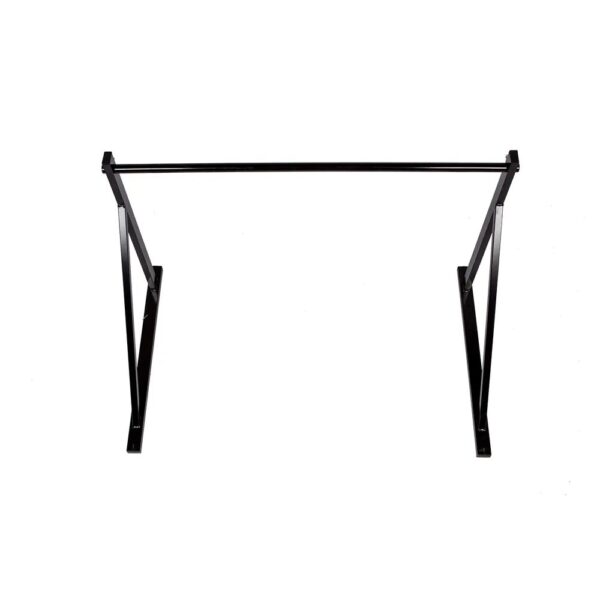
Pull Up Bar | CrossFitness Pull Up Bar
- 133 cm wide
- 77 cm wall clearance
- Handle 3 cm
- supports up to 200 kg
- CHF 70.-
Gymnastic elements need space in front of and behind the bar, not just underneath it. The 77 cm wall clearance is the reason why swinging is also possible here.
Ideal for: Pull-ups, toes-to-bar, and the introduction to gymnastics movements.
To the pull-up barDecision support
What is worth it for whom
You like running and want a goal
HYROX. You already bring half of the requirements and above all need to build strength endurance. Start with the Weight sled and two kettlebells of equal weight.
You want to learn technology
CrossFit. Snatch, clean and jerk, and gymnastics movements are learned faster and safer under instruction than alone. At home, you supplement that with a Pull-up bar for the wall.
You have little time
CrossFit. A class is done in 30 to 60 minutes and you don't have to plan anything yourself. Training for a race takes more time because of the added running volume.
You are equipping a club or studio
Both, but staggered. The sled side is missing almost everywhere and is worth doing first. We will advise you personally on the combination.
Frequently Asked Questions
Frequently asked questions about the difference between HYROX and CrossFit
Is HYROX easier than CrossFit?
Technically yes, physically not. The eight HYROX movements are deliberately kept simple and can be learned in weeks, whereas CrossFit includes Olympic lifting and gymnastics elements. On the other hand, a race runs continuously without a break, whereas a CrossFit workout usually lasts 10 to 20 minutes. Easier to learn therefore does not mean easier to endure.
Does CrossFit training help with HYROX?
A great deal. Most stations consist of movements that regularly occur in CrossFit anyway, plus the strength base for sleds and carries. What is missing is the running volume: half of a race consists of running, and that rarely appears in sufficient amounts in short workouts.
Do I need a CrossFit gym for HYROX?
No. For the preparation, a walking path and the equipment of the targeted stations are sufficient. Rowing and ski ergometers can be found in many gyms, but sleds and heavy sandbags are rarely found. Exactly for this reason, many people upgrade this corner at home instead of getting a second subscription.
What is the difference between HYROX and CrossFit in competition?
HYROX is fully standardized: eight stations, fixed order, identical loads worldwide, no qualification required. CrossFit announces the workouts only shortly beforehand and operates with a multi-stage qualification. One competition rewards targeted preparation for the known, the other broad fitness for the unknown.
Can I train both at the same time?
Yes, if you control it. It makes sense to get technique and strength from the class format and to plan running volume and the competition schedule separately. Running both uncoordinated alongside each other mainly leads to high volume with little progress and increases the risk of overload.
Which format is better for muscle building?
CrossFit, because it includes heavy compound barbell lifts and a progressive increase in load. HYROX training works predominantly in the strength-endurance range with fixed competition weights that cannot be increased at will. Anyone who primarily wants to build muscle needs a barbell and plates, not a sled and running shoes.
Build the corner you are missing
Whether for race preparation or barbell training: the functional training range is ready to ship in the Swiss warehouse.
For the hybrid training rangeTrademark notice
HYROX® is a registered trademark of HYROX World GmbH, Hamburg. CrossFit® is a registered trademark of CrossFit, LLC. Both trademarks are mentioned here exclusively for descriptive purposes to distinguish the two formats from one another and to indicate which training the products shown are suitable for. There is no license, partnership, or other business relationship between Fitcom AG or Fitness-Flohmarkt and HYROX World GmbH or CrossFit, LLC. All products shown are proprietary products of Fitcom AG and are neither manufactured, tested, nor certified by HYROX or CrossFit. The information regarding the procedure, competition categories, finisher rate, and number of events reflects the status published on hyrox.com as of August 2026, and the information regarding the method, category structure, and number of affiliate gyms reflects the status published on crossfit.com as of August 2026. Only the respective current information provided by the trademark owners is binding.