




Fitness Flohmarkt · Guide
How to use a foam roller correctly: rolling instead of just hurting
A foam roller costs CHF 12 here and yet lies unused under many beds because the initial attempts mostly just hurt. Here is how to roll properly, which areas to skip, and which tool from Mobility and Recovery suits you.
In short
Roll slowly and in a controlled manner, about the width of a hand per second. If you find a tender spot, stay on it for 20 to 30 seconds instead of moving back and forth frantically. The pressure may be uncomfortable, but never sharply painful. Joints, bones, and the lumbar spine should be avoided. One to two minutes per muscle group is enough.
Technology
How do you use the foam roller correctly?
Properly, you roll slowly, controlled, and with measured pressure. A pace of about one hand's width per second has proven effective: fast enough to feel like movement, slow enough to notice where it becomes sensitive. If you find such a spot, you stay on it for 20 to 30 seconds and keep breathing calmly, instead of frantically rolling right over it. One to two minutes per muscle group is enough, five to ten for the whole body. The key is moderation: the pressure can be uncomfortable, but never so sharp that you hold your breath or cramp up. If that happens, you take weight off by supporting yourself with your hands or your other leg. Joints, bones, the back of the knees, and the lumbar spine are to be avoided. The most common mistake is not too little pressure, but too much speed: anyone who rolls back and forth quickly isn't massaging, they're just rubbing the skin.
A spot that already hurts at rest does not belong under the roller, but needs to be checked out. And for individual pain points, the roller is not the right tool anyway, rather the Foam Ball 8 cm. How role and band complement each other in everyday life is described in Resistance Band Buying Guide.
| Body region | Tool | Duration per page | What you pay attention to |
|---|---|---|---|
| Front and outer thigh | Role | 60 to 90 seconds | Rest on forearms, slow down the pace |
| Calves | Role | 45 to 60 seconds | Place the second leg on top if more pressure is needed |
| Buttock | Roll or ball | 45 to 60 seconds | Sitting, ankle on the other knee |
| Upper back | Foam roller or duoball | 60 seconds | Pelvis raised, chin loosely toward the chest |
| Lower back | Duoball, not the roller | 30 to 60 seconds | Cutout directly above the spine |
| sole of the foot | Ball | 30 to 60 seconds | Lean against the wall while standing, adjust the pressure |
| Neck | Duoball or ball | 30 seconds | Only to the side of the spine, never in the center |
Time
Foam roller before or after working out?
Before training you roll briefly and quickly, after training longer and more calmly. The difference lies in the goal. Before the exertion, it is about opening up the range of motion for the upcoming exercises without making the muscles sluggish: 30 to 45 seconds per muscle group, followed by a few active movements so that the body also utilizes the gained range. After training, it can be slower and longer, because relaxation is the priority here rather than preparation. What the roller reliably achieves in the short term is both: slightly more mobility and a less uncomfortable physical feeling in the days following. What it does not achieve is replacing strength training or preventing injuries. Anyone who classifies it as a supplement rather than a miracle cure will end up using it longer. Two minutes before leg day do more than half an hour once a month.
On training-free days, neither rule applies, then you roll whenever it suits you. The roller belongs in the same compartment as the jump rope and band, so with the small parts from the Fitness accessories, which only work when they are not sitting in a drawer.
Back
Foam roller for the back: what you are allowed to roll and what not
You are allowed to roll the upper back, but not the lower one. The reason is anatomical: between the shoulder blades and the thoracic spine lies a strong layer of muscle that absorbs the pressure, and the ribcage additionally stabilizes the spine. Both are missing below the last rib. There, the lumbar vertebrae lie directly beneath a thinner layer of muscle, and a hard roller tends to push the spine into a hollow back rather than loosening the muscle. For the upper back, you place the roller transversely under the shoulder blades, lift your pelvis slightly, and let your chin drop loosely toward your chest. Anyone who still wants to work on the lower back should take the DuoballTwo connected balls with a recess in the middle leave the spinous processes free and only hit the muscle strands to the left and right of them. It works on the same principle on the neck. The limit is approximately at the level of the lowest rib, and it is not a recommendation, but a rule.
The Duoball is available in 16 cm and 24 cm. The smaller version works more specifically and fits well on the neck and lumbar region, while the larger one distributes the pressure more broadly. If back pain persists, no tool can replace a medical evaluation. Further equipment for this is in the Rehab and physio category.
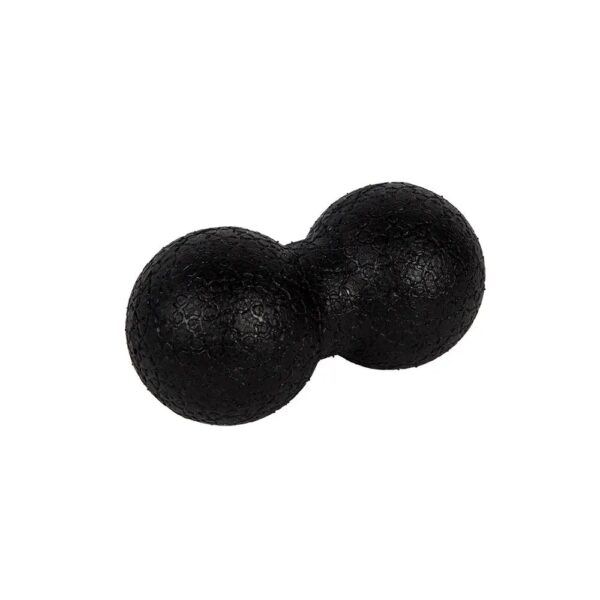
Duoball Massage Ball | Fascia Massage Roller
- 16 cm or 24 cm
- 0.2 or 0.3 kg
- Rigid foam
- up to 100 kg
- Art. F-92419
The only tool in the range that may be used along the spine. The pressure lands on the muscle strands to the left and right, not on the vertebrae. Available individually in both sizes or as a pair.
Ideal for: Neck and back tension from sitting, lower back, for use lying down or against the wall.
Watch DuoballSelection
Firm, soft, or Blackroll: what matters when it comes to foam rollers
Four details matter: length, diameter, firmness level, and maximum load. The name doesn't matter. Blackroll is a brand name that became so well-known that many use it like a product category; foam roller is the English term for the same thing, and anyone comparing fascia rollers in a sports store, at Decathlon, or online will find the same product under all three terms. When it comes to firmness: for most people, a hard roller is the right choice; soft rollers are more for easing back in after a long break. A soft roller gives way under body weight, distributes pressure over a larger area, and penetrates less deeply into the muscle. That's more comfortable, but doesn't do much for strong thighs. At Fitness-Flohmarkt we exclusively carry hard rollers and balls; you won't find a soft fascia roller with us. We prefer to state this gap in our assortment rather than gloss over it: anyone who insists on rolling softly will find what they're looking for elsewhere.
Anyone who finds the pressure too intense does not necessarily need a different product, but rather a different dosage: distribute more weight onto your hands and feet, work while sitting instead of lying down, or use the roller on a Yoga mat which absorbs part of the pressure. More important than the degree of hardness is the load limit anyway: The Foam Roller 30 cm is approved up to 100 kg, and when rolling the thighs, practically the entire body weight rests on it.

Foam Roller 30 cm | Fascia Massage Roller
- 30 cm long
- 15 cm diameter
- 0.3 kg
- Rigid foam
- up to 100 kg
- Art. F-58947
The classic black fascia roller for everything with surface area. At 30 cm in length, it covers one side of the leg in a single motion and remains short enough to fit horizontally under the shoulder blades.
Ideal for: the introduction, large muscle groups, warm-up before running, recovery after leg day.
View foam rollerTool selection
Foam roller, massage ball, or duoball: which tool for which body part?
The roller is for areas, the ball for points, the duoball for the spine. With that, the choice is summed up in one sentence. Thighs, calves, glutes, and upper back are muscle areas that a 30 cm long roller glides over in a single movement. The sole of the foot, the shoulder blade, and specific points in the glutes, on the other hand, need to be targeted precisely, and for that, an 8 cm diameter ball is the more precise tool. The duoball, in turn, is the only one of the three that may lie along the spine. All three are made of hard foam, black, and can support up to 100 kg. Anyone who wants to cover all three situations can buy them individually or as a set: Bought individually, that's at least CHF 22.--, namely CHF 12.-- for the roller, CHF 5.-- for the ball, and starting at CHF 5.-- for the duoball. The Fascia training set bundles the same three parts for CHF 19.-.
Hardly anyone needs a fourth tool. Anyone facing the same question with a different product group will find in the Overview of all buying guides the appropriate comparison.
| Tool | Mass | Weight | Load-bearing up to | What for | Price |
|---|---|---|---|---|---|
| Foam Roller 30 cm | 30 cm long, 15 cm diameter | 0.3 kg | 100 kg | Thighs, calves, buttocks, upper back | CHF 12.00 |
| Foam Ball 8 cm | 8 cm diameter | 0.05 kg | 100 kg | sole of the foot, shoulder blade, neck, individual points | CHF 5.00 |
| Duoball | 16 cm or 24 cm | 0.2 or 0.3 kg | 100 kg | spine, neck, lower back | from CHF 5.- |
| Fascia training set | Foam roller, duoball, and ball together | all three parts | 100 kg | all applications in one package | CHF 19.- |
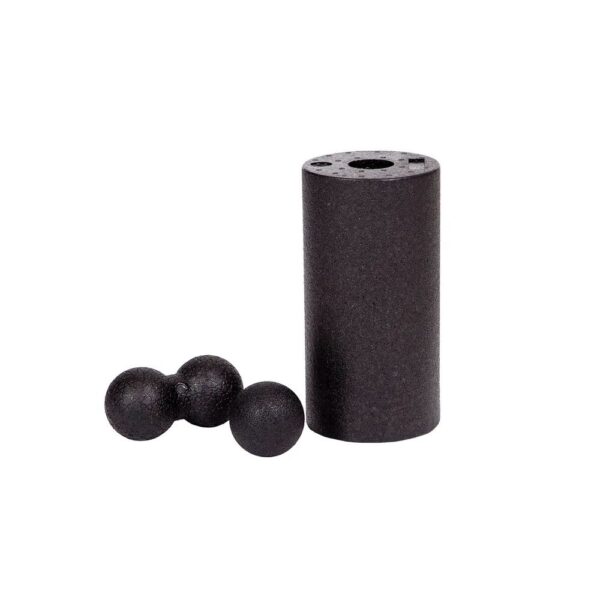
Fascia training set | 3-piece
- Foam Roller 30 cm
- Duoball 16 or 24 cm
- Foam Ball 8 cm
- CHF 19.-
- Art. F-25538
Foam roller for the surface, duoball for the spine, ball for the trigger point: three tools that do not overlap in use. Bought individually, the same combination costs at least CHF 22.–.
Ideal for: all those who don't want to buy items individually, and as a gift for female runners and heavy sitters.
View setDecision support
What is worth it for whom
You are just starting
One roller is enough. It covers the major muscle groups where the effect is most noticeable. Take the Fascia roller for CHF 12.00 and add later.
You sit all day
Your trouble spots are the neck and upper back, exactly the regions where a hard foam roller quickly reaches its limits. Duoball in 16 cm work cleaner there.
You run or do endurance sports
Calves, sole of the foot, and outer thigh are your constant topics. For the legs you use the roller, for the sole of the foot a Ball with 8 cm diameter.
You are equipping a practice or studio
Here, quantity and durability count. Hard foam withstands continuous use and is wipeable. You can find the rest for the treatment room in the Rehab and physiotherapy range.
Frequently Asked Questions
Fascia roller: the most frequently asked questions
How long should you roll on one spot?
20 to 30 seconds per sensitive spot is a good guideline, one to two minutes per muscle group. Longer rarely helps more, because the effect comes from the calm, steady pressure and not from the duration. Five to ten minutes are enough for a round covering legs, glutes, and upper back.
Why does the foam roller hurt so much?
Usually, it is due to too much weight on too small an area. A hard roller with a diameter of 15 cm concentrates the pressure heavily, and with your entire body weight on it, that quickly becomes more than unpleasant. Support yourself with your hands or the second leg and work more slowly, then the pain will decrease immediately.
May I roll my lower back with the foam roller?
No, you leave the lower back alone with the roller. Below the last rib, the protective ribcage is missing, and the hard roller pushes the lumbar spine into a swayback. Use the duoball there instead, whose recess sits over the spine and only works the muscle strands next to it.
Is a Blackroll the same as a foam roller?
Yes, Blackroll is a brand name for a fascia roller, not a distinct product type. Foam roller is the same thing in English. What matters for your choice is not the name, but the length, diameter, firmness level, and maximum load capacity. Our roller measures 30 cm with a 15 cm diameter, is firm, and can support up to 100 kg.
How often should I use the foam roller?
Daily is possible, three to four times a week is usually enough. Because it is a massage and not training, you don't need to schedule rest days. Rather than one long session per week, short five-minute routines that can be maintained alongside training are more sensible.
Does the foam roller help with sore muscles?
It can lessen the feeling of sore muscles in the days that follow, but it does not speed up muscle recovery. When you have sore muscles, roll with significantly less pressure than usual and do not target any spot that already hurts when at rest. If the pain remains severe for several days, it should be evaluated.
Ready for the first clean lap?
Foam roller, ball and duoball are in stock at our location in Liestal and are shipped from there throughout Switzerland.
View all fascia tools