



Fitness Flohmarkt · Guide
Balance Board or Balance Pad: How to Train Your Ankles
Both devices make the surface unstable, but in very different ways. Here is which one fits your training level and which one you can skip.
In short
A balance pad is a soft foam block that yields under the foot in all directions. A balance board tips over a hard hemisphere and challenges the ankle significantly more. For coordination and ankle stability, the board is the more intensive choice, while the pad is the gentler one. If you are only buying one device, get the board.
The difference
What is the difference between a balance board and a balance pad?
A balance board is a solid platform that sits on a pivot point and therefore tilts. In the round design—also known as a wobble board, balance gyroscope, or therapy gyroscope—there is a hemisphere beneath the platform, allowing the board to tilt in all directions. A balance pad, on the other hand, has no pivot point: it is a block of soft foam that sinks unevenly under the body’s weight. So the board moves, while the pad yields. This results in a practical difference: on the board, you have to actively stop a tilting motion; on the pad, you correct a gentle, slow sinking. This makes the board faster, more unpredictable, and significantly more challenging for beginners. In both cases, you control the intensity of the challenge through your stance. If you look into the subject, you’ll find these devices in the same category as resistance bands and small equipment, which we cover in the Resistance Band Buying Guide Classify it. By the way, whether you write “Balanceboard” or “Balance Board,” it’s the same device.
First, let me address one point that comes up regularly in our inquiries: We do not currently carry a classic balance pad made of soft foam. In the Category Balance Trainer There's a wobble board and an air cushion trainer. If you still want the softer option, a thick mat will do the trick—more on that below.
Designs
What balance boards are there and which one is right for you?
There are four common designs, and they differ primarily in the number of directions in which the device tilts. The round wobble board tilts in all directions via a hemisphere and is the most versatile design for ankle strength and coordination. The rocker board tilts only along a single axis—usually back and forth—making it more predictable and easier to use. The balance ball—an inflatable hemisphere mounted on a solid base—also provides additional give and is suitable for full-body exercises because you can kneel, sit, or rest your hands on it. The roller board, with a loose roller beneath the board, is the most challenging variant and originates from surfing and snowboarding, since the board can roll away sideways. For ankle exercises, the first two types are perfectly sufficient. If you compare balance boards at Swiss sports retailers, you’ll usually find the same design: a round wooden disc, a hemisphere underneath, and a non-slip surface.
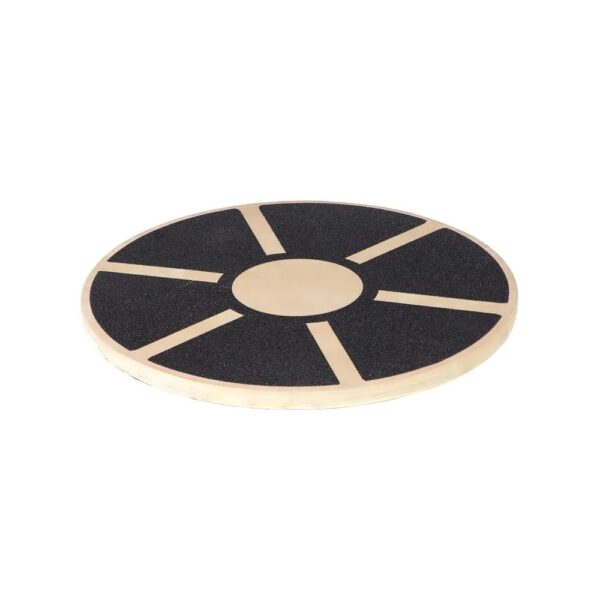
Round Balance Board | Wobble Board
- Ø 40 cm
- Height 8 cm
- Wood
- Max. 110 kg
- Item No. F-41118
- CHF 18.-
The round wooden disc with a hemisphere underneath—the design that has been a staple in physical therapy practices for decades. It tilts in all directions, has a non-slip surface, and, at 40 cm in diameter, takes up very little space. At CHF 18, it’s the most affordable and practical device for ankle exercises that we carry, and it can be stowed behind a door.
Ideal for: Ankle mobility and coordination, one-legged exercises, small training spaces.
View wobble board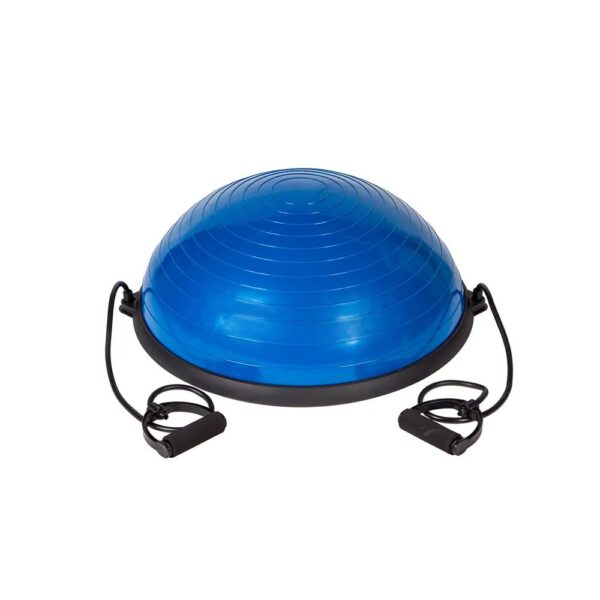
Balance Trainer | Balance
- Ø 58 cm
- Height 24 cm
- Rubber and plastic
- Max. 150 kg
- incl. straps
- Art. F-74727
- CHF 60.-
The inflatable hemisphere on a fixed base, with side resistance bands for pulling exercises. Because you choose the air pressure yourself, you can continuously adjust the difficulty level: a lot of air means more wobbling, less air a steadier surface. The 58 cm diameter allows exercises that are not possible on a 40 cm disc, such as push-ups or kneeling.
Ideal for: Core and full-body exercises, varying levels of difficulty, gyms and physical therapy clinics.
View Balance Trainer| Device | Type | Mass | Max. Load | Price | What for |
|---|---|---|---|---|---|
| Balance Board Circuit | Wooden disc on hemisphere, tilts all around | Ø 40 cm, height 8 cm | 110 kg | CHF 18.- | Ankle, One-Legged Stand, Coordination |
| Balance Trainer | Air cushion on a solid plate; it bounces and tilts | Dia 58 cm, height 24 cm | 150 kg | CHF 60.- | Full-body, core, pulling exercises with bands |
| NBR exercise mat | Soft foam—it sinks in instead of tipping over | 180 x 60 cm, 15 mm | not specified | CHF 19.- | Replacement for the Balance Pad, a gentle introduction |
| Balance Pad | Soft foam block, sinks unevenly | Not in our product lineup | Not in our product lineup | Not in our product lineup | A very gentle start, physical therapy |
The benefit
What are the benefits of balance training for the ankles?
Balance training improves coordination between the ankle joint, calf muscles, and nervous system. When the surface tilts, the joint signals the change in position to the spinal cord, and the stabilizing muscles react before you consciously make a decision. This very reaction becomes faster and more reliable when you practice it regularly. That’s why you’ll find a gyroscope in almost every physical therapy office, and why balance board exercises are part of the standard regimen for follow-up care after ankle injuries. For you in everyday life, this means you’re more likely to compensate for uneven ground—whether in the woods, on gravel, or on a curb. A balance board doesn’t make you stronger in the sense of increased muscle strength, but it does make you more responsive. If you want to build strength in your calves, you’ll also need to do calf raises with added weight, because the load on the board alone isn’t enough.
Here’s the honest caveat: If you’ve just been injured, are experiencing pain, or have recurring instability, buying a device from an online store isn’t the right first step. In those cases, load management should be handled by a physical therapist or doctor, and the device can be introduced later. If you already have a guide and are looking for equipment for home use, you’ll find it in our Rehab and Physio Category the remaining small appliances.
The structure
How do you structure your balance training?
Progress in this order: first soft surface on two legs, then soft surface on one leg, then board on two legs, then board on one leg, then board with eyes closed or an additional task. Each level is considered passed if you stand still for 30 seconds without the edge of the board touching the floor. Two to three sessions per week of five to ten minutes each are completely sufficient; balance is a nervous system task, not a question of training volume. It is best to place the training at the end of your warm-up while you are still fresh, because tired legs provide poorer feedback. Stand barefoot or in thin socks on the board, because cushioned running shoes filter out the exact information you want to train. And place the device so that a wall or the back of a chair is within reach.
- Level 1: Bipedal stance on a soft surface, 3 x 30 seconds.
- Stage 2: Single-leg stance on a soft surface, 3 x 30 seconds per side.
- Level 3: Two-foot stance on the board, do not let the edge touch down.
- Level 4: Single-leg stance on the board, 3 x 30 seconds per side.
- Level 5: One-leg stand with an additional task, such as catching a ball or closing the eyes.
You don't need a separate device for the soft steps. Our NBR Exercise Mat is 15 mm thick; folded once that results in 30 mm, folded twice 45 mm of soft foam under the foot. A purchased balance pad is usually a bit thicker, but 45 mm is enough to make the stance noticeably unstable. Anyone who needs the mat for floor exercises anyway saves themselves a second piece of equipment. For pure floor work without any balance requirements, the thinner one will also do 6 mm TPE yoga mat, additional variants are available in the Yoga mat category.

Gymnastics mat NBR | Fitness mat
- 180 x 60 cm
- 15 mm
- NBR foam
- nonslip
- with carrying strap
- Art. F-91365
- CHF 19.-
15 mm thick high-density foam, non-slip and water-resistant, featuring hanging eyelets and a carrying strap. Folded, it serves as a soft standing surface for the first two training levels; rolled out, it is the mat for everything that follows on the floor.
Ideal for: Introduction to balance training, floor exercises, joint-friendly mat.
View NBR MattePurchase criteria
What to look for when buying a balance board
Four values are crucial: diameter, height, load capacity, and surface. The diameter determines how far apart your feet can be; 40 cm is sufficient for single-leg stands and ankle work, while push-ups or kneeling require more surface area. The height determines the tilt angle: the higher the structure, the further the board tilts and the more demanding the stance becomes. The load capacity must clearly exceed your body weight because balancing temporarily puts more load on one edge than your static standing weight. And the surface must be slip-resistant, otherwise you are not training balance, but slip prevention. Wood versus plastic, on the other hand, is less important than it sounds: wood is dimensionally stable and durable, while plastic is usually lighter and often features an adjustable hemisphere. For home use, the material makes hardly any difference.
The surface is often overlooked. On parquet or tiles, the hemisphere can drift, on deep-pile carpet the board tilts unevenly. The board stands best on a firm, slightly gripping surface, i.e., on a rubber sheet or a non-slip mat. Which floor thickness is suitable for what is stated in the Fitness Flooring Buying Guide. And if you're adding small equipment anyway: A short loop around the ankles works well for balance training, you can find the variations in the Fitness band category.
Children
Balance Boards for Kids: What Should You Keep in Mind?
Three rules apply to children: supervision, free space, and a device that is not too high. Children handle a wobble board differently than adults; they jump on it, spin around, and experiment, and that is precisely the appeal, because coordination is very responsive during growth years. Therefore, what matters less is the weight capacity, which at 110 kg is more than enough for any child, but rather the surrounding area: at least one arm's length clear all around, no table or shelf edges at falling height, and no slippery floors. A low, round board is more suitable than a roller board because nothing can roll away. A specific age cannot be stated, as balance and body control mature at very different rates; it makes sense as soon as a child can stand securely on one leg.
Recommendation by profile
What is worth it for whom
Female runner and ball sport athlete
Those who travel on uneven terrain or abruptly change direction benefit most from the tipping sensation. The round wobble board for CHF 18.- is completely sufficient for this.
Studio, club, and physiotherapy practice
This requires devices that adapt to different people. The Balance Trainer with adjustable air pressure covers everything from cautious entry-level use to hard progression and supports up to 150 kg.
Home gym with a strength focus
Balance does not replace strength training, but it is a good addition as a warm-up finisher. A wobble board costs less than a weight plate and disappears between the rack and the wall.
Cautious start
Anyone who is still unsteady on one leg should start softly instead of tipping. Folded two to three times NBR mat for CHF 19.-, Wand within reach, board only afterwards.
Frequently Asked Questions
Balance Board and Balance Pad: The Most Important Answers
What is the benefit of a balance board?
A balance board improves the responsiveness of the ankle and stabilizing muscles. Because the board tilts, your nervous system has to constantly correct the movement, and this correction becomes faster over time. This helps on uneven terrain and when catching missteps. It barely builds strength; that requires additional weighted resistance.
Balance board or balance pad: which is better for the ankles?
For a noticeable workout, the balance board is the better choice because the tilting motion is faster and more unpredictable than sinking into the foam. The balance pad is suitable for beginners, for very cautious progression, and for people who cannot yet stand securely on the board. The sensible order is pad first, board second.
How long should you stand on a balance board every day?
Five to ten minutes on two to three days a week are enough. Balance is a task of the nervous system, not of muscle volume, which is why long periods of standing every day bring little additional benefit. It is more effective to increase the difficulty: from a two-legged to a one-legged stance and then with an additional task.
Is there a balance board test winner?
We do not know of an independent Swiss test that we could refer to. Test winner lists online are usually comparison sites without their own testing. Rely instead on verifiable values: diameter, installation height, specified maximum load, and a truly non-slip surface. These four details determine suitability and safety.
Is a wooden balance board better than a plastic one?
For home use, the material makes little difference. Wood is dimensionally stable, durable, and does not soften with continuous use; plastic is lighter and more often features a height-adjustable hemisphere. More important than the material are the non-slip surface and a weight capacity that clearly exceeds your body weight.
From what age is a balance board suitable for children?
A specific age cannot be stated because balance develops at very different rates. As a guideline: as soon as a child can stand securely and calmly on one leg. Supervision, a clear space of at least an arm's length all around, and a low round board instead of a construction with a loose roller are important.
Does a balance board help after a twisted ankle?
Coordination training is part of the standard follow-up care for ankle injuries, but the timing and dosage belong in expert hands. In the case of a fresh injury, persistent pain, or recurring instability, you should clarify this with a doctor or physiotherapist first. After that, a balance board is an affordable tool to continue the exercises at home.
Start with the simplest device
A round wobble board costs less than a training shirt and covers everything ankles need.
View Balance Trainer in the shopNote
This guide does not replace medical or physical therapy advice. In the event of pain, fresh injuries, or recurring ankle instability, consult a professional before training.