



Fitness Flohmarkt · Guide
Yoga mat, exercise mat, floor mat: which mat you really need
Three terms that get confused in everyday life and three completely different products. Anyone who knows the difference buys right once instead of buying the wrong thing twice.
In short
A yoga mat is thin and non-slip, intended for yoga and pilates. A gymnastics mat is thicker and cushioned, intended for floor exercises, core training, and rehab. A floor mat is not workout equipment, but rather flooring: it is laid out as a surface and protects the subfloor. For floor exercises, you additionally need a mat on top of it.
The three terms
What is the difference between a yoga mat, a gym mat, and a floor mat?
Yoga mats, exercise mats, and floor mats differ in thickness, material, and—most importantly—whether they are placed under your body or under the entire floor. At about 6 mm, the yoga mat is the thinnest of the three: It intentionally allows you to feel the floor so you can stand securely in poses and is designed for traction rather than cushioning. The gymnastics mat, at 8 to 15 mm, is significantly thicker and protects your spine, elbows, and knees during exercises done while lying down. The floor mat isn’t a piece of exercise equipment at all, but rather a floor covering: rubber or foam tiles that are laid out to form a continuous surface, protect the subfloor, and dampen impact noise. The Fitness Flooring Buying Guide. This is about the mat you're lying on. The most important thing to remember: A floor mat is no substitute for a workout mat, and a workout mat is no substitute for the floor.
| Mat type | What It Was Built For | Typical thickness | Format | Handling |
|---|---|---|---|---|
| Yoga mat | Yoga, Pilates, postures, stretching | 4 to 6 mm | A runner, approximately 180 × 60 cm | Rolls up and stores away |
| Exercise mat | Floor exercises, core, rehabilitation, aerobics | 8 to 15 mm | A runner, approximately 180 × 60 cm | Is rolled up, often with a strap |
| Floor mat | Protection and cushioning of the training area | 8 to 20 mm and more | Panels or rolls for the room | Stay down |
In practice, this means that two of the three mats are not mutually exclusive, but overlap. Anyone who has an area in the basement made of Fitness floor mats Even if you've laid down a floor, you should still use an exercise mat for crunches and planks. Conversely, no one needs a fitness floor just for a single yoga mat in the living room.
The decision
Yoga mat or exercise mat: Which one is right for your workout?
The rule of thumb is: If you mainly practice standing poses and need traction, choose the yoga mat. If you’re mostly on the floor and need cushioning, choose the exercise mat. The TPE yoga mat measures 183 × 61 cm and is 6 mm thick, weighing 0.85 kg. This thin profile isn’t a cost-cutting measure—it’s intentional: In standing poses, you want to feel where the floor is, rather than sinking in or tipping sideways. The NBR exercise mat is more than twice as thick at 15 mm and measures 180 × 60 cm. It’s designed for crunches, planks, back exercises, and rehab programs where the tailbone, elbows, and knees bear the brunt of the pressure. If you do both types of exercise, choose based on which you do more often and add the second mat later. You’ll find both in the Category: Yoga and Exercise Mats.
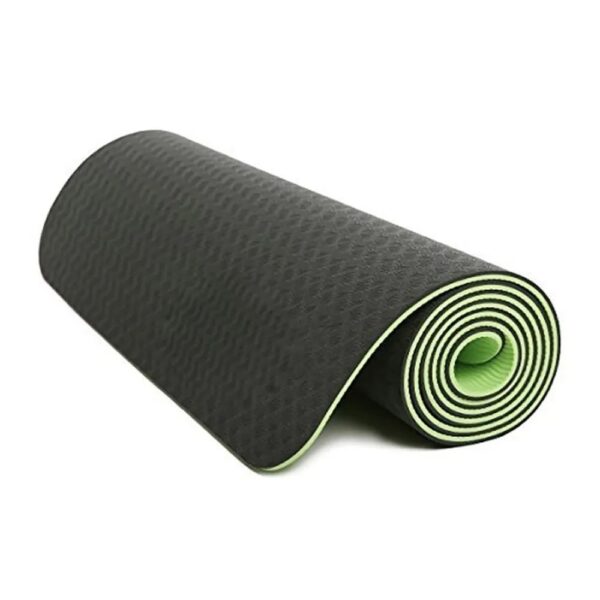
TPE yoga mat, eco-friendly, CHF 19.00
- 183 × 61 cm
- 6 mm
- TPE
- 0.85 kg
- green or black
Made of TPE, a thermoplastic elastomer that, according to the manufacturer, is fully biodegradable. Thin enough to provide a stable surface, light enough to take with you, and, at 0.85 kg, the lightest mat in the lineup.
Ideal for: Yoga, Pilates, mobility training, and anyone who spends a lot of time working while standing or on all fours.
View yoga mats
NBR Exercise Mat, Fitness Mat, CHF 19.00
- 180 × 60 cm
- 15 mm
- NBR
- nonslip
- Eyelets and carrying strap
NBR stands for nitrile butadiene rubber, a soft, water-repellent material with high tear and abrasion resistance. The high-density foam offers noticeably more cushioning than any yoga mat. The eyelets allow for wall hanging; the wall mount is not included.
Ideal for: Core training, back exercises, rehab, aerobics, and anything that takes place lying down.
View exercise matThe right strength
How thick should an exercise mat be?
For floor exercises, 8 to 15 mm is the sensible range, and the choice within this range depends on how much time you spend on your back and knees. 8 mm is enough for stretching, Pilates, and occasional core exercises; the mat remains light and rolls up small. 15 mm is the right choice if your spine or knees are sensitive, if you are working out on hard concrete or tiles, or if exercises are held in one position for a longer time. The upper limit is reached quickly: the thicker the mat, the more unstable you stand on it, and the heavier it becomes. That is why there is the 6 mm yoga mat and not the 25 mm yoga mat. Below 6 mm, on the other hand, things become uncomfortable for anything that is not standing.
| Matte | Mass | Thickness | Material | Price |
|---|---|---|---|---|
| TPE yoga mat | 183 × 61 cm | 6 mm | TPE | CHF 19.- |
| fitness mat, exercise mat | 182 × 60.5 cm | 8 mm | Foam | CHF 10.00 |
| NBR exercise mat | 180 × 60 cm | 15 mm | NBR | CHF 19.- |
| Foam floor mat | 60 × 60 cm | 12 mm | Foam | CHF 5.00 |
| Rubber floor mat 100 × 100 | 100 × 100 cm | 15 mm | Rubber | CHF 35.- |
The last two lines are intentionally included: They have similar thickness values as the training mats, but belong to a different product group. The next section explains why this makes a difference.
The most common misconception
Why a floor mat does not replace a gym mat
A floor mat is designed to protect and cushion the surface, not to provide support for your body, and that is precisely why it fails as an exercise mat. A prime example of this is our own foam floor mat: 12 mm of foam, soft, noise-dampening, CHF 5 per tile, and the product description explicitly states that it is not non-slip and that for exercises like mountain climbers, a separate training mat should be placed on top. On top of that come the joints: a surface made of tiles has an interlocking connection every 60 cm, and you can feel those in your back. Do the math yourself: one foam tile covers 0.36 m², while a 180 × 60 cm exercise mat covers 1.08 m². So for the same lying surface, you need three tiles at CHF 5 each, which comes to CHF 15 compared to CHF 19 for the continuous mat, which is also non-slip and can be rolled up.
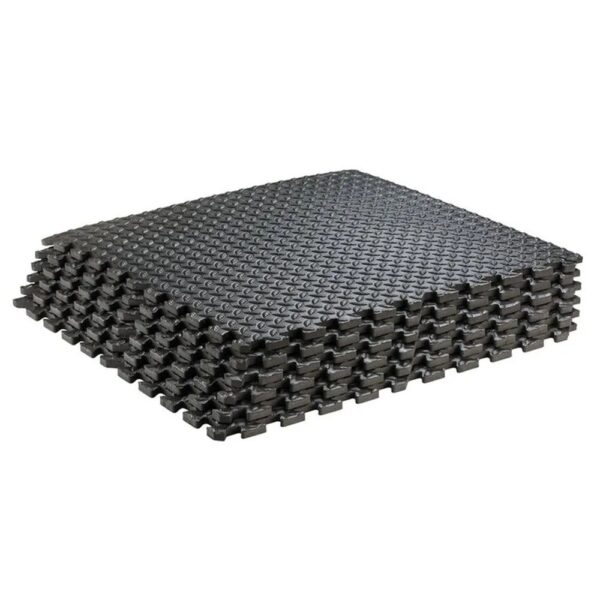
Foam floor mat 60 × 60 × 1.2 cm, CHF 5.-
- 60 × 60 cm
- 12 mm
- Foam
- Firmness soft
- Puzzle connection
The soft base surface for the gymnastics area: dampens impact sound, protects the subfloor, and can be expanded as desired. Edge finishing on two sides is included, the price is per tile. Not slip-resistant and not intended for free weights.
Ideal for: the floor area in the gymnastics or stretching area where the exercise mat is then placed.
View foam floor matConversely, the same applies: A training mat under the treadmill or under the weight bench is the wrong solution because it does not distribute point loads and is simply pressed through under the equipment foot. That is what rubber is for, such as the Rubber sheet in 100 × 100 cm format with a thickness of 15 mm and a dead weight of 13 kg. Which flooring suits which load is a separate question, and the flooring section answers that better than this guide.
Before buying
What you should look for when buying an exercise mat
Four points determine whether you will be satisfied with your mat for years to come: length, material, transport, and storage. Length is the factor that almost everyone underestimates. Exercise mats are almost universally between 180 and 183 cm long, and this figure refers to the mat itself, not your lying length. Anyone who is 1.80 m tall has about 3 cm of clearance on a 183 cm mat, which is practically none: during lying exercises, either the back of the head or the heels end up on the edge. Anyone over 1.85 m should therefore either work with a continuous floor surface or consciously accept that their feet will hang off the edge. When it comes to material: foam is light and inexpensive, NBR is heavier, softer, and significantly more resistant to abrasion, while TPE lies somewhere in between and is optimized for grip.
When transporting goods, it is worth paying attention to details that are overlooked when ordering. The Foam fitness mat for CHF 10.- has a carrying loop, the NBR mat a carrying strap plus eyelets for hanging. Anyone who stores multiple mats in a studio, club or practice will get along with the Wall-mounted mat holder for CHF 19.- further: 65 cm wide, 22 cm support depth, depending on the mat thickness it holds 10 to 20 pieces. Screws are not included, as they depend on your wall anyway. And if you are generally unsure which product group fits your project: The Overview of all buying guides sort that by category.
Recommendation by profile
What is worth it for whom
Yoga at home, two to three times a week
You need grip, not padding. The TPE mat with 6 mm is the right choice and, at 0.85 kg, light enough to take along to the course.
Back exercises and rehab program
Every extra padding counts here. Take this 15 mm NBR mat, especially when you are training on tile or concrete.
First home gym, tight budget
For CHF 10, the foam mat gives you a fully functional 8 mm underlay. The rest of the budget is better spent on training equipment, not the mat.
Studio, club or physiotherapy practice
Several identical mats plus a wall mount, in addition to a cushioned base. The matching plates are located in the Flooring range, the mats themselves in the Mat category.
Frequently Asked Questions
Buying an exercise mat: the most important answers
What is the difference between a yoga mat and an exercise mat?
The thickness and therefore the purpose. A yoga mat is thin at around 6 mm and designed for grip so that you have a stable stance in standing poses. An exercise mat is 8 to 15 mm thick and cushions the spine, elbows, and knees during floor exercises. The dimensions of both are similar, around 180 × 60 cm.
What thickness should a fitness mat be?
8 to 15 mm. 8 mm are enough for stretching, pilates, and occasional core exercises while remaining easy to transport. 15 mm are useful for a sensitive back or sensitive knees and on hard surfaces like concrete or tiles. It shouldn't be significantly thicker, otherwise you will stand unsteadily on it.
Are there foldable gymnastics mats?
Classic training mats made of foam, NBR, or TPE are rolled up, not folded. A fold edge would permanently weaken the material and leave a crease that gets in the way during workouts. If you want to store them to save space, roll the mat up and hang it on a mat holder instead of looking for a foldable option.
Are cheap exercise mats from the hardware store or from retailers like Landi and Ikea any good?
The quality is decided not by the dealer, but by the data sheet. Check three details: thickness in millimeters, material, and length. If one of them is missing, caution is advised. A solid 8 mm mat is also available from us for CHF 10.–; the price difference between suppliers is small for this product group.
Can I use a floor mat as an exercise mat?
Only to a limited extent. Foam floor mats are usually not non-slip and have interlocking edges every 50 to 60 cm that you can feel in your back. The manufacturer of our foam board even recommends placing a separate exercise mat on top for dynamic exercises. They are good as a base area, but not as a lying surface.
What mat length fits my height?
Exercise mats are almost always between 180 and 183 cm long. For someone 1.80 m tall, this leaves a buffer of about 3 cm, meaning the head or heels will be right on the edge. Up to about 1.75 m, this is not an issue. Anyone taller should plan for a continuous cushioned surface for floor exercises.
How do I store multiple mats to save space?
On the wall. Mats with eyelets, such as the NBR exercise mat, can be hung in a wall-mounted mat holder. The holder is 65 cm wide, offers a 22 cm support depth, and holds 10 to 20 mats depending on their thickness. Screws are not included because they must match the type of wall.
Ready for your mat?
Yoga, gymnastics, and fitness mats at a glance, ready to ship from our Swiss warehouse in Liestal.
View all mats