


Fitness Flohmarkt · Guide
Wall Ball, Slamball, or Medicine Ball: Which ball fits your workout?
Three balls that can be of equal weight and yet are built for completely different movements. Here is how you can tell the difference and which ball makes sense for you.
In short
Medicine ball is also an umbrella term. For the designs compared here: a Wall Ball has a large, soft shell for wall throws and catches. A Slamball is designed for ground throws and described as non-bouncing. The classic rubber medicine ball is more compact for controlled core and rotational exercises. Check shell, size, bounce and intended use; matching weights do not make the balls interchangeable.
If you are looking for a ball for functional training, you will come across three product types that look almost identical on the shelf. The difference only becomes apparent on the first throw. Anyone who buys the wrong ball will notice it either in their fingers or on the wall. The large, soft Wall ball with nylon cover is the standard for throws against the wall, the hard rubber ball for throws to the ground. This article explains which ball belongs to which training goal. If you are planning your complete setup for competition training, you will find all the weights of the eight HYROX stations in the appropriate buying guide.
Difference
What is the difference between a wall ball, a slamball, and a medicine ball?
The balls shown differ in shell, diameter and bounce. Our Wall Ball has a soft, double-stitched nylon shell over a sand core and measures 35 cm across all six weights. The Slamball has a grippy rubber shell filled with sand and air and is described as suitable for non-bouncing ground throws. The classic medicine ball has a textured rubber surface and is more compact. Compare the specific model: a 6 kg Wall Ball and 6 kg Slamball weigh the same but are built for different movements.
| Feature | Wall Ball | Slamball | Medicine ball |
|---|---|---|---|
| Shell | Nylon, double-stitched | Rubber, thick-walled | Rubber, textured |
| Core | Sand | Sand and air | Sand |
| Diameter | 35 cm for all weights | 24 to 40 cm depending on weight | 22 to 28 cm |
| Weights | 3 to 15 kg | 2 to 60 kg | 3, 5 and 8 kg |
| Rebound | low, easy to catch | none, no bounce | low |
| main movement | Wall toss and catch | Throw on the floor | Rotation, partner throws, rehab |
| Price with us from | CHF 35.- | CHF 8.00 | CHF 20.00 |
Choose the movement first, then check the intended use of both ball and training surface. A Rubber slam ball does not replace a soft catching ball. A rubber shell or the medicine-ball label alone does not authorise ground or wall throws. The full selection of medicine balls contains all three designs for direct comparison.
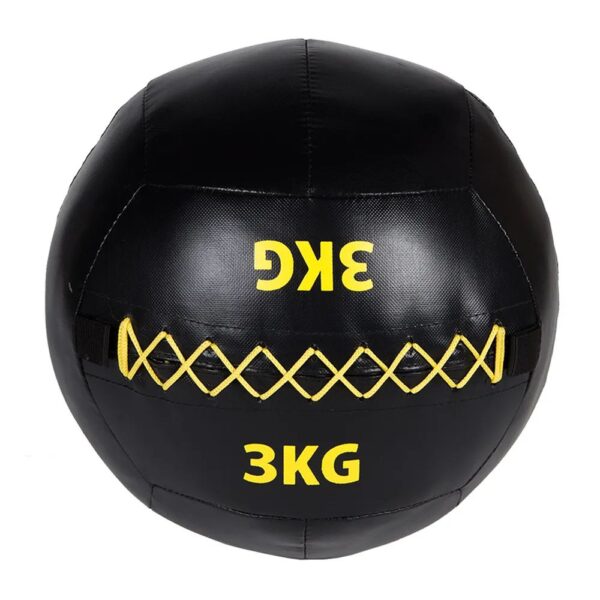
Medicine ball wall ball, from CHF 35.–
- Nylon cover, double stitched
- Sandcore
- 35 cm for all weights
- 3, 4, 6, 9, 12, and 15 kg
The soft, grippy shell is designed for throws followed by catches. All six weights measure 35 cm, so the external dimensions stay the same. A higher mass still changes the load during throwing and catching. Check each weight using controlled technique.
Ideal for: Wall balls, overhead throws, and sit-up throws against a solid wall, both in the home gym and in the studio.

Slamball rubber medicine ball, from CHF 8.-
- Rubber case, non-slip
- Filling of sand and air
- 24 to 40 cm depending on weight
- 2 to 60 kg in twelve increments
The Slamball is sold as “no bounce”. This describes its bounce behaviour, but does not guarantee it will stay in exactly the same place after every impact. Use a suitable, clear throwing area and follow the product instructions. This model is not intended for wall throws followed by catches.
Ideal for: Ball slams, rotational floor slams, and heavy carries without a rack and without a free wall.
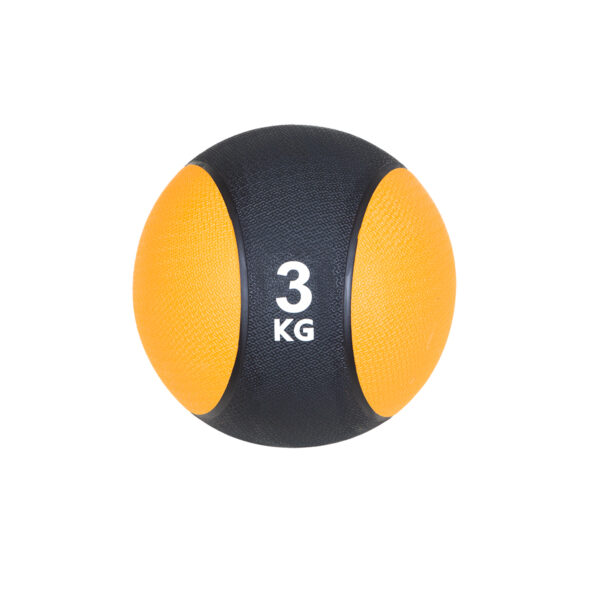
Medicine Ball, starting at CHF 20.00
- Rubber, textured surface
- Sandcore
- 3 kg / 22 cm, 5 kg / 22.5 cm, 8 kg / 28 cm
- Color-coded by weight
The smallest of the three balls. That’s exactly what makes it ideal for exercises where you want to roll the ball rather than throw it: Russian twists, sit-ups with added weight, standing rotations, and partner exercises during rehab.
Ideal for: Core and rotational training, physical therapy, and group classes for participants of varying skill levels.
Weight
What is the correct weight for a wall ball?
Choose a weight that lets you control the planned movement, target height and repetitions. A fixed weight by sex is not a general starting rule. Test throwing and catching with a light weight before buying a heavier one. For competition, your division requirements also matter. Our Wall Ball comes in six weights from 3 to 15 kg, each with a 35 cm diameter.
| Weight | Diameter |
|---|---|
| 3 kg | 35 cm |
| 4 kg | 35 cm |
| 6 kg | 35 cm |
| 9 kg | 35 cm |
| 12 kg | 35 cm |
| 15 kg | 35 cm |
If you are unsure between two weights, test the intended movement instead of buying by the heaviest number. A second ball makes sense if different users or exercises actually need it. Choose the Wall Ball in Six Weight Levels according to your needs and intended use.
Competition
Which wall balls are used at HYROX?
In HYROX, ball weight depends on the division. The 26/27 Singles Rulebook specifies 100 repetitions: Women 4 kg and Women Pro 6 kg to 2.70 m, Men 6 kg and Men Pro 9 kg to 3.00 m. The table helps you choose the competition weight. This does not imply a general recommendation to train with a heavier ball. Before racing, check the current official rulebook; the full equipment selection is covered in the HYROX buying guide.
| Class (Singles) | Ball weight | Target altitude | Repetitions |
|---|---|---|---|
| Women | 4 kg | 2.70 m | 100 |
| Women Pro | 6 kg | 2.70 m | 100 |
| Men | 6 kg | 3.00 m | 100 |
| Men's Pro | 9 kg | 3.00 m | 100 |
Doubles and Relay: Same balls, shared work
In doubles, the weights are not halved. A pair throws the same ball and completes the same 100 repetitions as an individual competitor; only the work is shared. How you divide it is entirely up to you, but flying handovers are not permitted: the ball either touches the ground or is handed over by hand. For the equipment, this means that a doubles pair needs the exact same ball as an individual competitor.
| Doubles class | Level | Ball weight | Target altitude |
|---|---|---|---|
| Women's doubles | White | 4 kg | 2.70 m |
| Men's Doubles | Gray | 6 kg | 3.00 m |
| Women's Doubles Pro | Gray | 6 kg | 2.70 m |
| Mixed Doubles | Gray | 6 kg | 2.70 m for her, 3.00 m for him |
| Men's Pro Doubles | Black | 9 kg | 3.00 m |
In the relay, four people share the race, and one person takes on all 100 wall balls completely. The other three stand at the station during that time and then cross the finish line together. Ball weight and target height follow the category in which the team is competing. For the sandbag lunges before that, however, you need a different piece of equipment, sensibly a Competition Sand Bag in your weight class.
Target area
Do you need a wall ball target?
A Wall Ball Target is the surface you aim at. A private target mark does not necessarily require a purchased target, but it does require a suitable throwing area. Check that the wall, surface, fixings and equipment are intended for repeated ball impacts. A mark does not establish that suitability. A rig target needs compatible components, installation and anchoring according to instructions, plus the target height and clear space for throwing and catching.
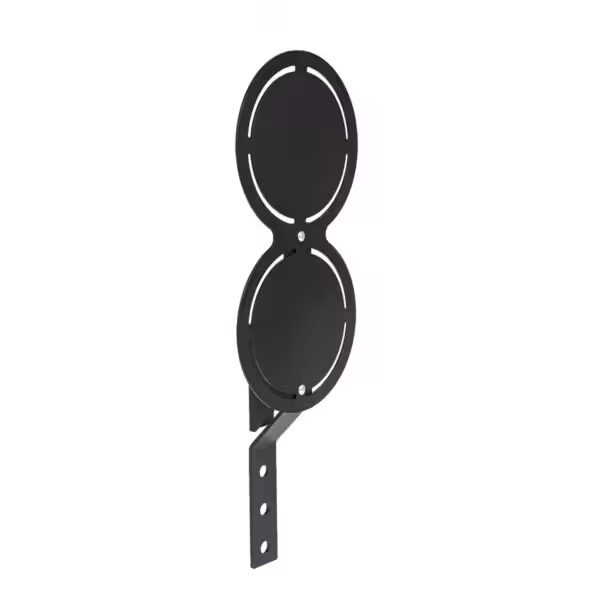
R-SERIES Wall Ball Double Target, CHF 95.-
- Two target altitudes at one station
- Steel, matt black
- Screw set included
- For R-SERIES rigs
The attachment is bolted directly to an existing rig and offers two target heights so that women and men can throw at the same station. It requires a compatible rig and does not work as a standalone part on a free wall.
Ideal for: Boxes and gyms that already have a rig set up and want a fixed, clean target surface.
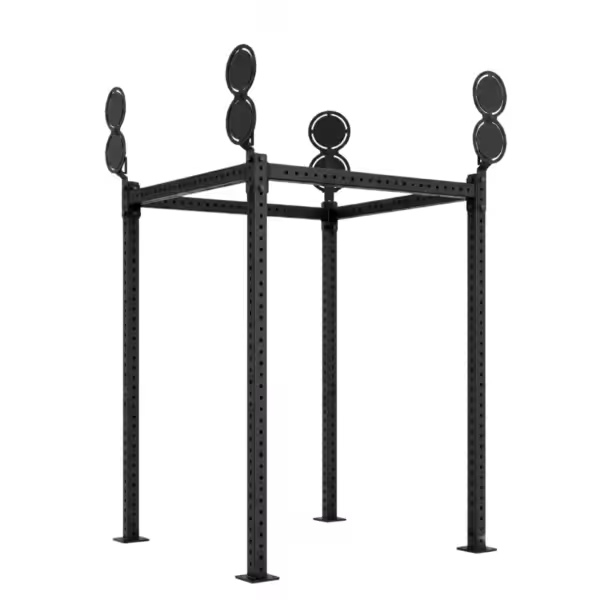
Freestanding Wall Ball Rig, 4 Stations, CHF 990.-
- Four throwing stations
- Double targets included
- Steel, powder-coated
- Intended for ground anchoring
Four people throw simultaneously, completely without wall mounting. That takes up space, but solves the most common problem in studios and conversions: there is no wall that can withstand a hundred throws per person.
Ideal for: Studios, boxes, and training areas without a suitable wall that want to set up a multi-station competition rig.
Both parts belong in the Hybrid assortment, along with sleds, sandbags, and the rest of the equipment for competition formats.
Slamball
How heavy should a slam ball be?
Choose Slamball load by movement and controlled technique too. A fixed starting weight does not suit everyone. Weight and acceleration affect the load; more mass also changes grip and handling. Available weights range from 2 to 60 kg. Before choosing, check that your ball and surface suit the intended throwing, lifting or carrying exercise.
| Weight | Diameter |
|---|---|
| 2 kg | 24 cm |
| 4 kg | 24 cm |
| 6 kg | 24 cm |
| 8 kg | 24 cm |
| 10 kg | 24 cm |
| 12 kg | 27 cm |
| 15 kg | 27 cm |
| 20 kg | 30 cm |
| 30 kg | 32 cm |
| 40 kg | 38 cm |
| 50 kg | 38 cm |
| 60 kg | 40 cm |
The twelve weight levels for the rubber ball offer different loads. A fixed boundary at 15 or 20 kg does not automatically decide whether you should throw, lift or carry a ball. Product instructions and your controlled technique are what matter.
Home
Slamball or wall ball: which ball for the home gym?
For a home gym, choose by planned movement and a suitable training surface. Wall throws with catches need an appropriate wall or correctly mounted target and room for the ball’s return. Slams need a suitable floor, a clear throwing area and, for overhead throws, overhead clearance too. If these conditions are absent, a medicine ball for controlled core exercises may be more suitable. A rubber mat alone does not automatically make impacts acceptable in a flat.
A Connect+ Rubber Floor may protect the surface depending on the floor build-up. It does not automatically authorise ball throws or guarantee enough sound insulation for neighbours. Check the floor structure, usage instructions and impact loads. Material choice is explained in the Flooring buying guide; find further equipment in the Conditioning assortment.
Classification
What is worth it for whom
Beginner in the home gym
First decide whether you want wall throws, slams or controlled exercises. Then check the surface and test a manageable weight. Ball type, weight and a suitable training area belong together in your buying decision.
Who trains for a competition format like HYROX
For your equipment, you need your division’s ball weight and the appropriate target height. Whether other weights are useful is a separate training-plan decision. A heavier second ball is not a prerequisite for preparation.
Rental apartment without load-bearing wall
Without a suitable wall or target, wall throws are not an option. A Slamball is not automatically quieter or gentler on the floor in a rented flat. For controlled core and rotational work, you can choose a Medicine ball in 3, 5 or 8 kg based on a load you can control.
Gym, club or boxing gym
What matters here is that several people throw at the same time and at the identical height. Several weight classes in stock, fixed target areas and a freestanding four-person wall ball station resolve this permanently if no suitable wall is available.
Frequently Asked Questions
Frequently asked questions about wall balls, slam balls, and medicine balls
What is the difference between Wall Ball and Slamball?
Our Wall Ball has a soft nylon shell, a 35 cm diameter and is designed for wall throws with catches. The Slamball has a rubber shell and is sold for non-bouncing ground throws. Check the type and usage instructions; weight alone does not distinguish them.
What is the weight of the wall ball at HYROX?
According to the season 26/27 singles rulebook, women open throw 4 kg, women pro and men open 6 kg, and men pro 9 kg, 100 repetitions each. In doubles, the same weights apply as in singles, and in the relay, the values of the category in which the team competes.
What is the height of the wall ball target?
The target height is 2.70 m for women and 3.00 m for men, in both the open and pro classes. At home, a marking at this height is sufficient. A purchased target is especially worthwhile where multiple people are throwing at different heights at the same station.
Are the weights halved in doubles?
No. A doubles pair throws the same ball and completes the same 100 repetitions as a singles competitor, only the work is shared. So you need the exact same equipment. A flying change is not allowed, the ball hits the ground or is handed over by hand.
Can I throw a slam ball against the wall?
Use the Slamball only for its intended applications. This model is designed for ground throws and is not a soft catching ball for wall throws. A Wall Ball also requires a suitable throwing area and an explicitly appropriate wall or target.
How heavy should a slam ball be?
Test the planned movement with a load you can comfortably control. There is no universal starting weight or fixed boundary beyond which every ball may only be carried. Follow product instructions and check the training surface’s suitability.
Do all wall balls have the same diameter?
All our Wall Balls from 3 to 15 kg measure 35 cm. External dimensions remain the same, but a higher mass changes the load during throwing and catching. Slamball dimensions increase with the weight.
Is a medicine ball the same as a wall ball?
Medicine ball is an umbrella term, also used in the shop for the classic compact rubber ball. A Wall Ball is a specific design with a larger, softer shell for wall throws and catches. Check the actual model instead of inferring bounce or throwing suitability from its name alone.
The next step
Once you know the movement you want to train, compare design, load and suitable surface: Wall Ball for intended wall throws with catches, Slamball for intended ground throws, and a compact medicine ball for controlled core and rotational exercises.
Trademark notice
HYROX is a registered trademark of HYROX World GmbH, Hamburg. We use the name in this article solely for descriptive purposes to indicate the ball weights and target heights you’ll use to prepare for this competition format. There is no licensing, partnership, or other business relationship between Fitcom AG or Fitness Flohmarkt and HYROX World GmbH. The balls, targets, and rigs shown here are Fitcom AG’s own products and are neither manufactured, tested, nor certified by HYROX. The weights, target heights, and repetition counts listed reflect the publicly published versions of the Singles, Doubles, and Relay rulebooks for the 26/27 season. Only the current information on hyrox.com is binding.