



Which Bumper
Plates Buy?
All bumper plates look the same: 45 cm, black or colored, 51 mm inner ring. The difference lies in the rubber hardness—and that determines how much the plate absorbs shock, how thick it is built, and how much weight can ultimately fit on the bar.
Bumper plates are rubber-coated weight plates that to be allowed to be dropped from a height — all in the standard 45 cm size, so the bar lies correctly. For frequent drops and outdoor use, the softer one is suitable HiTemp (Shore A70), for thin plates and a lot of weight on the bar the harder variants (A80–A90). For competition, there are the Competition-Urethane disc. Fractional plates allow the weight increase in small steps.
To the polls in 10 seconds
What are you up to?
Basics
What defines a bumper plate
A bumper plate is a rubber-coated weight plate with a metal core, built to, to fall from overhead height to the floor. That is precisely what is inevitable in Olympic weightlifting and functional training—a cast-iron plate would damage the floor, the barbell, and itself in the process.
The second point is the size: All bumper plates have 45 cm diameter, regardless of the weight. This ensures that the bar sits at the same height with 2 × 10 kg as it does with 2 × 25 kg — the prerequisite for snatches and cleans to work with technical precision from the floor.
The Inner ring with 51 mm fits all standard 50 mm Olympic barbells. A stainless steel ring keeps the rubber permanently in place—on cheap plates, it is precisely this connection that fails first.
The decisive difference
Rubber hardness: soft dampens, hard is leaner
Shore A hardness describes how compliant the rubber is. Softer plates absorb more impact, but require more material and are thicker. Harder plates are slimmer — this allows more weight to fit on the bar, but the impact is harder. There is no better or worse option, only the one that suits your training.
Important: Fractional plates do not belong on this scale — they are non-air-droppable. They complement your set for small weight increments, but they do not replace a bumper plate.
The discs in detail
Five variants compared
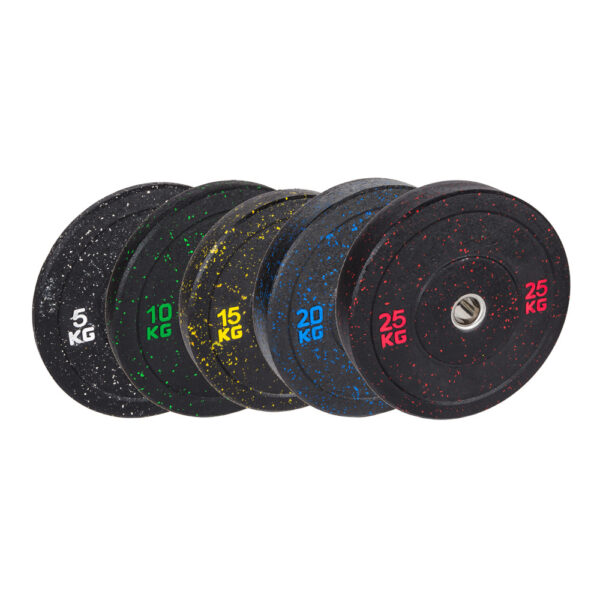
HiTemp Bumper Plates from CHF 20.-
The softest and most shock-absorbing disc in the range. The special rubber compound absorbs impact energy particularly well, protects the floor, and is robust enough for outdoor use, even without a protective mat underneath. Color-coded from white (5 kg) to red (25 kg).
Ideal for: anyone who drops weights regularly — CrossFit, Olympic weightlifting, garage and outdoor gyms.
View HiTemp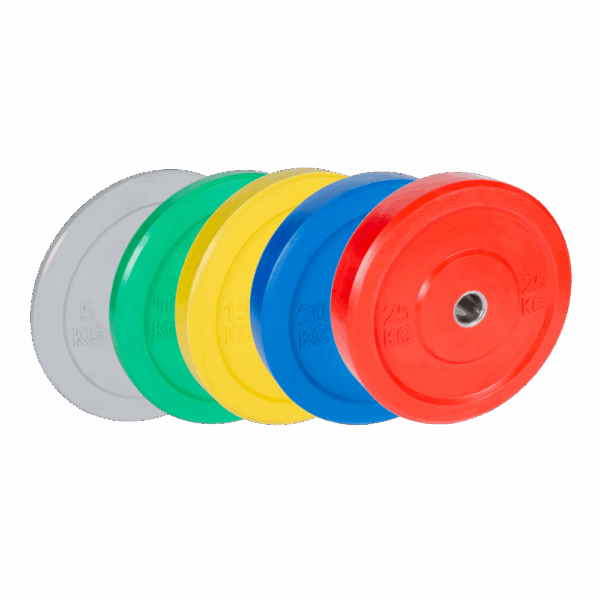
rubber-coated bumper plates · colored from CHF 25.-
The all-rounder: slightly harder than HiTemp and therefore built slimmer, with a full solid rubber coating and steel core for even weight distribution. The color coding from gray (5 kg) through green, yellow, and blue to red (25 kg) makes loading faster during operation — a practical advantage in classes and gyms.
Ideal for: Studios, course rooms, and home gyms where several people quickly change weights.
View colored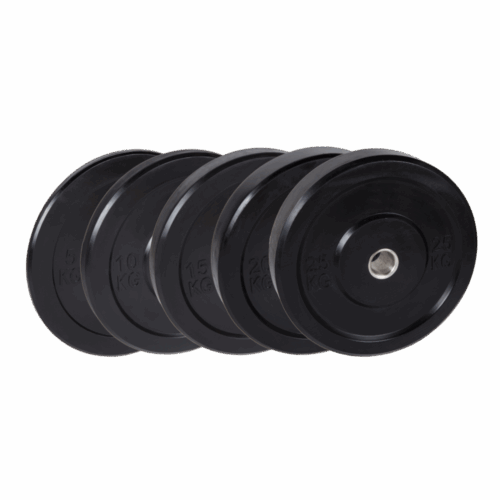
Bumper Plates rubber-coated · Black from CHF 25.-
The hardest and simplest variant: You can fit more kilos on the same bar before you run out of space on the sleeves. Uniform black — calmer in the room's visual appearance and resistant to signs of wear. The price for this is a slightly harder impact when dropping them.
Ideal for: heavy sliding doors, rooms with many panes, and anyone who prefers a minimalist look.
View Blacks
Competition Bumper Plates from CHF 35.-
The competition bumper plate: Urethan is used instead of rubber — more dimensionally stable, more wear-resistant, and completely odorless. The inner ring measures a precise 50.4 mm instead of 51 mm, meaning the plate sits on the bar with minimal play and does not rattle during lifts. Built slim and with a tight weight tolerance.
Ideal for: Competition preparation, clubs, and anyone who values precision and odor neutrality.
View competition
Fractional Change Plates from CHF 9.-
At some point, 2.5 kg more is too much and 0 kg is too little. That is precisely when you need fractional weights: starting at 0.5 kg, the load can be increased so finely that progression continues instead of stalling. Rubber-coated, odorless, color-coded, and with a very tight weight tolerance — also suitable for competition preparation.
Ideal for: Powerlifting, weightlifting, and everyone who progresses in small, planned steps.
View fractionalThe Alternative
Bumper plates or cast iron plates?
Cast iron plates cost a fraction — starting at CHF 5 instead of CHF 20. The question is not the price, but whether you ever drop your barbell instead of setting it down in a controlled manner.
| Bumper plates | Cast iron weights | |
|---|---|---|
| Dropping allowed | Yes | no |
| Diameter | always 45 cm | increases with weight |
| Starting position from the floor | always correct | different |
| Volume | steamed | sea |
| Price | from CHF 20.- | from CHF 5.- |
| Space requirement per kilo | medium | low |
| Typical of | Weightlifting, CrossFit | Bench press, rack work, machines |
In short: Anyone who lifts Olympic style or does functional training needs bumper plates. Anyone who works exclusively in the rack and on the bench and always places the barbell down in a controlled manner, cast rubberized cast iron 1.25–25 kg variable no no CHF 5.- Many combine both: bumpers for the base load on the floor, cast iron for filling up in the rack.
Everything side by side
The discs in comparison
| Pane | Hardness | Weights | Diameter | Droppable | Color code | Starting at |
|---|---|---|---|---|---|---|
| HiTemp | Shore A70 | 5–25 kg | 45 cm | Yes | Yes | CHF 20.00 |
| Colored | Shore A80 | 5–25 kg | 45 cm | Yes | Yes | CHF 25.- |
| Black | Shore A 90 | 5–25 kg | 45 cm | Yes | no | CHF 25.- |
| Competition | Shore A85 | 5-25 kg | 45 cm | Yes | Yes | CHF 35.- |
| Fractional | Rubber | 0.5–5 kg | 15–23 cm | not alone | Yes | CHF 9.- |
| Guess | Cast iron | diverse | variable | no | no | CHF 3.75 |
The periphery
What else you need
Bumper plates alone don't make a setup. These three factors determine whether you can train safely, properly, and without causing damage.
Rods & Fasteners
Bumper plates require a 50 mm Olympic barbell. For drops, it must be drop-rated — and collars are part of it, otherwise the plates will slide.
- 20 kg Olympic bar CHF 150.-
- Ladybar 15 kg CHF 180.-
- Lock Jaw Closures CHF 10.00
Floor & Platform
Even damped discs need a support surface. For repeated lowering from a height, a dedicated platform is the safest solution.
- Weight Lifting Platform CHF 790.-
- Connect+ Floor 20 mm Starting at CHF 15.00
- To the flooring guide →
Storage & Racks
Weights should be stored upright, not stacked—this protects the rubber and saves space. A rack is what turns weights and a bar into a training system.
- Wheel Stand Bumper CHF 120.-
- Weight plate rack 50 mm CHF 120.-
- All Power Racks →
Frequently Asked Questions
Bumper Plates: The Most Important Answers
Which bumper plates should I buy?
If you throw the ball regularly or train outdoors: HiTemp — Softest cushioning, most affordable entry-level option, suitable for outdoor use. When you need to switch gear quickly in the studio or during a class: the colored version. If you want to put a lot of weight on the bar: the black or the Competition — Both are slim.
What do Shore A70, A80, or A90 mean?
Shore A is the measure of rubber hardness. A70 is soft, A90 is hard. Softer rubber provides more cushioning and less impact noise, but the disc is thicker as a result. Harder means thinner—it can hold more weight on the rod, but the impact is harder. Hardness is not a measure of quality, but rather a characteristic that must be suited to the intended use.
Why do all plates have a diameter of 45 cm, no matter how heavy they are?
So that the bar is always at the same height. In the snatch and the clean and jerk, the movement starts from the floor — and the starting height must remain the same regardless of the weight loaded. With cast iron plates, the diameter increases with the weight, which is why light sets start from the wrong position there.
Can I really drop bumper plates?
Yes, that's what they are built for. Two things you should keep in mind: The surface must be suitable, and light, thin plates alone on the bar handle repeated drops worse than heavier ones. A suitable floor or a lifting platform significantly extends the service life of discs, rod, and substrate.
Can I mix bumper plates and cast iron plates?
Better not on the same bar at the same time if you drop weights: The hard cast iron plate doesn't absorb the load and can damage both plate and bar. It makes sense to combine them separately by use — bumpers for work from the floor, cast iron in the rack and on the bench where nothing drops.
What is the difference between competition plates and regular bumper plates?
Three things: the material (urethane instead of rubber — more dimensionally stable, more wear-resistant, odorless), the inner ring (50.4 mm instead of 51 mm, resulting in less play on the bar), and the tighter weight tolerance. For contest preparation and clubs, this is worth it; for a normal home gym, the extra charge compared to HiTemp Seldom necessary.
What do I need fractional plates for?
For progress in small steps. The smallest usual increase is 2 × 1.25 kg, which is 2.5 kg per set — often too much at once for overhead exercises or after a longer break. Fractional Plates from 0.5 kg, increments of one kilo are allowed. They cannot be dropped independently.
How many plates do I need to start with?
A useful basic set for home usually consists of 2 × 10 kg, 2 × 15 kg, and 2 × 20 kg — a total of 90 kg including the bar. This covers squats, deadlifts, and Olympic lifts during the building phase. Adding a pair of 5 kg plates makes fine adjustments easier. You can expand at any time since all plates have the same dimensions.
How do I store bumper plates correctly?
Stacked vertically, not flat. Constant downward pressure can deform the rubber, especially with softer disks. One Disc stand keeps it upright, saves space, and makes docking faster — in everyday use, that brings more than it costs.
Do the plates fit on my bar?
All bumper plates shown here have an inner ring of 51 mm and therefore fit any standard 50 mm Olympic barbell. They do not fit on 30 mm bars. If you drop them regularly, make sure that the pole droppable — not every cheap rod can handle that.
Ready for your set?
All bumper plates, bars, and racks ready to ship from our Swiss warehouse — plus personal consultation for your setup.
View all bumper plates