


Fitness Flohmarkt · Guide
Weight plates 30 mm or 50 mm: the system question before buying your first plates
The number on the dial decides everything you buy after that: rods, closures, additions. Whoever sets it once usually sticks with it.
In short
For the first home gym with dumbbells, curls, and moderate loads, are enough 30 mm discs. If you are planning on doing squats, deadlifts, or Olympic lifts, buy the right one from the start. 50 mm systemOnly there are bumper plates, barbells up to 450 kg, and the large selection of specialty bars. The price difference lies in the bar, not the plates.
Basics
What 30 mm and 50 mm mean for weight plates
The number designates the diameter of the bar sleeve onto which the weight plate is slid, not the thickness of the plate and not the diameter of the grip. A 30 mm system consists of a bar with 30 mm thick ends and plates whose bore hole is minimally larger: The cast iron plate in the 30 mm system has an inner ring of 31 mm so that it can be slid on without jamming. In the 50 mm system, there is a 50 mm sleeve and a 51 mm bore hole. This one millimeter of play is intentional and not a manufacturing defect. Do not confuse the number with the grip diameter: For most bars, this is between 28 and 30 mm, regardless of whether the ends measure 30 or 50 mm. The 50 mm design is also called the Olympic standard because it corresponds to the international competition standard. What types of plates exist within the 50 mm system is categorized by the Bumper Plates Buying Guide.
In practical terms, this means: The two systems are not compatible. A 51 mm plate wobbles on a 30 mm bar and is never secure, while a 31 mm plate won't even fit on a 50 mm mount. Therefore, buying your first weight plates is not a standalone decision, but a system decision. Anyone who today Cast iron weight plate 30 mm adds to the shopping cart, thereby determines which rods, closures, and additions will match it in the coming years.
The decision
30 mm or 50 mm: which system suits your training?
What matters is not your current strength level, but the heaviest exercise you want to be able to do in two years. If you're sticking to dumbbells, curls, shoulder presses, and light rowing, the 30 mm system is the right choice: The 180 cm barbell with 30 mm diameter costs CHF 30, weighs 10 kg and supports up to 150 kg. As soon as squats, deadlifts, heavy bench presses or Olympic lifts are involved, there is no way around 50 mm. The Olympic barbell with 50 mm sleeve costs CHF 150.-, weighs 20 kg and can hold up to 450 kg. The extra charge of CHF 120.- sounds like a lot, but it is the only place where the systems actually differ in cost: The cast iron plates are in the same price range in both systems, from CHF 3.75 to CHF 60.- per piece. Anyone who switches later will have to buy the bar and plates completely new.
| Criterion | 30 mm | 50 mm (Olympus) |
|---|---|---|
| Bore of the disc | 31 mm | 51 mm |
| Barbell in assortment | 180 cm, 10 kg, CHF 30.- | 220 cm, 20 kg, CHF 150.- |
| Maximum barbell load | 150 kg | 450 kg |
| Length of the disc mount | 33 cm per side | 41 cm per side |
| Droppable discs | no | Yes, drop bumper plates |
| Rotating sleeves | no | yes, needle bearing |
| Cast iron plates, price per piece | CHF 3.75 to CHF 60.00 | CHF 3.75 to CHF 60.00 |
| Special bars (SZ, hex, safety squat) | EZ curl bar | full range of choices |
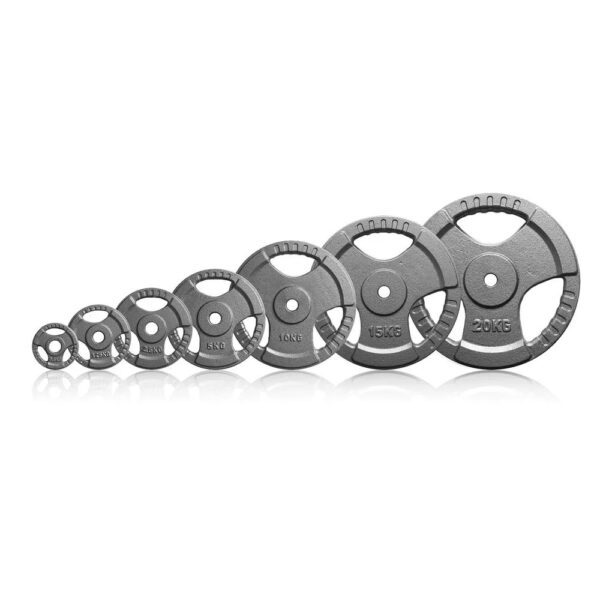
Cast weight plate | 30 mm
- Inner ring 31 mm
- 1.25 to 20 kg
- cast iron, color-coated
- finger holes
- non-air-droppable
- Art. F-92334
Solid cast iron with a colored coating for rust protection, integrated grip holes, and a compact outer diameter. The 5 kg cast iron plate measures 23.5 cm, the 20 kg plate 40 cm. Price from CHF 3.75.
Ideal for: the first home gym, dumbbell training, and anyone who doesn't drop a barbell.
View 30 mm disc
Cast weight plate | 50 mm
- Stainless steel inner ring 51 mm
- 1.25 to 20 kg
- cast iron, color-coated
- finger holes
- non-air-droppable
- Art. F-13343
Same design and price range as the 30 mm series, but with a stainless steel inner ring for 50 mm bars. At 20 kg, with a width of 38.5 cm, it is even slightly more compact than its 30 mm counterpart. Price starts at CHF 3.75.
Ideal for: Bench press, rack work, and machines when the bar is never dropped.
View 50 mm discThe hard border
How much weight does a 30 mm bar actually hold?
With the 30 mm barbell, it is not the space on the sleeve that is the limiting factor, but the bar itself. Do the math: The bar weighs 10 kg and has a weight capacity of up to 150 kg, leaving 140 kg for plates, which is 70 kg per side. Using 20 kg plates that are each 40 mm thick, that is three plates plus one 10 kg plate, totaling 150 mm. On the 33 cm long sleeve, 330 mm would be available, which is more than twice as much. In other words, you reach the weight limit of the bar long before space becomes tight. With the dumbbell, it is the other way around. The Dumbbell bar with 30 mm sleeve has only 11 cm of loading space per side. Two 20 kg plates take up 80 mm of that, and the rest belongs to the collar. So you can't get more than around 42.5 kg per dumbbell.
These 150 kg are the point where people regret the change. Squatting with 140 kg is realistic for an ambitious trainee after two to three years, and then a completely new purchase is due: barbell, all plates, collars. If you are unsure about this question, 50 mm is the cheaper answer, even if it looks more expensive today.
The weights
What weights are available for 30-mm weight plates?
The cast iron series in the 30 mm system covers six increments: 1.25 kg, 2.5 kg, 5 kg, 10 kg, 15 kg, and 20 kg. This allows for all common increments, from 2.5 kg per set using two 1.25 kg plates up to 40 kg per set using two 20 kg plates. With cast iron, the outer diameter is more important than the weight increments because it determines how the barbell rests on the floor: the 20 kg plate in the 30 mm system measures 40 cm, while the 5 kg cast iron plate measures only 23.5 cm. A lightly loaded barbell therefore sits noticeably lower than a heavy one, and precisely this makes deadlifts with light weights technically sloppy. The Cast iron plate with 51 mm inner ring has the same problem. Only Bumper Plates can solve it, because they always measure 45 cm regardless of weight.
| Weight | Ø 30 mm | Thickness 30 mm | Ø 50 mm | Thickness 50 mm |
|---|---|---|---|---|
| 1.25 kg | 16.5 cm | 15 mm | 15.5 cm | 20 mm |
| 2.5 kg | 19 cm | 20 mm | 19 cm | 25 mm |
| 5 kg | 23.5 cm | 25 mm | 22.5 cm | 30 mm |
| 10 kg | 32 cm | 30 mm | 30 cm | 35 mm |
| 15 kg | 35.5 cm | 40 mm | 36.5 cm | 40 mm |
| 20 kg | 40 cm | 40 mm | 38.5 cm | 40 mm |
The periphery
What else besides the disks is connected to the system
The system doesn't just determine the discs; it also determines the entire selection of bars and accessories. In the 30-mm range, there are barbells, dumbbells, and EZ bars, all of which come with star-lock clamps included and are priced under CHF 40. The selection of 30 mm dumbbell bars It’s straightforward and specifically designed to help you get started with a home gym on a budget. In the 50-mm range, you’ll find a trap bar, safety squat bar, multi-grip bar, Ladybar, technique bar, and farmer’s walk handles; the collars are purchased separately. The second difference concerns the floor: cast iron plates must not be dropped in either system, but the 50 mm plus Bumper Plates system allows it—and in that case, you’ll need a suitable floor among them. Those who work exclusively in the rack and on the bench can skip this step in both systems.
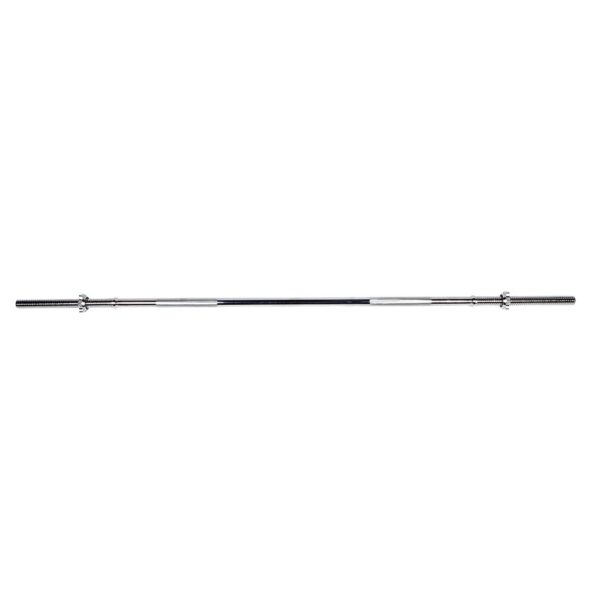
Barbell 30 mm | 180 cm
- 180 cm
- 10 kg net weight
- max. 150 kg
- Width: 33 cm
- 30 mm handle
- Item No. F-72838
Spring steel, chrome-plated, inner grip width 114 cm, two spin-lock collars included. Not drop-weight safe, the sleeves do not rotate. Price CHF 30.
Ideal for: Bench press, rowing, and squats with moderate loads at home.
View 30 mm rod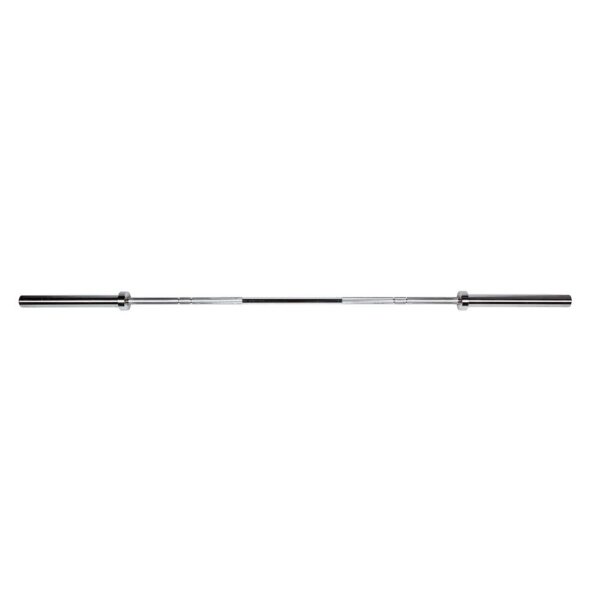
Olympic barbell 50 mm
- 220 cm
- 20 kg net weight
- max. 450 kg
- Recording 41 cm
- 28 mm handle
- Art. F-37583
Spring steel, chromed, inside grip dimension 131 cm, 8 needle bearings and IWF markings. Dropable, collars are not included. Price CHF 150.-.
Ideal for: Squats, deadlifts, and Olympic lifts with a focus on progression.
View Olympic barbellRecommendation by profile
What is worth it for whom
First home gym, tight budget
A bar and a basic set of plates for under CHF 200 is all that is needed to get started. If building strength in the mid-range is the goal and the bar never touches the floor, 30 mm is objectively correct and not the compromise it is often considered to be. Start: Cast iron weight plates in 30 mm.
Ambitious, goal 100 kg and more
Buy the 50 mm right away. If you train as planned, you’ll reach the 150-kg limit of the 30-mm bar in two to three years, and switching will then cost you the entire setup a second time. The 50-mm weight plates cost the same per kilo.
Deadlift, Snatch, Clean
50 mm is not a recommendation here, but a prerequisite. You need a drop-rated barbell and plates with a uniform 45 cm diameter so that the starting position is correct regardless of the weight. Which rubber hardness suits you best is clarified by the Buying Guide for Bumper Plates.
Studio, club, physiotherapy practice
50 mm, because replacement procurement and compatibility must remain plannable over the years and because most plate-loaded machines have 50 mm weight horns. 30 mm plates can be used there sensibly at most as additional weight in the gymnastics area.
Frequently Asked Questions
30 mm and 50 mm: the most important answers
Do 30mm weight plates fit on a 50mm bar?
No. The bore of a 30 mm disc measures 31 mm and cannot even be pushed over a 50 mm arbor. Conversely, while it is physically possible, a 51 mm disc sits on a 30 mm rod with 20 mm of play and slips with every movement. Neither is a viable solution.
Why do 30 mm washers have a 31 mm hole?
The one millimeter is intentional play so that the disc can be slid on and pulled off again without force. With the exact same dimensions, it would jam as soon as the bar is slightly warped or the coating is a bit thicker. In the 50 mm system, the same principle applies with a 51 mm bore.
Are 30mm weight plates worse than 50mm plates?
No, they are made of the same material and are available in the same price range from CHF 3.75 to CHF 60.00 each. The difference lies not in the quality of the plate, but in the load capacity and selection of the corresponding bars. For moderate loads without dropping, 30 mm is fully adequate technically.
Are there 30 mm weight plates with 20 kg?
Yes. The cast iron series in the 30 mm system ranges from 1.25 kg to 20 kg. The 20 kg plate measures 40 cm in diameter and is 40 mm thick. Those who search the shop for 30 mm weight plates will also find the same series as 10 kg cast iron weight plates 30 mm and as a 5 kg variant.
Can I drop 30 mm plates?
No. Both cast iron series are explicitly not drop-resistant, neither in 30 mm nor in 50 mm. Cast iron breaks or deforms upon impact and damages the floor and the bar. Only the following are drop-resistant: Bumper plates, and those are available exclusively with a 51 mm inner ring.
What does the later switch from 30 mm to 50 mm cost?
Virtually a complete new purchase. The bar, all the weight plates, and the collars must be replaced because none of it is cross-compatible. With a 100 kg setup, this quickly adds up to several hundred francs. The CHF 120 surcharge for the Olympic bar on the initial purchase is significantly cheaper.
What does the grip diameter of 28 or 30 mm mean?
That is the thickness of the bar where you grip it and has nothing to do with the sleeves. The 30 mm barbell has a 30 mm grip, the Olympic bar 28 mm, which corresponds to the competition standard. Thinner grips are more comfortable for smaller hands, while thicker ones challenge grip strength more.
System question resolved?
All discs, bars, and closures for both systems are ready for shipping from our Swiss warehouse; if you are unsure, we will advise you before you order.
Buy dumbbells