




Fitness Flohmarkt · Guide
Hex Bar or Barbell: When the Trap Bar is Worth It
The hex bar looks bulky, yet it answers a very specific question: How do you lift heavy from the floor without your lower back becoming the limiting factor?
Learn the barbell deadlift: setup, starting position and lowering step by step
In short
A hex bar, also called a trap bar, is a hexagonal barbell that you step inside of. Because the load is at your sides instead of in front of you, your upper torso remains more upright and your lower back experiences a shorter lever arm. It is worth using if you want to lift heavy from the floor, but your barbell deadlift technique is not yet solid.
Basics
What is a hex bar and why is deadlifting with it friendlier to the back?
A hex bar is a hexagonally bent barbell with two inward-facing handles, in the center of which you stand. What that looks like is shown by Hex Trap Bar 50 mm from our range: 25 kg dead weight, 185 cm length, can hold up to 500 kg training weight. Instead of gripping the bar in front of your body like in the classic deadlift, you hold it with a neutral grip at your sides next to your hips. As a result, the center of gravity of the load moves closer to the center of your body, your upper body stays more upright, and the lever arm on the lower back becomes shorter. This is precisely why the hex bar deadlift is considered a back-friendly variation: not because fewer muscles work, but because the load shifts more from lower back extension toward leg extension. Anyone learning the movement for the first time gets into a safe position faster with it, because less can go wrong with an upright starting position.
The name trap bar comes from the time when the bar was primarily intended for shrugs and thus for the trapezius muscle. Today, it is used almost exclusively for deadlifts and jump variations; the terms hex bar, hexbar, and trap bar refer to the same piece of equipment in commerce.
Two details of the design are immediately noticeable during training. First, the slightly elevated grip position: you start higher up than with a barbell on the floor, which eases the way into the starting position. Second, the grip diameter of 25 mm compared to 28 mm for an Olympic bar, along with the knurling. The thinner grips are easier for smaller hands to hold onto for longer, which makes all the difference, especially during multiple heavy sets. The hex bar is loaded like any Olympic bar, with 50 mm plates. Which type of plates makes sense for this is explained in detail in the Bumper Plates Buying Guide.
The direct comparison
Hex bar or barbell: what changes in deadlifts?
When lifting with the hex bar, you stand inside the bar instead of behind it, use a neutral grip instead of an overhand or mixed grip, and lift with a more upright posture. In practice, this means: the leg muscles take on a larger share, the lower back a smaller one, and most people lift more weight in this variation than with the conventional deadlift. The price for this is specificity. Those who compete in powerlifting must practice the competition movement with the straight bar, because that is also what is tested there. For those who simply want to become stronger and more resilient, nothing is lost with the hex bar. A second difference concerns the stance: the two handles are 79 cm apart, which largely dictates your foot position. Sumo variations or very narrow stances are only possible with the Olympic barbell 50 mm.
| Feature | Hex Trap Bar 50 mm | Olympic barbell 20 kg |
|---|---|---|
| Dead weight | 25 kg | 20 kg |
| Length | 185 cm | 220 cm |
| Handle diameter | 25 mm | 28 mm |
| grip width | 79 cm, fixed predefined | 131 cm handle spacing, freely selectable |
| Recording | 50 mm | 50 mm |
| Max training weight | 500 kg | 450 kg |
| Droppable | no | Yes |
| Rotating sleeves | no | yes, 8-fold needle bearing |
| Price | CHF 145.- | CHF 150.- |
Remarkable is the load limit: the hex bar holds 500 kg and thus more than the Olympic barbell at 450 kg. This is due to the design, not the material quality, because the short, multiply welded hexagonal frame simply bends less than a 220 cm long bar.
The two designs
Open hex bar or closed hex bar?
The closed hex bar is a continuous hexagonal frame: you step in from above, stand completely enclosed, and lift. The open variant leaves one side free so you can walk in from the back instead of stepping over the frame. That sounds like a minor detail, but it makes all the difference: anyone with limited space, who frequently reloads weights, or who works with trainees who cannot easily step over a frame gains time and safety with the open design. The Open Hex Trap Bar also comes with two grip positions and integrated stands, allowing it to stand upright by itself for loading. In exchange, it costs CHF 50 more.
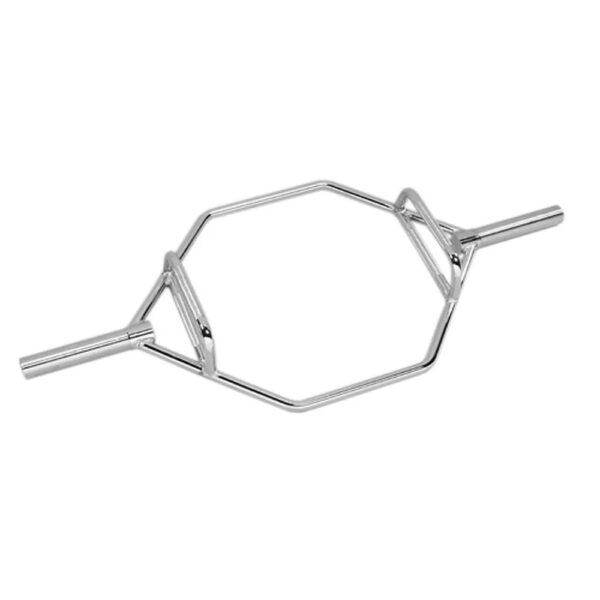
Hex Trap Bar 50 mm | Hex barbell
- 25 kg dead weight
- 185 cm tall
- 50 mm mount
- 25 mm handle
- up to 500 kg
- Chrome-plated steel
The closed design with angled, knurled grips. Chromed steel, no moving parts, accordingly low-maintenance. The scope of delivery includes the bar alone, collars and plates are available separately. Article number F-32368.
Ideal for: Home gyms where deadlifts are the main exercise and the barbell stays permanently in one place.
View Hex Trap Bar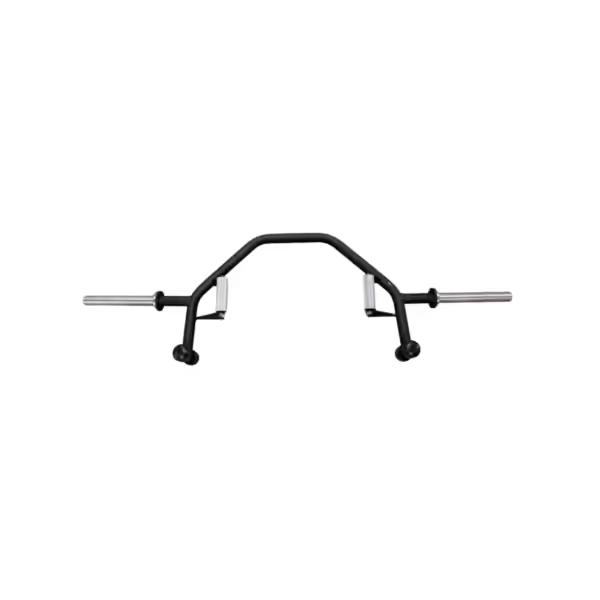
Open Hex Trap Bar | 50 mm
- open frame
- two grip positions
- 50 mm mount
- integrated feet
The open frame allows entry from the back instead of over the bar. The dual handles provide two grip widths and thus two starting heights, and the feet keep the bar elevated when loading plates. Item number F-67712.
Ideal for: Studios, clubs, and practices with changing users, and for anyone who frequently relocates equipment.
View open variantBoth rods are in the category 50 mm barbell bars, along with straight bars, curl bars, and specialty bars.
Application area
Which exercises can be done with the hex bar and which cannot?
The hex bar covers everything that goes from the floor upwards: deadlifts, rack pulls, shrugs, farmer's walks, lunges, light-load jump variations, and, with limitations, standing squats. What it cannot do is just as important: bench press, overhead press in the rack, wide-grip bent-over row, and any exercise where you need the bar on your back or in the front rack position. Furthermore, according to the manufacturer, this hex bar is not drop-resistant. Therefore, you cannot let it drop from hip height, but must set it down in a controlled manner. Anyone who needs to drop it from a height should use the Olympic barbell and load it with droppable bumper plates.
When doing squats, the hex bar is a compromise. The load hangs from the hands instead of resting on the back, which is why the movement resembles more of a heavy, long-lever goblet squat. This works well for leg work without back loading, but not for heavy squatting. If your actual problem is the squat, not the deadlift, the Safety Squat Bar for CHF 140.– the more fitting answer: It is on the back, but relieves the shoulders and wrists.
An honest assessment: The hex bar does not replace a barbell, it complements it. If you don't have any bar in your home gym yet, the straight Olympic barbell is the first purchase. The hex bar is the second.
Space and accessories
How much space does a hex bar need and what does it include?
For a hex bar, you need less room width than for a barbell. The math behind this is simple: the Olympic barbell measures 220 cm, the hex trap bar 185 cm. That is 35 cm less width, which in a basement or garage can make the difference between bumping into things or not. In addition, there is movement space on each side for loading, in practice around half a meter. So calculate with nearly three meters of usable width. In terms of depth, your own standing area is sufficient because the movement runs vertically.
Accessories include three things. First, 50 mm inner ring plates, either from the selection of 50-mm weight plates or as a rubber-coated bumper version. Secondly, collars, because the bar comes without them and otherwise the plates will slide outward when you set it down. Lock-Jaw collars from CHF 10.- clamp with a lever and can be quickly changed between sets. Thirdly, a surface that can withstand being dropped: A floor protection mat protects screed, tiles, or parquet and takes the impact out of the room.
Recommendation by profile
What is worth it for whom
Introduction with back concerns
You want to lift heavy, but you've already had lower back problems or are returning after a long break. The closed hex trap bar here is the bar with which you get a clean start, because the position is harder to get wrong.
Strength for endurance sports
You run, cycle, or row a lot and want to build leg strength without spending weeks learning technique. The hex bar delivers just that: a heavy stimulus for your legs and core, a short learning curve, and low risk of injury when fatigued.
Studio, club, or practice
Changing users, different heights, little time for technical adjustments. The open design with floor stands saves handling steps with every set. Which other devices fit, is shown by our buying guide.
Powerlifting competition
Here is the honest answer: do not buy one, at least not first. The deadlift is tested with the straight barbell, and you have to train that movement. The hex bar remains a useful supplement for accessory work and building phases.
Frequently Asked Questions
Hex Bar: The Most Important Answers
What are the benefits of a hex bar?
A hex bar shifts the load from in front of the body to the sides of the body. As a result, the upper body stays more upright, the leverage on the lower back becomes shorter, and the leg muscles take on more of the work. For many, this means more weight with less strain on the back and a shorter learning curve.
What is the difference between a hex bar and a trap bar?
None. Both terms refer to the same bar. Trap bar is the older name and refers to the original use for shrugs and thus for the trapezius muscle. Hex bar describes the hexagonal shape that has become established as the design. Both spellings, as well as hexbar, appear in retail and search queries.
How heavy is a hex bar?
Our hex dumbbell handle weighs 25 kg and is therefore 5 kg heavier than a 20 kg Olympic barbell. This is important when calculating: anyone who has 100 kg on their sheet only loads 75 kg of plates on the hex bar. The dead weight is part of the load, not an addition to it.
Do standard weight plates fit on a hex bar?
Yes, as long as they are 50 mm plates. Both hex bars have a 50 mm sleeve and accommodate any standard Olympic plate, whether cast iron, rubberized, or bumper plate. Plates with a 30 mm bore do not fit. Collars are not included.
What is an open hex bar?
An open-frame hex bar: One side of the hexagon is missing, allowing you to walk in from the back instead of stepping over the bar. The open variant additionally offers two grip positions and support feet that make loading easier. It costs CHF 195.- instead of CHF 145.-.
Can you do squats with the hex bar?
Yes, but only as a supplement. Because the load hangs from the arms instead of resting on the back, the movement resembles a heavy goblet squat. For leg work without back support, this is useful; for heavy squatting, it is not. For that, you need a barbell and a rack or a special squat bar.
Are you allowed to drop the hex bar?
No. According to the manufacturer, the 50 mm Hex Trap Bar is not drop-resistant. You set it down in a controlled manner instead of letting it drop from the hips. Anyone who needs to drop it from a height, such as in Olympic weightlifting, works with a drop-resistant Olympic barbell and bumper plates on a cushioned surface.
How much does a hex bar cost?
At Fitness-Flohmarkt, the closed hex trap bar 50 mm costs CHF 145.–, and the open version CHF 195.–. Plates and collars are extra, as they are not included. This puts a hex bar on par with the price of a solid Olympic barbell.
Ready for the next heavy set?
Both Hex Bars and all specialty bars are ready for dispatch from our Swiss warehouse. Weights, collars, and everything else for barbell training: Buy dumbbells.
View all 50 mm barbell bars