


Fitness Flohmarkt · Guide
Medicine ball exercises at home: core, rotation and partner training
You do not need a throwing wall to train with a medicine ball. Here are six exercises with clear instructions and a simple home session. The first five involve no impact; add partner passes only when the ball, space and catching control are suitable.
In short
Start with a ball you can hold steadily and control throughout the movement. Begin with squats, lunges, diagonal lifts and core stability without throwing. Our compact rubber medicine ball comes in 3, 5 and 8 kg from CHF 20.–. If even 3 kg is too heavy, choose a lighter ball rather than settling for an available weight.
Before you start: ball, grip and space
For controlled exercises, secure your grip: dry hands, an undamaged surface and both palms on the ball. Start with it close to your body. Reaching your arms further out makes the movement harder even without more weight. Choose your load by the most demanding exercise in the session and try each movement unloaded first.
Clear enough room for a full lunge and your longest arm movement. Check floor grip, furniture and overhead clearance. Passes also need a clear flight path and room behind both people. A rug or rubber mat does not establish that the floor is suitable for impacts or sufficiently soundproof.
6 medicine ball exercises with controlled technique
1. Squat with the ball at your chest
Hold the ball close to your chest, feet roughly hip to shoulder width apart. Bend your knees and hips only as far as you can stay stable. Stand without pushing the ball forward. Aim for a smooth movement; reduce depth or load if your back rounds or the ball drifts away.
2. Reverse lunge with a ball
Hold the ball at your chest. Step one foot back and lower slowly. Keep the front foot fully grounded and let the knee follow its direction. Push through the front leg to return to standing, then switch sides. Start with a shorter step and smaller range if balance is uncertain.
3. Controlled diagonal lift
Move the ball diagonally from one hip towards chest height on the opposite side, then return slowly. Let your feet and hips turn; do not force your torso over fixed knees. Keep the ball close enough to stop at any point. Use no momentum, throwing or forced maximum rotation.
4. Supine heel slide
Lie on a mat with knees bent and hold the ball steadily in both hands in front of your chest. Slowly slide one heel forward along the floor and bring it back. Alternate while keeping your pelvis and ball still. Shorten the range if your lower back arches. Try it without a ball first, and set the ball down under control before getting up.
5. Walk carrying the ball in front
Hold the ball close to your body with both hands and walk with small, steady steps through a clear area. Stay upright without leaning back or shrugging. Turn slowly or march in place. Finish before grip or posture deteriorates. Carrying adds to the session without throwing or dropping the ball.
6. Partner chest pass – optional
Begin with a handover. Only if both people securely control a ball suited to passing should you face each other at a short distance. Announce the pass, gently push the ball from chest height towards your partner’s chest and keep the flight path clear. Catch with both hands and allow your arms to give. Avoid throws towards the head and hard return passes. If passing becomes rushed or uncertain, return to handovers.
A simple session of around 15–20 minutes
This starting example is for adults without symptoms, not a personal training plan. Warm up for two to three minutes with walking, easy arm movements and unloaded squats. Then do two rounds of exercises 1–4. Duration depends on pace and rest.
| Exercise | Example per round |
|---|---|
| 1. Squat with the ball at your chest | 8–12 repetitions |
| 2. Reverse lunge with a ball | 6–8 each side |
| 3. Controlled diagonal lift | 6–8 each direction |
| 4. Supine heel slide | 6–8 each leg |
Rest around 30–60 seconds between exercises, longer if needed. Keep some reserve at the end of each set. If grip and posture remain secure, add two 20–30 second carries. Passes are a separate block to practise while fresh: a few calm passes per person, stopping before catching control fades. You do not need all six exercises in one session.
Start with, for example, two weekly sessions on separate days. Once repetitions stay clean over several sessions, first increase them within the suggested range. Then try another round or more weight, changing one thing at a time. Moving from 3 to 5 and 8 kg is a substantial jump; adding weight is not a compulsory form of progress.
Three mistakes you can avoid
Too much weight: if you rely on momentum or cannot set the ball down under control, reduce the load. Forced rotation: let your feet move and stay within a comfortable range. Catching while tired: passes require attention and space; stop before you need to chase the ball. Stop the exercise if it hurts.
Our compact medicine ball: when grip and load fit
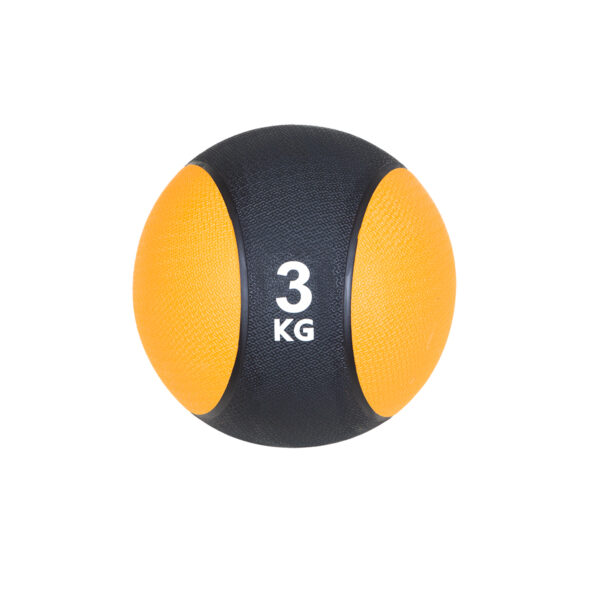
Medicine Ball | Medicine Ball
- From CHF 20.–
- 3 / 5 / 8 kg
- Rubber surface · sand core
The textured rubber surface and compact shape suit controlled holds, lifts and rotations. Choose by exercise rather than the highest weight. The limit: this model starts at 3 kg. If that is too heavy for your technique, a lighter ball is the better choice.
View the 3, 5 and 8 kg medicine ballPrice as of 27.10.2026: from CHF 20.– per ball, including VAT, excluding delivery. The listing also describes throwing and catching uses. This does not approve hard floor throws or impacts against any wall. For partner passes, both people must also be able to catch this specific ball securely.
Frequently Asked Questions
FAQ: medicine ball exercises at home
Which medicine ball exercises work at home?
Squats holding the ball at your chest, reverse lunges, controlled diagonal lifts, heel slides and carries involve no impact. Match weight and range to your control and clear space. Partner passes are optional.
What weight do I need for medicine ball exercises?
There is no universal starting weight. Test the most demanding exercise with clean technique. Our model comes in 3, 5 and 8 kg; choose a lighter ball if 3 kg is already too heavy.
Can I use a medicine ball in an apartment?
Yes, controlled exercises without throwing or dropping the ball can work in a suitable clear space. A mat alone does not make floor or wall throws apartment-friendly. Assess the floor, space and noise separately.
How often should I train with a medicine ball?
The starting example uses two weekly sessions on separate days. Account for your other training and recovery. Progress only once technique and grip stay controlled over several sessions.
Can I slam a classic medicine ball on the floor?
Not simply because of its name or rubber shell. The ball and floor must be intended for that impact. Our programme needs no floor throws; use the linked comparison for ball types and throwing suitability.
Do I need a throwing wall for partner training?
No. Start with calm handovers or suitable, controlled chest passes. Both people need a secure grip, clear flight path and room to move. Choose a ball the less experienced person can also catch securely.
One ball, a clear session, the right load
If 3, 5 or 8 kg fits your controlled technique, our compact medicine ball can suit your home training. Unsure about weight or intended use? Tell us which exercises you plan to do and we will help you choose.
View the 3, 5 and 8 kg medicine ball Ask us about weightProduct specifications come from our linked listing. The exercises are editorial guidance, not independent product testing or an individual rehabilitation programme.