




Fitness Flohmarkt · Guide
Sled Push: How much weight, which surface, which alternative
The sled is the most honest piece of equipment in functional training. It forgives neither incorrect loading nor the wrong flooring, and you had better figure both out before ordering rather than after.
In short
During a sled push, you push a loaded sled over a fixed distance. You can tell the correct load by the pace: for sprinting you load a little, for leg power so much that you can only take it step by step. The surface is also a factor, because on artificial turf the same sled slows down significantly more than on concrete.
Effect
What Sled Push and Sled Pull achieve in training
Sled training is work against friction without a braking phase, and that is precisely where its value lies: you push or pull the sled, but you never catch it. What loads actually apply in the three competition stages is in the Buying guide for HYROX training; it's about the journey there. Because the eccentric load is missing, there is hardly any muscle soreness, and you can incorporate heavy leg work several times a week without your running training suffering. At the same time, your heart rate spikes immediately, which is why the same sled acts as a strength or conditioning machine depending on the load. Pushing and pulling tax the body differently: when pushing, the calves, front thighs, and core work forward against the resistance, while when pulling, the load is handled via grip strength, back, and arms, while the legs stabilize and the upper body remains upright. Anyone who only pushes misses out on half the effect, and anyone who only pulls wastes the leg stimulus.
What the sled does not achieve: It replaces neither squats nor deadlifts. There is no stretched position under load and therefore no stimulus that builds muscle mass in the thighs and glutes. And without a surface, it doesn't work at all. A sled without a track is a 36 to 50 kilogram piece of furniture.
Loading
How much weight belongs on the sled?
You don't determine the right load in kilograms, but rather by the pace you can still maintain with it. For acceleration, you load it so lightly that you are truly running. For race-near pushing, you take so much that brisk walking remains the fastest form of movement. For maximum leg strength, you load it so heavily that every step is taken individually and the distance remains short. If the pace drops or your back rounds, the load is too high. Always include your own body weight in the calculation: The Prowler Sled weighs 36 kg empty, so 76 kg with two 20-kg plates and 116 kg with four plates. The Competition Sled starts at 50 kg and holds up to 150 kg of plates, resulting in a total load of 200 kg. For beginners, this often means: The empty sled is enough for the first few weeks.
| Training goal | Pace criterion | Example on the Prowler | Distance per sentence |
|---|---|---|---|
| acceleration, speed | You are really sprinting | 36 kg empty to 56 kg | 10 to 15 m |
| Conditioning, Interval Training | Brisk marching pace, pulse high | 56 to 96 kg | 20 m, several rounds |
| Competition-specific pushing | Fast walking without stopping | 76 to 116 kg | 12.5 to 25 m |
| Maximum leg strength | Step by step, full tension | from 116 kg | 10 to 15 m |
The kilogram column is a starting value, not a rule. On artificial turf, you are significantly lower for the same effect than on smooth concrete. Therefore, note the surface for every load, otherwise next time you are comparing apples and oranges. Which 50-mm Bumper Plates the clarifies whether it is suitable for loading Bumper Plates Buying Guide.
Underground
On which surfaces does sled training work?
The surface is the second weight specification for a sled. Steel runners glide on smooth concrete almost by themselves, grip significantly stronger on artificial turf, and block almost completely on soft grass. In practice, this means: concrete and asphalt are suitable for speed work with little added weight, artificial turf for anything that should feel like competition, and laid rubber flooring not at all. Anyone who does not have one of these surfaces uses a sled with wheels and a braking system instead of runners, because there the resistance comes from the device and not from friction. Before buying a sled, it is therefore worth looking at the area, because a flooring that can withstand sled work permanently quickly costs more than the sled itself. And the order is important: a sled can be replaced at any time later, but installed flooring cannot. Material for a permanent track is in the Artificial turf category.
| Underground | Resistance | What is it suitable for | Please note |
|---|---|---|---|
| Smooth concrete, asphalt | low | acceleration, speed | Runners wear down, loudly |
| Artificial turf, turf | medium to high | Pushing and pulling, close to competition | Roll or ready-made sheet needed |
| Rubber floor, tile, or click-lock | high | not suitable | Slabs are shifting, surface is suffering |
| Lawn, meadow | very high, uneven | Outdoor Conditioning | unusable after rain |
| Any, with pneumatic tires | Adjustable via the brake stage | Indoors without a designated area | higher purchase price |
The most common planning mistake in a home gym: The basement gets a 20-mm click-lock floor, and the sled is simply added to it. Sled runners push the laid rubber tiles apart and dig into the surface. If you work out in the basement, you should either set up a turf zone, for example with the 10-meter Sprint Track Turf, or use the ATX Resistance Power Sled a wheeled sled that doesn't come into contact with the surface. Here's a quick calculation regarding track length: The Competition Sled measures 109 cm; behind it, you'll need about 1.5 m for your own strides. That means a good 2.60 m is occupied before you’ve even covered one meter of track. A usable 10-meter track therefore requires just under 13 m of space in the direction of push.
Selection
Which sled is right for your situation?
Three questions are key: What kind of surface do you have, how much weight do you want to load, and do you also want to pull? For concrete and asphalt, a simple sled with runners is sufficient, and you’re better off spending the difference in price on discs. If you’re aiming for competition-level performance, choose a model with marked handlebars and a symmetrical design that allows for changes in direction without any modifications. If you’re training indoors on normal floors, you’ll need a wheeled sled with brakes. To pull it in the desired direction, you’ll also need a rope, which isn’t included with any skid-type model. The Polyester Sled Rope The 38-mm-diameter version is available in 6-meter lengths for CHF 45 and 15-meter lengths for CHF 65; for 12.5-meter runs, you'll need the long version. All models are available in the Strongman Category and in the category Training for HYROX.
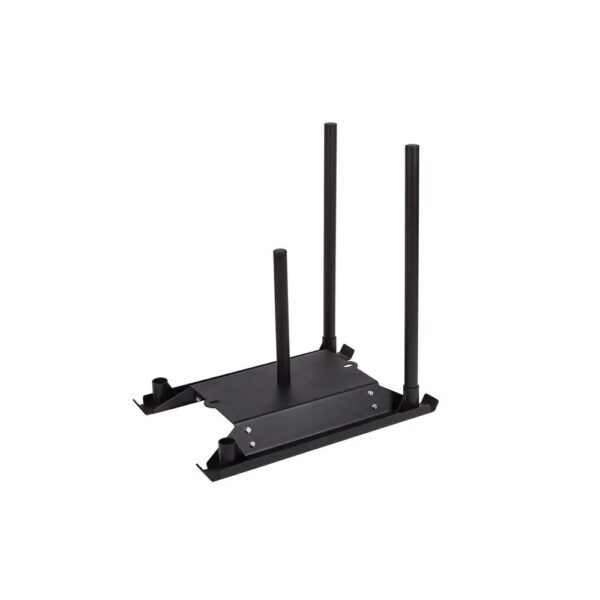
Prowler Weight Sled | Sled · CHF 150.-
- 36 kg curb weight
- 94 cm long
- 50 mm insert, 50 cm long
- max. 500 kg
- powder-coated steel
The most affordable way to get into real sled work: two handlebars for pushing, a 500 kg weight capacity for each configuration, and a price that makes it worth trying out, even if you just want to see if sled training fits into your program. Weight plates are not included.
Ideal for: Garage, driveway, and outdoor areas made of concrete or asphalt.
View Prowler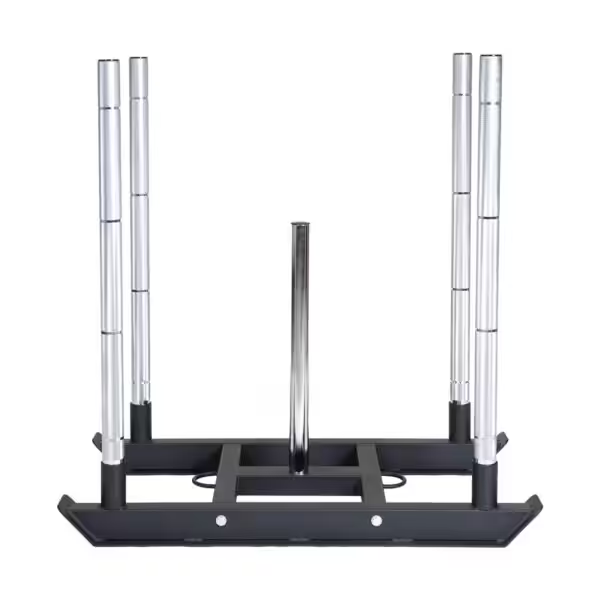
Competition Sled | Weighted Sled · CHF 295.00
- 50 kg dead weight
- 109 x 61 x 108 cm
- 50 mm lens, 63 cm long
- Max. 150 kg of discs
- four marked handrails
The model for anyone who follows competition standards. The symmetrical design allows for a change in direction without any modifications; the markings help with adjusting the handle height, and the handles can be removed for storage. A pull eye for attaching a rope is included.
Ideal for: Hybrid athletes aiming to compete and gyms with turf surfaces.
View the Competition Sled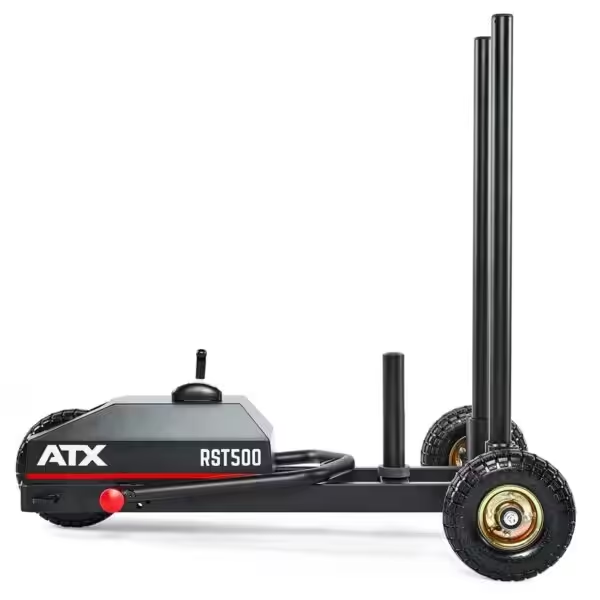
ATX Resistance Power Sled | Sled · CHF 845.00
- 41 kg curb weight
- 115 x 80 x 110 cm
- 8-level magnetic brake
- Pneumatic tire 26 cm
- Pull strap 160 cm included
The sled for everyone without artificial turf and without a concrete surface. The resistance comes from an eight-stage magnetic brake instead of friction; plates are optional. Two grip widths of 50 cm and 37.5 cm, towing eyes at the front and back, fold-down front handle for storage.
Ideal for: Basement gym, studio spaces, and the transition between indoor and outdoor.
View ATX SledAlternatives
Sled Push Alternative: What Works Without a Sled
There is no exact substitute for a sled push, but three options come close to the stimulus. The first is a self-powered curved treadmill with resistance levels: you generate the propulsion yourself, the brake provides the load, and the space requirement is limited to the footprint of the equipment. The ATX Speed Runner Curved CT-02 for CHF 2,490 it covers that and can additionally be used for running training, which doubly justifies it when space is tight. The second way is uphill sprints outdoors, which require the same forward-leaning body position and the same concentric work and cost nothing except shoes. The third is the resistance sled with a braking system, because it runs on any surface and solves the ground surface question right from the start, but is higher in purchase price than the skidded models. An honest limitation applies to all three: none of these solutions replicate the pulling work. Anyone who wants to train the pull as well cannot avoid sleds and ropes.
What is often recommended and doesn't do much: sliding a loaded weight plate on a towel over tiles. The load can hardly be increased, the towel slips, and the deep grip position has little to do with the actual movement pattern. Useful as a makeshift solution for two weeks, but not as a training plan.
Classification
What is worth it for whom
Garage or driveway, small budget
Concrete in front of the house, weight plates are available, and you want to start on a budget. The Prowler for CHF 150.- fits here because the 500 kg load capacity can handle every expansion stage and you don't need to change anything on the ground.
Hybrid competition preparation
You orient yourself towards fixed station weights and practice both pushing and pulling. Competition Sled for CHF 295.- plus the 15-meter rope for CHF 65.-, plus a turf area. The steps are in the HYROX Buying Guide.
Basement gym or gym without turf
The floor is rubber or parquet, a special surface is out of the question. Then there is no way around the braked wheel carriage. The ATX for CHF 845.- costs more, but completely saves the track.
Area not decided yet
If the room is being planned from scratch, you first clarify the flooring and then the sled. Turf tracks, rubber zones, and hybrids differ greatly in price and durability. The comparison can be found in Flooring buying guide.
Frequently Asked Questions
Sled Training: The Most Important Answers
How heavy should the sled be for a sled push?
So heavy that you can barely maintain your desired pace. For sprinting, the empty sled is often enough; for race-specific pushing, you are usually between 76 and 116 kg of total load, and for maximum leg strength, above that. Always factor in the dead weight: the Prowler already weighs 36 kg empty, and the Competition Sled 50 kg.
Can I push a weight sled on rubber flooring?
Not with steel runners. Laid rubber mats shift under the pushing force, and the runners dig into the surface. Only sleds with wheels are suitable for rubber surfaces, such as the ATX Resistance Power Sled with its 26 cm pneumatic tires. The alternative is a separate turf track next to the rubber zone.
How long does a home sled track need to be?
Calculate with the sled length plus around 1.5 m for your own steps, for the Competition Sled at 109 cm that is a good 2.60 m, before the actual track begins. A usable lane of 10 meters thus requires just under 13 m of space. Shorter distances also work, in which case you increase the number of laps.
What is the difference between a sled push and a sled pull?
During the push, you push the sled forward via handle bars, with the calves, front of the thighs, and core doing the work. During the pull, you pull it toward you via a rope, which works grip strength, back, and arms. The same equipment covers both, provided it has attachment loops for the rope.
Which rope do I need for pulling a sled?
A durable rope with eye hooks, at least as long as your pulling track. The polyester sled rope has a diameter of 38 mm and a pre-assembled hook; it is available in 6 m for CHF 45.- and in 15 m for CHF 65.-. For pulling distances of 12.5 meters, you need the long version.
Can I leave the sled outside?
Short-term yes, permanently better not. All three models are powder-coated and thus protected against corrosion, but the coating on the runners wears off during use anyway. Drying them off after training and storing them dry noticeably extends their lifespan, especially with road salt in winter.
Ready for the first lap?
Sleds, ropes, and accessories are available for immediate dispatch from our Swiss warehouse. We offer personalized consultations for space planning for your studio or club.
View all sleds and strongman equipmentTrademark notice
HYROX® is a registered trademark of HYROX World GmbH, Hamburg. The mention here is purely descriptive, to indicate the competition format for which the shown sleds and ropes are suitable as training equipment. There is no license, partnership, or other business connection between Fitcom AG or Fitness-Flohmarkt and HYROX World GmbH. All products shown are proprietary products of Fitcom AG and are neither manufactured, tested, nor certified by HYROX. The stated pull track length of 12.5 meters reflects the publicly published status of the organizer (July 2026); only the current information on hyrox.com is binding.