


Fitness Flohmarkt · Guide
Hyperextension at home: how to train your back extensors correctly
The lower back is the muscle group most commonly forgotten in the home gym. This guide shows you what the movement looks like with proper technique, which equipment is available, and when buying your own back extension machine is worth it. You can find an overview of all product groups in our Buying guides for strength and functional equipment.
In short
A back extension trains the spinal erectors, glutes and hamstrings. In the variation shown here, the pad supports your upper thighs and leaves the hip crease free. Bend at the hips, keep your back in its natural position and raise your torso under control until it lines up with your legs. A 45-degree back-extension bench or a correctly adjusted GHD allows this movement. Without a machine, you can train the posterior chain with floor exercises.
Setup and technique · Compare equipment · If you have back pain
Basics
What is a hyperextension and which muscles does it work?
In the variation shown here, a back extension is a hip extension against your body weight: secure your feet, support your upper thighs, lower your torso and raise it again. Your lower back is not working alone. The spinal erectors stabilise your spine while the glutes and hamstrings extend your hips. The pad therefore ends just below the hip crease. If it is high enough to block your pelvis, the movement changes. Pad height is first about finding the right fit, rather than simply turning back-muscle work up or down.
Multiple terms for the same thing appear in everyday language. Hyperextensions refers to the exercise, a hyperextension device or hyperextension back trainer refers to the equipment for it, and in English catalogs you read hyperextension machine. In each case, what is meant is fixed hip extension in a prone position. Anyone searching for back extension machine usually ends up with the same type of equipment.
Technology
How do you perform the hyperextension correctly?
Set the pad so it supports your upper thighs while allowing your hips to bend freely. Its top edge ends just below the hip crease, not against your abdomen. Secure your feet according to the machine’s instructions and check the setup without added weight first. Three points guide the movement:
1. Adjust the pad and foot support
Your thighs rest firmly on the pad, with the hip joint free above its edge. The footplate and rollers securely support your feet and lower legs. Keep your knees softly unlocked rather than forcing them straight.
2. Lower by hinging at the hips
Cross your arms over your chest and slowly lower your torso. Keep your back and neck in their natural position. Only lower as far as you can control the hip hinge. You do not need to reach a fixed angle or a maximum stretch.
3. Stop in a straight line
Raise your torso under control. Once your torso and legs form a straight line, the upward movement is complete. Do not lift your chin or chest further to move beyond that line.
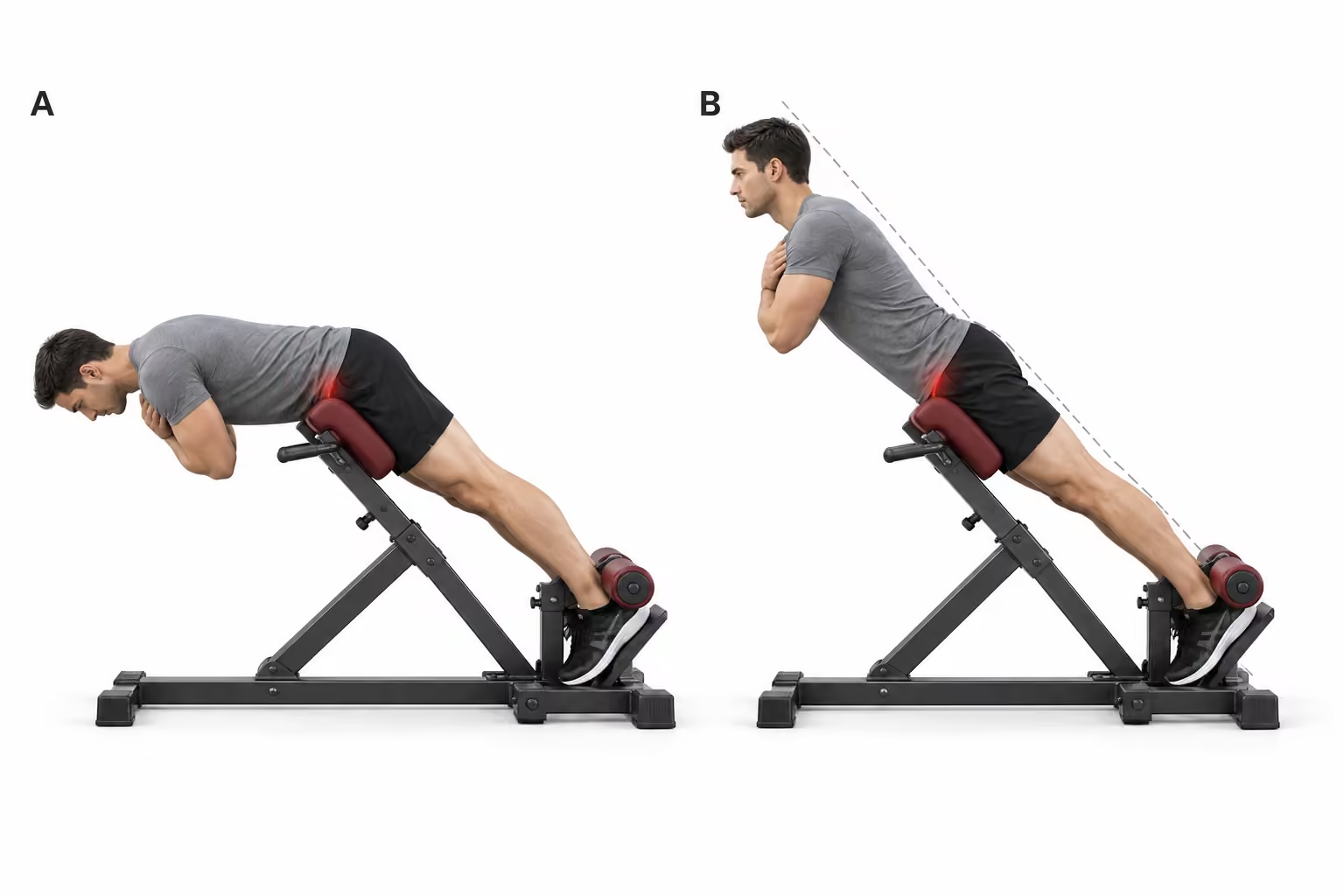
Hyperextension: hip hinge and aligned finishing position
When learning the movement, start without added weight and film yourself from the side. This makes it easier to see whether the pad leaves your hips free and whether your torso travels too far back at the top. The variation described here keeps your back steady. Variations that deliberately flex and extend the spine are different techniques; raising the pad does not automatically make them correct.
The distinction between hip movement, spinal movement and pad height is also explained in Lyle McDonald’s back-extension technique article.
Check these mistakes first
- Pad against your abdomen: It blocks the hip hinge. Step off and adjust the support before continuing.
- Lowering too far: Your back changes shape even though you are practising a hip hinge with a steady spine. Shorten the range.
- Moving beyond the body line: You arch your lower back at the top. Stop earlier and reduce the load if needed.
- Using momentum instead of control: Your head initiates the movement or the machine moves with you. Reduce the load and speed, and check that the machine is stable.
Device types
What types of hyperextension machines are available, and how do they differ?
Three main designs are common in homes and gyms. A 45-degree back-extension bench places your legs on a slope and remains relatively compact. On a horizontal bench, your legs are horizontal and the torso has its longest lever arm at the top. On a 45-degree bench, that point occurs when your torso passes through horizontal. A Glute Ham Developer, or GHD, adds an adjustable footplate and large pads for different exercises. In a back extension, the movement stays at the hips; a glute ham raise also primarily involves bending the knees. A GHD does not automatically make either technique easy.
Catalogue names are not always consistent: Roman chair can also refer to an angled bench, and hyperextension machine alone tells you little about the angle. Check the design, pads and foot support. At Fitnessflohmarkt, you will find these models in the category Weight benches. In a reverse hyperextension, the torso instead stays on the pad while the legs move. It is a different type of machine and is deliberately outside this comparison.
| Design | Movement | Hardest point | Base area | Goes well with |
|---|---|---|---|---|
| 45-degree back extension bench | diagonally, hips free | Torso horizontal | about 1 m² | Home Gym, Beginner |
| Horizontal / Roman Chair | horizontal | at the topmost point | model dependent | Advanced, studio |
| GHD | horizontal, adjustable base plate | depending on the setting | Model dependent, plus room to move | Hybrid, CrossFit, club |
| Weight bench approved for back extensions | Depends on the design | Depends on the angle | model dependent | Multipurpose, if specifically suitable |
| Ground without equipment | Alternative posterior-chain exercises | Depends on the exercise | mat area | Start without investment |

ATX Hyperextension 45° | Back trainer
- CHF 395.-
- 118 x 84 x 85 cm, 31 kg
- Max. load 250 kg
- Two-piece cushion, adjustable via indexing plunger
- Casters and swivel handle
The angled design stays compact. Adjustment with the locking pin is quick, which matters when several people share the machine at home. The key is that the pad height suits your body size and that you can control the movement without momentum.
Ideal for: Home gyms with a fixed footprint and mixed training levels.
To the back trainer
GHD Back Extension | Glute Ham Developer
- CHF 490.-
- Max. load 500 kg
- Base plates multi-adjustable
- Powder-coated steel, faux leather upholstery
- Strap mounts on the front
The GHD covers hyperextensions and glute ham raises, thereby replacing two machines. The price for this is space: you need additional room behind the machine for the lowered upper body.
Ideal for: Hybrid and competition training, boxing and ambitious basement gyms.
To GHD
RealLeader Hyperextension | FW-1006
- CHF 890 instead of CHF 1,990
- 150 x 86 x 88 cm, 73 kg
- Hip pads adjustable on slide rail
- Frame made of 3 mm steel
- Grab rails for getting in and out
At 73 kg, the FW-1006 is intended for a permanent training spot. Its sliding rail adjusts the hip pads to different heights, which matters when different people use it every day. A heavy machine still needs a stable base.
Ideal for: Studios, club weight rooms, and physiotherapy practices with high traffic.
To the studio machineAlternatives
How do you train the erector spinae without a hyperextension bench?
The cheapest starting point is the floor. A glute bridge trains hip extension, while a diagonal arm-and-leg reach on all fours trains trunk control. These are posterior-chain alternatives, not an identical back extension with a freely lowering torso. An adjustable backrest and foot rollers do not turn an ordinary weight bench into a back-extension bench. Only use it that way if the manufacturer specifically allows it and the support leaves your hips free.
For additional hamstring work, compact options include the ATX Glute Ham Roller or the Floor Glute Trainer. These do not reproduce the same back-extension movement as a 45-degree bench either.
Honestly, if your programme already includes deadlifts and rows, a back-extension bench is not essential. It becomes useful when you want an additional, easily adjusted exercise for your back, glutes and hamstrings. Body weight still loads your muscles and spine. A back-extension bench is therefore not automatically pain free or inherently easier on the joints than every compound exercise.
Dosage
How much weight, how many repetitions, and how often?
When starting, control comes before added weight. Begin with a small amount, for example one or two sets of 8 to 12 controlled repetitions, and stop the set before your position deteriorates. If that is too much, shorten the range or reduce the repetitions. Two spaced-out training days per week can be a starting point. What you tolerate also depends on deadlifts, squats and your other back and leg training.
Build control and repetitions first. You can then hold a small additional load close to your chest. A plate behind your neck is not a necessary next step. Resistance bands are only an option if the machine has suitable attachment points. Their resistance changes with stretch and can make the upper part harder. For choosing a resistance for your purpose, see the Resistance Bands Buying Guide.
| Level | Resistance | Repetitions | How to tell if the level is right |
|---|---|---|---|
| 1 | Body weight, short controlled range | A few controlled repetitions to start | Hips move, back stays steady |
| 2 | Body weight, arms across the chest | For example, 8 to 12 | No momentum needed, speed remains constant |
| 3 | Small added load at the chest | Adjust again to maintain good technique | Several controlled repetitions would still be possible |
| 4 | Band on approved attachment points, optional | Depends on band and initial tension | No extra arching or jerking at the top |
Planning
How much space and what load capacity do you need at home?
The footprint alone is not enough: you also need room to lower your torso and get on and off. For example, the ATX bench measures 118 x 84 cm, just under 1 m² of equipment space. Adding an example 60 cm in front for movement and 50 cm behind for access brings this to around 2 m². This is a planning aid, not a universal safety clearance. Your height, the actual direction of movement and the manufacturer’s instructions determine the clearance needed. The FW-1006 occupies around 1.3 m² at 150 x 86 cm, also before extra movement space.
The second figure is the permitted load: the product pages list 250 kg for the 45-degree model and 500 kg for the GHD. Check the instructions for how the manufacturer defines that limit and what added load is allowed. Do not compare only the weight plate with that figure. Your body weight and intended use matter too.
One often overlooked point is the machine’s own weight. The ATX bench weighs 31 kg and the FW-1006 73 kg. If your training room also serves as a guest room or laundry, this helps determine whether the machine remains genuinely movable or effectively stays put. Wheels help on level floors. Whether you need help moving it also depends on handles, thresholds, stairs and the route.
What is worth it for whom
Beginner with little space
Start without a specialist machine if you mainly want extra posterior-chain work. Glute bridges and controlled diagonal reaches on all fours need little space. For the same movement with a freely lowering torso, you need a suitable support. You can find appropriate equipment among our benches and racks.
Home gym with a fixed footprint
If the equipment footprint plus movement space can remain permanently clear, the 45-degree back extension bench from ATX is a compact option. It adjusts quickly, has transport wheels and weighs 31 kg. Before ordering, check that the pad position suits your height.
Hybrid and competitive athletes
Anyone who needs both hamstrings and back extensors equally is well-served with to the GHD Better. One device, two movement patterns, plus band attachments for progression.
Studio, club, physiotherapy practice
When users change daily, adjustability and stability matter more than price. The FW-1006 with slide rail adjustment is built for this.
Discomfort
What if you have back pain?
The name back-extension bench is not a promise of treatment. A guide cannot determine whether back extensions suit your symptoms. The NICE guideline on low back pain names exercise as a possible treatment option and says to consider individual needs and capabilities when choosing it. This does not amount to a blanket recommendation for this particular exercise.
If the movement causes or worsens pain, stop the set and discuss technique and loading with a qualified professional. This matters especially with acute symptoms or when returning after surgery. Adding weight or increasing the range is not a useful self-test in that situation.
Frequently asked questions about hyperextension
What are the benefits of hyper-extensions?
It strengthens the spinal erectors, glutes and hamstrings. In the hip-hinge variation shown here, the spinal erectors keep the spine steady while the glutes and hamstrings extend the hips. Difficulty depends on technique, range, leverage and added load. Body weight alone does not automatically mean a light load.
What muscles does the hyperextension work?
The spinal erectors, gluteus maximus and hamstrings work together. With free hip movement and a steady spine, the glutes and hamstrings perform hip extension while the spinal erectors stabilise. A higher pad changes the movement rather than simply switching on more back-muscle work.
Is hyperextension bad for the back?
The exercise is neither universally bad nor automatically suitable for every back. In the variation shown here, your back and neck remain steady and you stop at the top in line with your legs. With existing or new symptoms, the exercise and load need to suit the individual. See the section on back pain.
How often should you do hyperextensions?
Two spaced-out training days per week can be a starting point. Start with little volume and account for deadlifts, squats and other posterior-chain exercises. More sessions are not automatically better. What matters is controlling the movement and recovering sufficiently between sessions.
What is the difference between a 45-degree and a 90-degree hyperextension?
On a 45-degree bench, your legs are angled and the torso’s lever arm is longest when it is horizontal. On a horizontal bench, your legs are horizontal and the longest lever arm occurs at the top. Both machines need to fit your height. Even 45 degrees can already be challenging for a beginner.
Can you do hyperextensions on a weight bench?
Only if the manufacturer intends the bench for that function. An adjustable backrest and foot rollers alone are not proof. Your thighs need support, your hip crease must remain free and the foot restraint must suit the intended exercise. Do not improvise a restraint.
How much does a hyperextension bench cost?
At Fitnessflohmarkt, the ATX 45-degree bench costs CHF 395, the GHD CHF 490 and the RealLeader FW-1006 currently CHF 890. Prices checked on 26 October 2026; see each product page for current prices and availability. Compact hamstring trainers are a different type of equipment and are not a like-for-like price comparison.
Find the Right Back Trainer
All hyperextension machines, GHDs, and adjustable benches are in one category for us, sortable by price.
To the benches and back trainersNote
This guide does not replace medical advice. If you have acute lower back pain, have had a herniated disc, or are training after surgery, discuss exercise selection and intensity with your doctor or physical therapist beforehand.