


Fitness Flohmarkt · Guide
Cable crunch: set up kneeling rope crunches correctly
A cable crunch depends more on controlled trunk curling than on the stack label. If only your hips fold while your back keeps the same shape, you are bowing rather than performing the same crunch. Set up the high pulley, rope and kneeling position so you can understand and check the difference.
In short
Kneel facing the high pulley. Hold the rope ends beside your head without pulling on your neck. Use a light load, keep your pelvis as still as practical and bring your lower ribs towards your pelvis. Your elbows follow the curl downwards. Return calmly instead of letting the cable pull you up abruptly.
Cable crunch: high pulley, distance and rope position
You need a suitable high pulley, a compatible rope attachment and a firm, comfortably padded surface for your knees. Check the attachment, pulley lock and clear cable path. Install the station for this use according to its manufacturer. An unchecked door anchor is not a substitute for that setup.
Kneel in front of the station with your knees around hip-width apart. Set your hips slightly back and keep that starting position as consistent as practical. Do not sit on your heels or force your thighs to stay vertical. Choose a distance that lets the cable approach from above, leaves your hands clear beside your head and keeps the stack controllable throughout the movement.
Hold one rope end in each hand, roughly beside your temples. Keep your arms bent and let them accompany the rope. Do not press it against your throat or neck. There is no universal distance from the station or ideal rope length for everyone: check head, hand and rope clearance with a light load first.
The movement: ribs towards pelvis, rather than hips moving back
Your rectus abdominis flexes your trunk with help from the obliques. Your trunk shape should therefore change during a cable crunch. A rounding back is part of the movement; this is not a forward bow with a rigidly straight back. Keep your pelvis in roughly the same place.
- Start with your trunk comfortably long, without forcing a deep back arch. Let your head follow your torso and keep your hands beside your head.
- Breathe out as you curl. Bring your lower ribs towards your pelvis and your elbows towards the middle of your thighs. Do not pull down with your hands.
- Stop before you merely fold at the hips, slide onto your heels or push your head towards the floor. Floor contact is not a goal.
- Let your trunk lengthen again under control. Keep your pelvis and knees as still as practical. Do not slam the stack or let it jerk you upwards. Stop the set if you feel pain.
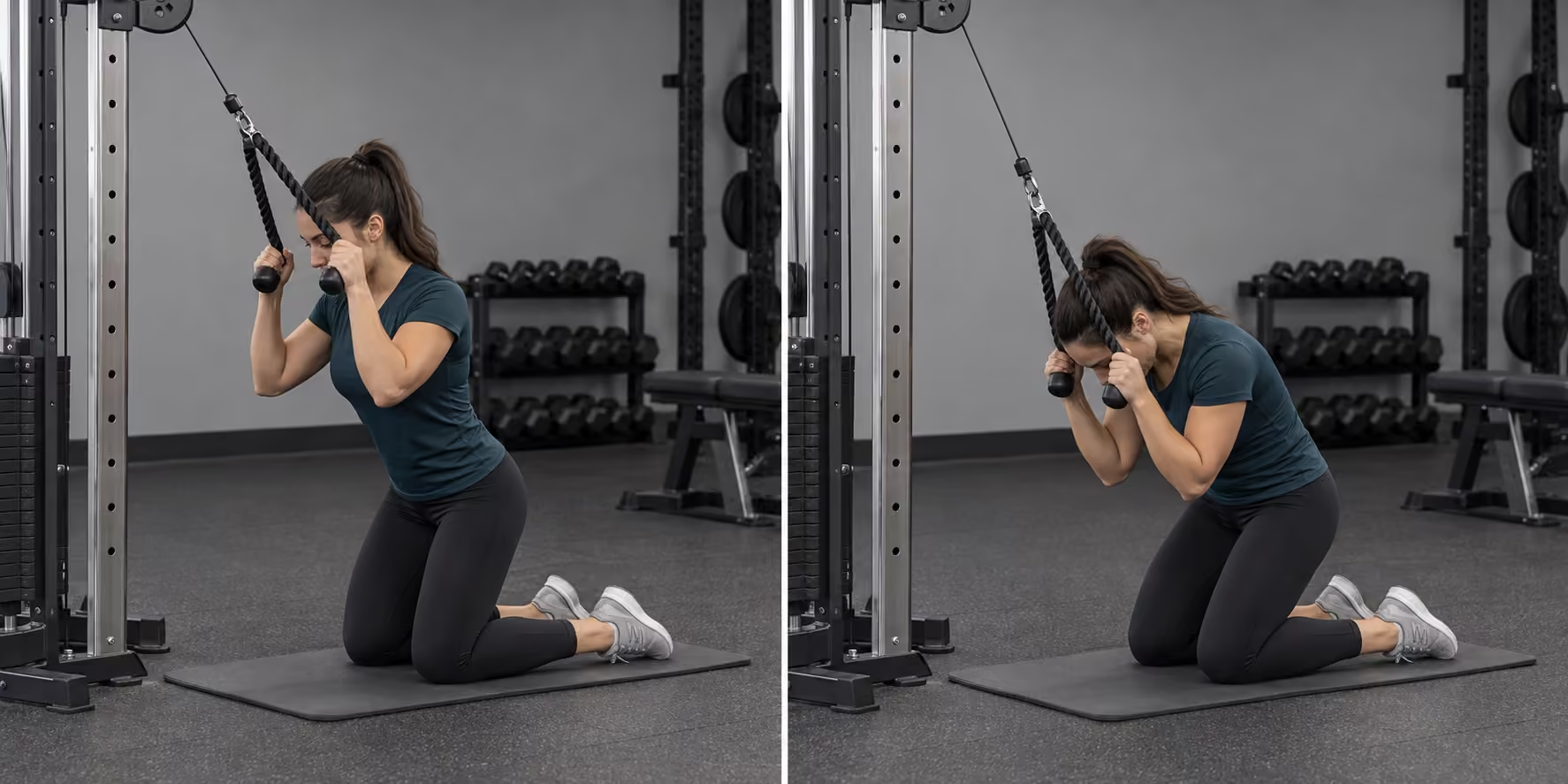
A side view of your set can help: do your hips move far back while your back keeps its shape, or does your rib cage visibly approach your pelvis? What matters is repeatable trunk movement, rather than the total distance your elbows travel.
Four common cable-crunch errors and how to adjust
| What you notice | What to check |
|---|---|
| Your hips slide towards your heels | Reduce the load and practise the pelvic position without cable resistance. Avoid moving your whole body backwards. |
| Only your arms pull down | Keep your hands beside your head and your arm angle roughly unchanged. Curl your rib cage rather than doing a triceps pushdown. |
| Your neck strains or your chin is tightly tucked | Check the rope position and load. Let your head follow your torso without pulling it down with your hands. |
| The return is jerky | Use less weight and reverse sooner. Control a comfortable range rather than seeking maximum stretch. |
How much weight and how many repetitions?
Start light enough to control the return as well as the curl. As a learning example, try two sets of 10–15 controlled repetitions. This is our adjustable suggestion, not a prescribed number from the exercise source. Increase by a small step once you can repeat the setup and movement.
Kilogram labels on different stations are not directly comparable. Pulley ratio and friction affect cable force, and the lever arm changes with your position. Record load, setup and controlled repetitions on the same machine. Cable crunches train your abdominals but do not selectively remove the fat over them.
Which accessories make sense for cable crunches?

Nylon triceps rope
CHF 10.–
The shop lists a 68 cm total length, nylon and a chrome swivel. The two ends can be held beside your head. That length does not guarantee a suitable setup for every height: check hand clearance and station compatibility. The stated 120 kg capacity is a product limit, not a recommended training load.
Check the rope and connector
NBR exercise mat | optional
CHF 19.–
180 × 60 cm and 15 mm thick, with eyelets and a carrying strap. An option if the floor feels uncomfortably hard on your knees. Check that the soft surface stays stable beneath you: thicker is not automatically better. If you already kneel comfortably and steadily, you do not need another mat just for this exercise.
View the optional knee supportThe rope plus optional mat costs CHF 29 in accessories. The station, suitable connectors and any shipping depend on your existing setup and may cost extra. Do not rebuy suitable accessories already included with your station. Specifications and original shop photos were checked, without claiming a hands-on test. Prices checked 29.10.2026.
Cable crunch or ab wheel: different tasks
A cable crunch curls your trunk against cable resistance. An ab-wheel rollout challenges your control of increasing back extension as you roll out. This is not simply an easier-versus-harder comparison. Choose according to your aim, control and available equipment.
Frequently Asked Questions
Cable crunch: common questions
How high should the pulley be?
For kneeling crunches, the cable comes from a high pulley above you. Set height and distance to leave your hands and head clear and allow controlled trunk curling. One fixed height does not suit every station and person.
Should my back stay straight?
No: your trunk deliberately curls during this exercise. Avoid simply bowing at the hips with an unchanged rigid back. Control a comfortable range without forcing maximum rounding or arching.
Where should my hands and the rope stay?
Hold one rope end in each hand beside your head, roughly near your temples. Your hands accompany your head rather than pulling it down. The rope should not press on your throat or neck.
How much weight should I use?
Use a load that lets you control pelvic position, curling and the return. Reduce it if your hips move substantially or only your arms pull. Stack labels on different cable stations are not directly comparable.
Do I need a special abdominal rope?
Not necessarily. A two-ended rope works if the connector, length and hand clearance suit you and your station. The checked 68 cm nylon rope costs CHF 10. Keep suitable accessories you already own.
Do cable crunches selectively burn belly fat?
No. You train your abdominal muscles without deciding where your body loses fat. More cable weight is not evidence of targeted fat loss.
Source and practical interpretation
The basic movement is checked against ExRx Cable Kneeling Crunch: high pulley, rope beside the head, steady hips and trunk flexion. Setup checks, accessory choices and learning volume are our practical additions. For the starting position we describe a comfortably long trunk rather than requiring strong hyperextension.
A suitable rope without unnecessary purchases
With a suitable high pulley and compatible rope, test the setup lightly first. The nylon rope is an affordable addition if you lack that attachment. If the connector is unclear, show us your station so we can check what fits and what you can continue using.