




Fitness Flohmarkt · Guide
Floor protection mats under equipment: what really protects
Soil protection costs between CHF 12.- and CHF 60.- per square meter. This guide shows you which mat belongs under which equipment and where thin and cheap stops working.
In short
Under a cardio machine, a thin protective mat is enough against scratches, pressure marks, and sweat. Under a rack, bench, and free weights, rubber starting at 20 mm is needed because impact and point loads are added there. Anyone dropping weights from a height cannot get by with any mat and needs a platform. The crucial factor is not the mat, but the load on it.
Basics
What does a floor protection mat really protect against?
A floor protection mat performs four different tasks, and very few Protective floor mats for fitness equipment fulfill all four at the same time. First, it distributes point loads: a machine foot presses the entire weight onto a few square centimeters, while the mat distributes this pressure and prevents dents in parquet, laminate, and vinyl. Second, it absorbs abrasion and scratches that occur when moving a machine. Third, it catches sweat that would otherwise seep into joints and wooden floorboards. Fourth, it dampens structure-borne noise, meaning the vibrations that travel through the floor into the ceiling below. A thin, hard layer is enough for the first three tasks, but the fourth requires mass. This is precisely where most bad purchases fail: a 4 mm thin mat reliably protects your parquet, but it doesn't make your treadmill quieter. Conversely, thick rubber under a lightweight exercise bike offers nothing that a thin sheet couldn't also do. So the question is never which mat is the best, but rather which of the four problems you currently have.
Added to this is a fifth effect that is rarely written on the packaging: the mat keeps the equipment in place. On tiles and smooth vinyl, bikes and rowing machines wander centimeter by centimeter over months because every movement shifts them minimally. An anti-slip underlay puts a stop to that. Which flooring is suitable for an entire training area is explained in detail in the Fitness Flooring Buying Guide. Here, the focus is deliberately on the individual case: one mat, one device.
Device by device
Which floor protection mat do you need under which device?
The answer depends on whether the equipment only bears weight or if impacts also occur there. Weight that shifts rhythmically is under stationary bikes, indoor bikes, elliptical trainers, and treadmills: A thin, firm mat that prevents scratches and sweat and keeps the equipment in place is sufficient there. Point load is added under weight benches, racks, and strength stations because the equipment weight plus training weight is distributed over four to six small feet: Solid rubber starting from 20 mm is the right base there. In the free weight area, dumbbells also drop to the floor from knee height, and from chest or head height during Olympic lifting. For the latter case, there is no mat that suffices, only a dedicated platform. These three stages—weight, point load, and drop—form the entire system behind the question. Everything else is a question of format, color, and budget. Assign your equipment to one of the three stages, and the answer is already determined.
| Device | Main risk | Sensible underlay | Thickness |
|---|---|---|---|
| Treadmill | Vibration, sweat, abrasion | Protective mat in one piece, measure length | from 4 mm |
| Exercise bike, indoor bike | Walking on smooth ground | Protective mat 160 x 87 cm | from 4 mm |
| Cross trainer | Point load on the stern drive | Protective mat, reinforced under the drive | from 4 mm |
| Rowing machine | Rail length, impact sound insulation | Rubber under the two contact points | 8 to 25 mm |
| weight bench | Point load, slippage | Rubber pads under the feet | from 20 mm |
| Rack, power station | Permanent point load | Solid rubber as a continuous surface | 20 mm |
| Free weight area | Dropping dumbbells from knee height | Solid rubber, tightly laid | 20 to 25 mm |
| Olympic weightlifting | Lowering from height | Weightlifting platform instead of mat | 30 mm |
When it comes to cardio equipment, it's worth taking a look at the design: an elliptical with a rear drive concentrates its weight in one spot, a rowing machine distributes it across two widely spaced points and needs nothing at all in the middle. Footprint and dead weight are listed on the product pages in the Endurance and cardio area.
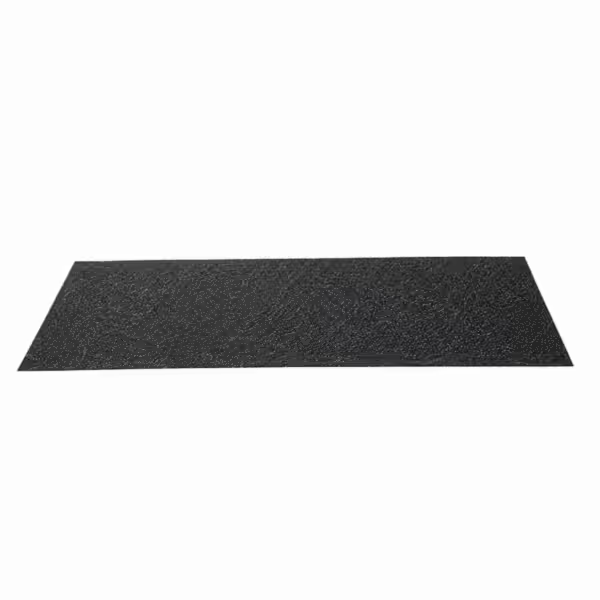
Fitness Floor Protective Mat | Home Gym & Cardio Underlay
- 160 x 87 cm
- 4 mm
- PVC
- black
- retractable
- Art. F-99907
A single mat instead of many individual panels. It catches scratches, pressure marks and sweat and gives the device a stable footing. The data sheet classifies it as neither shock-absorbing nor sound-absorbing: it is a protective layer, not insulation.
Ideal for: a single cardio machine on parquet, laminate or tile.
To the protective mat 160 x 87 cmRead data sheet
How do you tell if a mat really absorbs impact?
Based on two details in the data sheet, not the promotional text: Shock Absorption System and Noise Dampening. Both fields appear on every flooring product page under Additional Information, and both are set to either Yes or No. For the 4 mm thick PVC protective mat, it says No twice. For the 2.5 cm thick rubber mat and the 20 mm thick Connect+ flooring, it says Yes twice. That is the most honest comparison you can get because it dispenses with marketing terms like shock-absorbing or quiet. In practical terms, this means: Anyone who buys rubber floor protection mats is also buying dampening. Anyone who buys a thin PVC sheet is buying surface protection. Both are correct as long as you know which of the two problems you currently have. A second indicator is weight: A mat weighing 2.1 kg at half a meter square stays put and absorbs vibration, whereas a sheet you can roll up with one hand does not.

Rubber floor mat 50 x 50 cm | Fitness floor
- 50 x 50 cm
- 2.5 cm
- Solid rubber
- hard
- offline
- Art. F-97383
The thickest single mat in the range, marked as "Yes" in the data sheet for both shock absorption and noise reduction. Because it doesn't require interlocking teeth, you place it specifically where the load is rather than covering the whole room. Four mats cover one square meter.
Ideal for: Weight bench, home gym, and the storage space next to the rack.
To the 50 x 50 cm rubber matArea
How large must the mat under the device be?
Calculate the footprint of the device plus around 10 cm on each side. The overhang is not for comfort, but for function: it absorbs shifting when getting on and off and prevents a foot from landing next to the mat when folding. For the 160 x 87 cm protective mat, this means specifically: devices up to a base length of around 140 cm fit comfortably, while longer frames will be a tight fit. Treadmills are usually well above this, which is why you should measure your device before ordering instead of relying on the term cardio mat. If one mat is not enough, you place two next to each other or switch to sheet material that you can extend as far as you like. Under a rack, the following applies anyway: a continuous surface instead of individual islands under the feet, otherwise the device will stand at four different heights and warp over time.
With racks and rigs, there's an additional detail: if the equipment is anchored to the floor, the mat has to be put down beforehand, otherwise you'll be drilling twice. The basic dimensions are at the Rigs and Racks, the matching formats throughout flooring assortment.
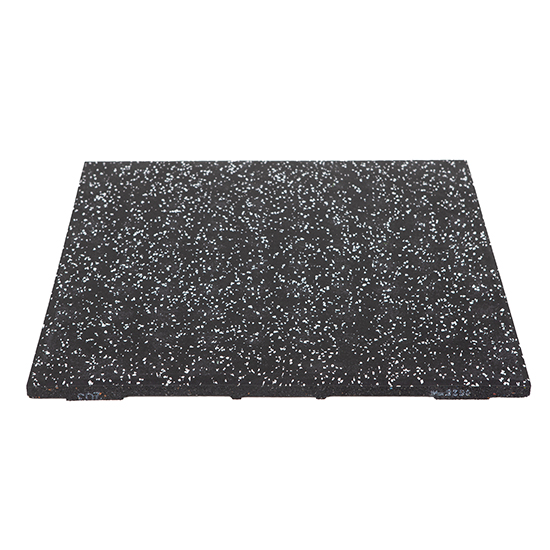
Connect+ floor | Premium rubber fitness floor
- 500 or 1000 mm
- 20 mm
- Solid rubber
- Click-System
- 6 colors
- Art. F-85571
The flooring for everything heavy and stationary. 20 mm solid rubber, positively locked via a click system, without glue and expandable at any time. In the 500 format you need four tiles per square meter, in the 1000 format one. From 40 tiles onwards, the unit price decreases in tiers.
Ideal for: Rack area, free weight corner and the permanent base in the home gym.
To the Connect+ floorPrice
How much does ground protection cost per square meter?
Between CHF 13.90 and CHF 173.25 per square metre, depending on what the flooring is designed for. The range seems large, but is entirely explained by material and thickness. You can do the math behind it yourself for any offer: unit price divided by the area of a single unit. The protective mat measures 160 x 87 cm, which is 1.392 m², and costs CHF 29. That comes out to around CHF 20.85 per square metre. The rubber mat in the 50 x 50 cm format covers 0.25 m² and costs CHF 12, which is CHF 48 per square metre. Exactly this comparison is the reason why rubber floor protection mats seem more expensive than they are: they cost little per piece and a lot per area because a single tile hardly covers any area. Anyone who compares only unit prices often ends up buying the more expensive solution, even though the smaller number was on the price tag.
| Solution | Format | Thickness | Price per unit | Area | Price per m² |
|---|---|---|---|---|---|
| Foam-Matte | 60 x 60 cm | 1.2 cm | CHF 5.00 | 0.36 m² | around CHF 13.90 |
| PVC protective mat | 160 x 87 cm | 4 mm | CHF 29.00 | 1,392 m² | around CHF 20.85 |
| Rubber mat | 50 x 50 cm | 2.5 cm | CHF 12.00 | 0.25 m² | CHF 48.- |
| Connect+ Floor | 50 x 50 cm | 20 mm | Starting at CHF 15.00 | 0.25 m² | from CHF 60.- |
| Weight Lifting Platform | 240 x 190 cm | 30 mm | CHF 790.- | 4.56 m² | around CHF 173.25 |
The foam mat is deliberately included in the table as a counterexample. The Foam floor mat 60 x 60 cm is the cheapest surface in the range, but soft and not non-slip. It does not belong under an appliance because appliance feet sink into it and the appliance wobbles as a result. At the other end is the Weight Lifting Platform with 30 mm of cushioning and a load capacity of up to 500 kg: a square meter costs eight times as much as the PVC mat, but it is the only solution for repeated dropping from a height.
Borderline cases
Pool, washing machine, underfloor heating: where the limit lies
Fitness floor mats regularly end up under things they were never intended for, and most of the time it works. Beneath an above-ground pool, a rubber or foam surface replaces the classic pool liner and protects the plastic from stones and roots underneath. Anyone looking for pool floor protection mats should check two points: A filled pool creates a surface load of several hundred kilograms per square meter, which is uncritical for the mat, but very much a structural question for balconies and terraces. Furthermore, nothing dries out underneath a pool liner; it stays wet underneath on wood and interlocking pavers for months. Regarding underfloor heating: A mat placed locally under a single appliance is uncritical, but wall-to-wall 20 mm rubber flooring covering the entire heating area noticeably reduces heating performance and traps heat under heavy appliances. When in doubt, ask your heating engineer before laying out a large area.
And under the washing machine and tumble dryer, thick rubber mats work well against impact sound, but during the spin cycle only when the appliance is properly leveled: a mat does not compensate for uneven feet; it actually makes an unbalanced appliance even more restless.
Recommendation by profile
What is worth it for whom
A device in the living room
You have a bike or an elliptical and a floor that doesn't forgive scratches. A Protective mat for CHF 29. solves that in one step without you having to lay slabs.
Home gym with rack and bench
You are building a surface that is meant to last. Then it's worth the Connect+ floor with 20 mm from the beginning, because later you add on instead of relaying.
Upper floor or rented apartment
Your topic is not the floor, but the ceiling below. Here, mass counts: 2.5 cm solid rubber under the contact points provide more than a thin strip over the entire surface.
Studio, club or physiotherapy practice
You design several zones with different loads. Which zone gets which flooring is clarified by the Overview of all buying guides including the needs calculator.
Frequently Asked Questions
Questions about floor protection mats that we receive again and again
What is the purpose of a protective floor mat under fitness equipment?
It distributes the point load of the appliance feet, absorbs scratches and abrasions, catches condensation, and keeps the appliance in place on smooth surfaces. Whether it additionally dampens noise and vibration depends on the material and thickness: thin PVC sheets do not, while solid rubber from about 20 mm certainly does.
How thick does a floor protection mat under a treadmill need to be?
For scratches, pressure marks and sweat, 4 mm is enough. When it comes to impact sound in the apartment below, you need mass instead of surface area, i.e., 20 to 25 mm of rubber under the contact points. With treadmills, length is more important than thickness anyway: measure the frame before you order a mat.
What distinguishes rubber floor protection mats from thin PVC mats?
Rubber adds mass and thereby absorbs shock and sound, whereas PVC only forms a hard protective layer. This is stated in the data sheet on our product pages: for the 4 mm PVC mat, shock absorption system and noise dampening are marked as No, while for the rubber variants they are marked as Yes. The price per square meter differs accordingly significantly.
Does a floor protection mat reliably protect parquet and laminate?
Yes, it reliably protects against pressure marks, scratches, and moisture, as long as the surface is flat, clean, and dry. Parquet is not protected against weights that fall beside the mat. Therefore, plan the area more generously than the actual footprint of the device, with an overhang of about 10 cm on each side.
Can dark rubber discolor light vinyl or PVC flooring?
On soft PVC and vinyl, dark rubber can cause discoloration after a few weeks because dyes migrate into the flooring via the plasticizers. This does not happen on tiles, screed, sealed parquet, and laminate. In the case of light-colored synthetic floors, first test a panel in a hidden spot for 14 days.
Are gym floor protection mats also suitable as pool floor protection mats?
Yes, as a base for an above-ground pool, rubber and foam mats work well and protect the pool liner from underneath. Note two things: nothing dries underneath the liner, and on wooden decks, it stays wet underneath permanently. And the load capacity concerns not the mat, but the ground on which the filled pool stands.
Do I need a mat under every appliance?
No. On concrete, screed, and robust tiles in the basement or garage, a mat is often unnecessary as long as nothing falls and no one lives underneath. It becomes useful as soon as one of three points applies: sensitive flooring, living space below you, or weights being dropped instead of set down.
Ready for the right mat?
Compare formats and thicknesses side by side or call us with the dimensions of your device before you order.
Buy fitness floor mats